Tier lists are a fashionable/fun way to rank order things, ranging from F to S (super, above A). I already did one for arguments for the existence of God, so I thought I’d be a little more Latter-day Saint specific and do one for apologetics arguments for LDS truth claims.
There are two kinds of apologetics arguments (roughly): “offensive” and “defensive.” The former being giving positive arguments for the faith, and the latter defending against attacks against the faith, so this list will focus on the former. Basically, from a logic-based perspective, what are some of the best arguments for accepting the Church’s truth claims?
The obligatory throat-clearing: none of these are slam dunks. As originally stated by Carl Sagan and quoted by Richard Bushman, extraordinary claims require extraordinary evidence, so none of these are enough to compel belief in something as big as your religion. Nor are they meant to. Unlike other faith traditions, we don’t think you can reach the top of the mountain through intellect. Still, some arguments are better than others and, contrary to some sentiment in some corners of the internet, the top tier ones can’t be simply waved away either. Also, I cover a lot of this ground in my Latter-day Saint Scholars Testify testimony.
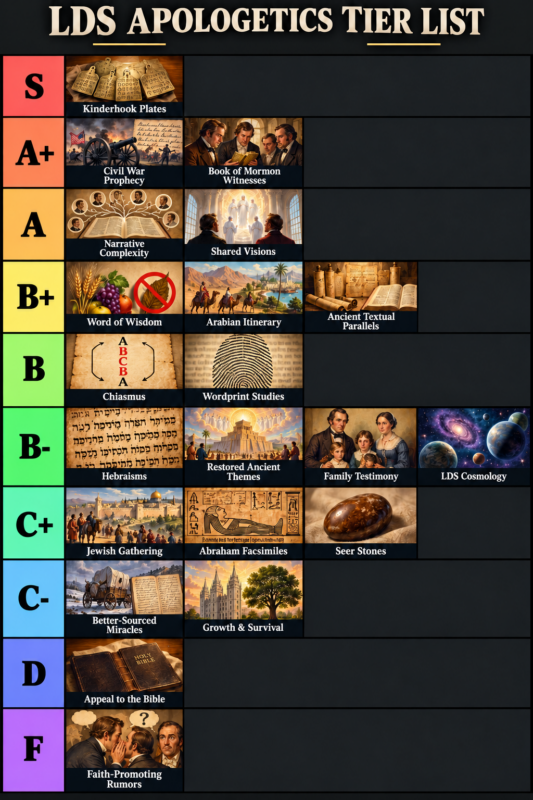
F
- Friend-of-a-friend, urban legend, faith-promoting rumors. Literally no value. Here I’ll put:
- Missionaries missing their Zone meeting at the top of the twin towers on September 11th (as an aside, my brother served in the New York, New York North mission on September 11th, and he thinks it’s cute that people think the mission was wealthy enough to have a Zone conference on the top of the World Trade Center).
- The Del Parsons fireside where that kid exclaimed that the red robe Jesus was the person who saved his parents.
- That “12 signs of the true Church” story that circulated in missions in my day where a bunch of people all decided to find a Church that has the 12 characteristics outlined in the Bible, and they all ended up joining the Church.
- The temple elevator shafts in the Salt Lake Temple.
- And on and on, I’m sure you can name some.
D
- Appeal to the Bible. There are a number of biblical scriptures we sort of see as potentially confirming the restorationist angle. Still, to paraphrase Joseph Smith, the Bible can be interpreted by so many people in so many different ways so as to destroy all confidence by appealing to the Bible. Still, not absolutely nothing, so the D.
C-
- Faith-promoting rumors that may be a little better sourced. Pacific Islander prophecies about the missionaries (and yes, I know they were also interpreted as supporting the Protestant missionaries), David O. McKay’s healing handkerchief (or maybe that isn’t quite so supported? Don’t know), the handcart stories in “17 Miracles.” The kind of miraculous historical stories that most faith traditions have, except instead of being healed by a holy relic they are healed by a priesthood blessing, etc. but the difference with the above being that they can actually be traced to a solid primary source and eyewitness testimony. Again, not nothing, and some of them more compelling than others historiography-wise but the fact that these sorts of stories are found in a lot of faith traditions argues against putting too much weight on them vis-a-vis the particulars of the Church of Jesus Christ of Latter-day Saints.
- The Church’s growth and survival. The Church has been on the tipping point of destruction many, many times, but it always seems to survive and even, at times, thrive. That being said, this can also be explained using a sort of Darwinian logic. Thousands of new religions have been born, and out of those thousands the vast majority die, and a small handful will survive a number of close calls and thrive. Early Christianity went through a similar process where it almost got snuffed out at birth, as did Islam, Judaism (I always thought it was ironic that the first historical reference to Israel was proclaiming its destruction [“Israel is laid waste—its seed is no more”], sort of a theme of people always thinking they’ve finally done in the Jews), and now the Church of Jesus Christ of Latter-day Saints.
C+
- On that note, I will actually put the prophecies about the Jewish gathering, and Orson Hyde’s dedication of the Holy Land for the return of the Jews, combined with Israel’s miraculous continued existence, as higher than the C-category. No, it doesn’t mean that I agree with every policy of the Netanyahu regime, but yes, the Jews returning to Judea is in fact prophesied fairly clearly in our Latter-day scriptures, and I think their presence in the Middle East today is a fulfillment of that prophecy, regardless of the political particulars.
- Book of Abraham facsimiles. Yes, I know the Robert Ritner fans are plucking out their hair at this one. In terms of translation he simply got much of the facsimiles wrong, but he also got some of the symbols right, and in the aggregate I think the accuracy was better than guessing, so, in full recognizance of the missed shots, once we step away from assuming infallibility on the part of the facsimiles, in the end he got more right than I think he would have by just making things up (Kolob, four corners of the earth, Sobke the crocodile God of Pharaoh, etc.), so in light of the pluses and minuses I’ll put this at a C+ level.
- Joseph Smith’s seer stones. Once again, this is usually seen as a criticism, but stay with me here. His treasure-hunting is seen as a sign of fraudulent behavior, but it’s clear from his keeping of stones and usage of them throughout his life that he himself believed in it. So a point for him having sincere supernatural beliefs even if he knew they probably wouldn’t go over well with traditional Christians wary of the occult, but sincerity only goes part way in defending LDS truth claims, hence the C+.
B-
At around the B- level we start to get into arguments I wouldn’t feel skittish bringing up with a hypothetical skeptical interlocutor.
- Hebraisms outside of chiasmus. Admittedly I’m not terribly familiar with these arguments, but I remember reading them and thinking they were interesting, but could also be chalked up to the happenstance of the KJV style that BoM imitated lining up with Hebrew. Plus the final Nephite language was probably far removed from paleo-Hebrew or whatever. So it’s interesting and there might be something there, I guess.
- Deification/Divine council/Concentric circles of holiness. Joseph Smith had a knack for tapping into deep religious themes that were long since lost to the kind of low-Church Protestant upbringing that he was raised in, but are found in earlier texts and iterations of the faith, as well as across faiths worldwide, such as deification, the divine council, and the sort of concentric circles of holiness that undergird temple worship. Again, maybe he was simply bold enough to tap into Jungian archetypes regardless of how heretical they were to Nicene Christianity, but still, it is intriguing that in the restored Church you do get practices and beliefs that were, well, restored.
- Family testimony. As I mentioned in my Joseph Smith/L. Ron Hubbard post, it is a significant point in Smith’s favor that the people that knew him best, his family, basically saw him as sincere and loving, and accepted his calling as a prophet, even if polygamy caused legitimate stresses. Doesn’t prove anything per se, but it would make any chicanery on his part much deeper and more subtle than your run-of-the-mill conman psychopath that leaves a trail of destruction in his wake.
- Latter-day Saint cosmology. While there are heretical exceptions that met their end at the stake, the idea that there are numberless stars with planetary systems and worlds was bizarre in Joseph Smith’s day, and I think we sometimes don’t appreciate just how revolutionary and weird that belief was that later turned out to be correct.
B
- Chiasmus. TBH, I’m kind of agnostic on this one. It seems like some of this could just be happenstance, but then there are the statistical studies that purport to show that they aren’t happenstance, but I haven’t done a deep enough dive on them to know if there’s any merit there. Alma 36 seems kind of compelling. I’d have to spend more time on this to really be able to gauge its apologetic value. I could be convinced either way.
- Wordprint studies. Ditto. It’s neat that we have these studies and that they show different authors for the Book of Mormon, but again I’d have to dive deeper than I have into this literature to really be able to adjudicate it.
B+
- Word of Wisdom. It’s not flawless (the reason for hot drinks is still not clear health-wise), and my understanding is there was some speculation about alcohol/tobacco being unhealthy even then, but in general the LDS health code being more or less right is a point for the Church.
- Nahom, Bountiful, and Arabian itinerary. Getting geographic details right is impressive. Of course, could still be a coincidence but still a solid hit.
- Book of Mormon incorporating other ancient texts. A number of places in the Book of Mormon incorporate other ancient texts that strongly argue against Joseph Smith just making it all up on the fly, whether “all the ships of the Sea” in the Isaiah passages or Josephus/Book of Mormon both contradicting the Torah in saying that Moses was translated. At least clearly argues for something along the lines of Joseph Smith “studying it out in his mind” (and yes, I know a standard apologetic line is that there is no evidence that Joseph Smith ever consulted other books during the translation process, but I have a hard time seeing how both the Textus Receptus errors made it into the BoM along with the older, pre-KJV readings).
A
- Book of Mormon narrative complexity. As somebody who got a B in Book of Mormon at BYU, I can attest to its narrative complexity. It’s the kind of thing that the Mark Twains of this world can just blow past when they’re skimming the Book of Mormon just to say that they “read” it, but when your grade is on the line you all of the sudden realize how mind-numbingly complex all the parallel storylines and casts of characters can be. Hard to see this as being written extemporaneously; it would have required some savant-like ability to keep names, locations, and storylines straight.
- Shared visions. While we make a big deal about the Book of Mormon Witnesses never renouncing their testimonies, we sometimes forget that Oliver Cowdery and Sidney Rigdon both had mutual revelatory experiences with Joseph Smith, Oliver Cowdery in D&C 110 and Sidney Rigdon in D&C 76. If he was a conscious fraudster it’s highly doubtful he would have exposed himself to that level of risk by involving others. Oliver Cowdery could have easily come out and simply said “actually, we didn’t see Jesus in the Kirtland temple,” and likewise Rigdon could have disclaimed experiencing the revelation about heaven. The fact that they were both involved strongly suggests something happened or at least that there was some sort of collective hallucination, but not so much intentional deceit.
A+
- Civil War prophecy. Yes, South Carolina was in a tariff crisis when the revelation was first received, but even putting aside the fact that dispute over federalist principles does not necessarily equal a full blown north versus south, intra-country violent war, the fact is that Smith doubled down on the prophecy with more detail in D&C 130 in 1843, long after the tariff crisis was resolved but meaningfully before the Civil War. So yes, this is a very specific “hit.”
- Book of Mormon witnesses. I don’t know if I have much more to add to my take on the witnesses than I’ve already discussed here and here. Again, does it force you into a corner? No, but it’s not as easily hand-waved away as some think.
S
- Kinderhook plates. Wait, what? How is this S-tier for the Church? Stay with me here. Don Bradley’s presentation at FAIR on this pretty clearly demonstrated that Joseph Smith used the Book of Abraham as a crib sheet to try to translate the characters the forgers transcribed on the Kinderhook plates…which means that he sincerely believed in his translations. He literally tried to use them to help with other translations, and was unclear enough about his modus operandi that it wasn’t for another century and a half before scholars realized fully what he was doing. This puts an arrow in the heart of the idea that he didn’t believe in what he was doing, and it’s one reason for why, even if I were to take a naturalist view of the restoration, I would think that Joseph Smith eventually, at least by the 1840s, believed in his own prophetic ability.
Leave a Reply