
I ran across the below photo of the multilingual story hours that public libraries used to put on for immigrant communities (the below is of Italian children listening to Pinocchio). As a father of fashionably attention-deficit sons, I was immediately struck by how rapt the young children’s attention was to the teacher. With kids these days a basic Pinocchio storyline would barely muster any interest.
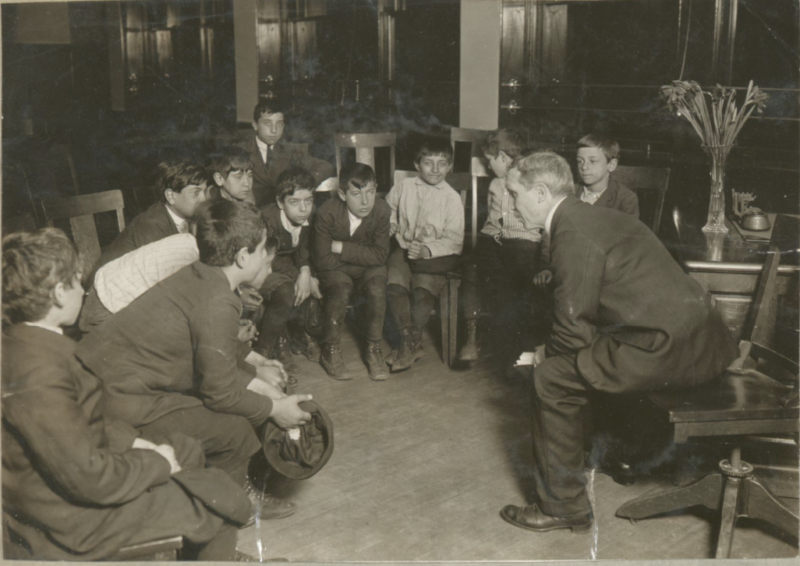
On one hand, we can stop pretending that The Iliad is objectively exciting reading (yeah, I said it). The craft of storytelling is much more honed and developed because it has to compete with so much else out there. On his show Bill Maher made the insightful point that when he started in the entertainment business your competitor was whoever happened to be on the television at the same time, whereas now when you produce content you are literally competing against everything that has ever been made, so if you’re going to put a creative product out in the world, it has to compete against The Godfather, Stairway to Heaven, and Harry Potter.
(Earlier this year my family stayed in a hotel on a cross-country trip. When we put the TV on for the kids they quickly bored of what was on and asked for Paw Patrol or something, and we had to explain that no, with a TV you had to just watch what was on—”oh, like when you were a kid.”)
In his book Planet Funny Ken Jennings talks at length about how with the rise of Twitter the appetite for funny content is insatiable because we habituate so fast to funny stimulus, and on his podcast he pined for a time when you were actually surprised by the classic horror tropes like He Was Dead The Whole Time! that has been recycled so many millions of times the effect has worn off like a injecting-in-the-vein heroin addict smoking opium.
Probably the greatest musical experience of my life was on my mission when, after having gone for over a year without listening to something other than Mormon Tabernacle Choir (gosh how I still hate them. I mean, carrots are fine and healthy, but when you’re only allowed to eat carrots for two years you never want to touch them again), I found myself in the middle of a Spanish plaza at night with Linkin Park playing on large speakers, and I feel like I finally grasped a little bit of the feeling that music obsessives feel. But it took a year of zen-like non-stimulation to get to that point. (One of the most moving accounts of this phenomenon is the story of a solitary confinement prisoner in Argentina’s “Dirty War” who saw a fellow human eye after a long stretch with no human contact. It’s maybe a two pages long, so too long to paste, but it’s the account titled “Eye” here).
So yes, this is another one of those gripes about how kids these days (and increasingly parents) can’t focus anymore or appreciate anything in-depth because of the deluge of material. But I’m of two minds. On one hand our children have access to exponentially more content: uplifting content, stimulating content, depressing content, gross content. If you are what you eat diet-wise: whereas our ancestors could get the occasional berry by the stream, now we have an all-you-can-eat buffet of inspirational material.
On the other hand, there’s a certain superficiality you get from scrolling and YouTube shorts that you don’t get from long-form meditation and prayer. So on the one hand I love the community and ritual afforded by church and don’t think that it should be replaced by streaming or scrolling, but still, it’s naïve to think that with our children early morning seminary and 2 hours on Sunday can begin to compete with hours of scrolling content in terms of personal influence.
On the other hand, “back in my day” if you wanted to get up to date on something you had to drive down to a library and hope that the book you wanted wasn’t checked out, whereas now anybody can get the cutting edge take on just about anything. Want to listen to all the General Conferences ever? Easy enough to do. Have a difficult gospel issue you want to get to the bottom of? You can access the criticisms, apologetics responses, critical responses to the apologists, the far-out theories, the most recent evidence. Want to listen to dozens of different variations of your favorite hymn? Easy peasy.
So we devout religionists have to play and be adept at both games. We should keep the temple trips, multi-hour family viewings of The Ten Commandments, and deep scriptural study, while also providing 30-second, high production value clips that can compete in today’s attention landscape. Yes, the YouTube shorts can’t get us to heaven by themselves, but that is where people are at, and self-righteousness about short form versus long form content isn’t going to help anybody. Yes, there are things about the gospel you’re not going to grasp in 30 seconds, but that doesn’t meant that the 30-secon window is impenetrable by the light of the gospel.
Leave a Reply