A common piece of conventional wisdom is that people basically make the decision to stay in the Church once as a teenager/young adult and then you’re locked in as a non-active member or active member for the rest of your life. That’s one reason why, with some reason, a lot of resources are vectored towards the youth.
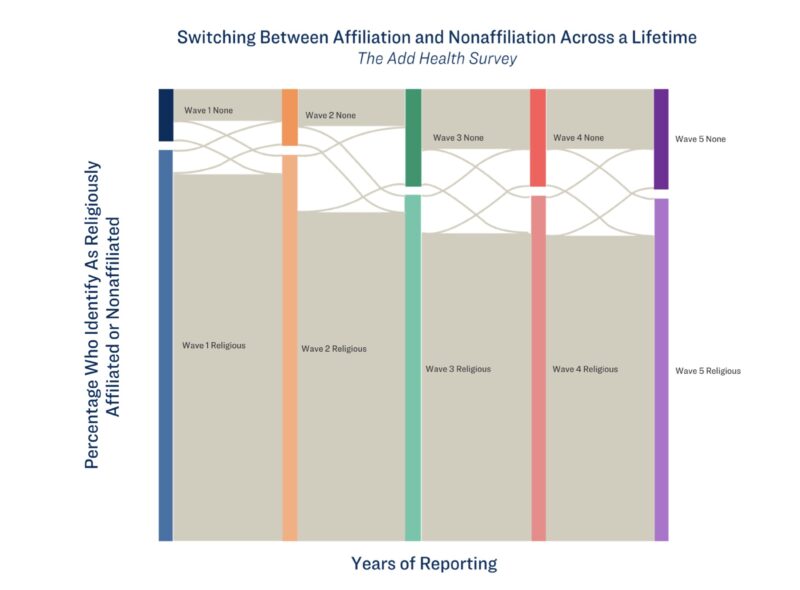
However, while religious turbulence is particularly acute during this time period, there is plenty of turbulence after. A graphic I generated for a Wheatley Institute report based on Add Health survey data that followed a cohort of young people across time made this point, showing that a lot of people switched from religiously affiliated to unaffiliated as they reached young adulthood. However, there’s still quite a bit of switching afterwards in the 20s and 30s, both into religion and away from religion.
This matches up with my lived experience. Yes, a lot of people leave once they move out and never look back. However, you live long enough you’ll also see people who were stalwart members and leadership material into old age…and then they leave.
I actually feel quite morose for those people. In the classic book (and movie) The Remains of the Day an old-school butler who dedicated his life (with no love or children) to serving what he saw as a great man later finds out that his master–and therefore his life efforts–weren’t so great, but now he’s old so what is he going to do with what remains of his life? (Hence the title). I got the same sense from a member of a New Religious Movement I interviewed during my Baylor postdoc who dedicated his life to proselytizing his newfound faith, only for the faith to break apart when he was older. (He was a good sport about it though: “I have no money saved up, but I also have no debt.”)
Of course, the Church of Jesus Christ of Latter-day Saints doesn’t require us to be monks; we can still live enjoyable lives and have them be consecrated, and I would hope that the fruits of the gospel can be felt and viscerally experienced throughout our life, and our recompense is not just in the promise of a future reward. Still, I can’t imagine what it would be like to decide in your 70s none of it’s true (although I get the sense that it’s typically a gradual process).
On the other hand life course-wise, it seems like a lot of the fornicating (or at least “heavy petting”) blue collar football players in my Utah area high school now sport Facebook photos of them in front of a temple with four smiley kids, while the Seminary Council/Honor Council types are in their bajillionth year of graduate school and are very much not Mormon. First shall be last and all that.
So yes, while we should rightly put a lot of resources towards the youth, it’s not impossible to overemphasize the youth. The married couple with three kids and the empty nester grandparents also benefit from good ministers and religious attention. It isn’t over until it’s over, and there’s a lot of life to live after our 20s.
Comments
9 responses to “Every Decade is a Decade of Decision”
I suppose I get the general sense of this. But the chart needs value markings and larger type. (Former marketing research guy.)
The older I get the closer I feel to God and the more I think I understand His character. But the Church has made itself largely irrelevant to me with its constant emphasis on the youth and marriage and families.
As a current nonbeliever who left belief in the church over the course of my 30s, I don’t think you should feel too sad for people who leave religion later in life. I learned a lot from growing up in the church, and I don’t think it was time completely wasted even though I don’t believe it anymore. Life just happens, and I think people should be proud of following the truth as far as what they knew. Making a decision like that later in life can take an enormous amount of character, courage, and self-knowledge that people can be very proud of.
I know I’m coming from the other side of the issue to some extent, but I wish the church spent less effort trying to “keep people in the church” at any cost and spent more effort on helping people develop skills of evaluating truth claims and build moral character regardless of where they end up. I actually don’t think very many more people would leave the church as a result and both members and ex-members would be better off as a result.
“…I can’t imagine what it would be like to decide in your 70s none of it’s true…”
I don’t think this is how it works, and I hope this is not the prevailing mindset among those who study activity demographics. I think that some (many? most?) of those who seem to disaffiliate in their later years do so because of irrelevance — they themselves are seen as irrelevant in their wards because of their age or for some reason no longer fitting the preferred pattern, or the lessons they hear in their meetings are irrelevant to daily reality.
Lily’s first sentence resonated strongly with me. With regard to the second, the constant emphasis on pay, pray, and obey seems problematic. Rather than extracting from the members, it seems to me that church attendance should refresh, replenish, and recharge — rather than thinking that members exist for the church, it seems to me that the church exists for the members.
It might be fruitful for the church’s demographers to shift from a true/untrue binary, if they want to better understand and to help resolve.
To be clear, the 70-year old who decides it isn’t true is most certainly not the typical experience, it was just one particular scenario I thought would be particularly hard. I get that it’s usually a more gradual process across years or decades where one gradually sorts out what they like from what they don’t.
Good post, I think we need to remember there are many groups at Church we have to be careful not to take for granted. The old men in EQ sit on hard chairs in a gym segment. The empty nesters are often not engaged beyond Temple and family history work. The members in Primary and Youth are disconnected from the adults. The time intensive calling folks are near burn out. The members on the margin are at risk of falling away. Women are often undervalued by default. Building and maintaining community is hard.
I have made a personal commitment to persevere until the end, even if I am the last one in my family to do so. My teenage children are finding it increasingly difficult to go to church on Sundays, and it saddens me that, after doing everything we were taught as a married couple and a family, in the end only my wife and I attend on Sundays.
I wish church services were more meaningful, and that the classes and participation had a deeper impact on me and my family, but I don’t know if it’s us or if we’ve lost our love for the simple, essential things.
Personally, I make a great personal effort to make Sundays at church special, but I don’t know if it’s me or the people at church or the church’s rigid structure, or if I’ve learned to view life with a depth that makes me think that not everything is quite like that, nor as easy as the four- or five-step recipe for reaching exaltation and having a life full of joy.
@RL: Building and maintaining community *is so* hard, especially in the atomistic modern world we live in. There is always so much to do to make others feel welcome while still avoiding burnout. Today I drove a new convert home from a youth activity and at first felt a little grumbly about not having time to relax and listen to a podcast, but after talking to him and his plans for a mission I felt a new energy.
@Frank: I’m so sorry to hear that, I hope the best for you in the Church.
I mentally left the Church after my first trip through the temple. This ritual was so far removed from anything i personally believed that I became mentally disengaged. My first temple visit was at the start of my 2-1/2 year mission to Belgium and France. It was 1964, and there were some very unfortunate things still in the ceremony. But the whole thing seemed like a glorified initiation ceremony.
After my first encounter, I left the MTC (one week at that time) and walked up and sat on the State Capitol lawn. I was pretty much in a daze. I sat there for several hours shattered. I finally decided to continue my mission to Europe. I can’t remember exactly why.
My mission did nothing to improve my faith. If anything it did the opposite. The Mission i was in was an exercise in killing time. Few if any baptisms. The Church in most areas was in bad shape. Ten percent of members were active. Many branches had missionary presidents. Much of what we were told to teach has since been proven wrong or inaccurate.
One of the few Church books we had to read was Mormon Doctrine. I didn’t agree with significant parts of the opus. McConkie got it wrong.
After my mission, the leadership moved the Church even farther away from my personal beliefs. I’m not even PIMO anymore. Now I just want to help my neighbor. Which seems to be at the heart of NT teachings.