
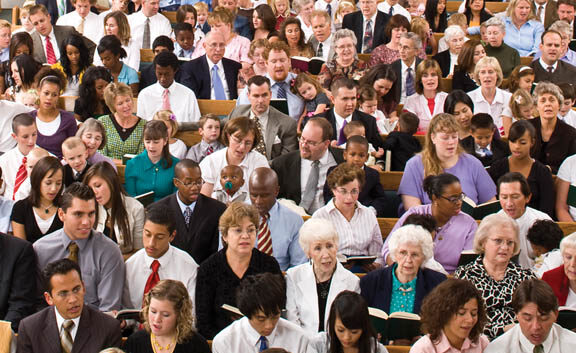
Regardless of what we think the ideal Church meeting is like, others are there. While our purpose in going to Church is to worship, we seem to believe that others need to be there. I am not aware of anything that says that we can’t worship by ourselves (and many of our worship practices—prayer, scripture study, meditation, etc. are often done alone), we still gather to worship together. There is something important that happens when we worship together.
So, how much do we think about others when we think about what should happen in Church? Are we focused on what would be best for us? Or on what would be best for others as well? And if the latter, how do we know what would be better for others? Have we asked? Or just assumed that what we think would be better for everyone?
Should we expand how we think about Church to make sure that everyone has an uplifting experience? If so, how do we do that?
In this and in many previous posts in this series, I am trying to suggest that each of us can have better experiences at Church if we change our perspective, seeing not only our own interests, but those of others as well. When we do so, we will find that our own experience is better—simply because we have a broader view of what is going on, and the details behind what others are doing at Church. For some people it might seem that looking at what others are doing at Church might make our experience less, since adding the needs of others might “dumb-down” Church to the “lowest common denominator,” I think its actually the opposite, we gain from the differences in opinion, and even from less sophisticated ways of seeing—such approaches often inspire new thoughts about our worship, not unlike when the actions or statements made by children or those unfamiliar with a topic open up new ways of thinking about a topic.
So, if you aren’t thinking this way, maybe try it next Sunday, or the next time you are in a class or meeting. If you have already thoughts inspired by what happened at church, what are they? How did you react to what happened in Church yesterday? What did you notice? What did others do that you found interesting or different? Did you end up thinking differently? Do you think your reactions were what they should be? Were they looking for what God had to tell you? Did your reactions make things better?
This is the latest invitation for reactions to local meetings, continuing a series of weekly posts that started with my post on September 25th, 2025 about how we receive what happens in Church meetings—sermons, lessons and anything else—and enter a conversation with them, magnifying what was said or adding what we think. In these posts I’m asking us all to think about how we listen and receive what happens at Church. If we only listen for mistakes, or things that bother us, what does that say about us? Is it most important to criticize others? Or to try to change ourselves?
So please, write down reactions and thoughts to what happened in Church. You might keep your own ‘spiritual journal’, or, if you like, you can post your reactions below. I’m adding my own reactions and thoughts as a comment to this post — instead of as a part of this post, because my reactions aren’t any better than anyone else’s.
Let me emphasize that this is NOT a place to criticize what is wrong with church or your fellow congregants. The point is to post what you learned because of what happened at Church or how that led you to think. It’s about the good things we can get out of Church, not the negative things that disturbed or upset us. It doesn’t have to be orthodox, traditional or even on topic.
If you like, make your response in the format, “They said or did this, and I said or thought that.” Even the things you dislike the most can be turned into lessons for what the gospel teaches we should do.
My hope is that these reactions serve as an example of a better way to treat what happens at Church instead of the perennial complaints about speaker or teacher preparation or ability, or complaints that the Church should do things differently.
Comments
6 responses to “Others in our Meetings (Or What Did Church Lead You to Think About Yesterday), 9/13”
Here’s a few of my thoughts in reaction to what I experienced in Church yesterday (9/13):
I was filling in as a Sunday School teacher, so I got to teach the first lesson under the new schedule. My point was that it can seem like the despair of Ecclesiastes is the natural outcome of the limits of the wisdom of Proverbs, but I wanted to read the other direction, from Ecclesiastes back to Proverbs; what does it take to get there?
In any case, 25 minutes is fine, but you can only cover one topic, and you only get one move. That is, if you’re doing it right, you only have time to adequately set up one question, and then have a discussion about that question.
A member of the quorum presidency had to teach on short notice. It was a good lesson and the teacher shared some of his personal worst days and best days. I think 25 minutes is just the right amount of time for that scenario, where 50 minutes would have left a lot of dead air time.
I did notice that with the new schedule, it feels like we have twice as much homework per week as we used to have, as there are two reading assignments to keep in mind.
In response to your question about who moves rooms, ours is opposite that… the women stay put and the men move. For us it is a function of who has more wheelchairs/walkers, and the unique layout of our mid-century building which makes getting IN to the RS room particularly challenging (>4′ wide hallway with 2 90-degree turns, and only one narrow door in (other door goes into kitchen then out). So that largest classroom in the building works only with what is effectively one way traffic at the transition times (in after Sacrament meeting, out after Sunday School and after RS).
My own observations on Sunday … we talked in Primary about what it means to Fear the Lord, and related it to reverence. (Ie, God loves us. One way we can show love back is by Trusting Him, Listening to Him, and helping others to be able to Listen to Him by how we behave.) Kids in both Jr and Sr Primary were quite responsive and engaged in the discussion. One of the key things we arrived at was how much children rely on teachers/grown-ups to help them to discover opportunities to feel and share reverence.
To Jonathan, I would add that it seems the CFM lessons are anticipating the “pick just one” plan. As PML, I teach CFM via music, and it is my nature to want to see the big picture so that what we do in ST reinforces/coordinates with what is done at home and in class. As I looked through 2026, and again at 2027 CFM, I note that some main points are repeated. Were I to be teaching Sunday School these days, noting this fact would give me confidence that we are covering the essential ground with I’d first look over the whole year the one-question method. I’d also as i go through highlight what is repeated, and give priority to use such alternative discussion point where possible (or at least prioritize it in my study).
In my experience, the Lord is more willing to give me inspiration when I’m thinking about others’ needs than my own, and that includes reading the scriptures with an eye to sharing insights with my ward in Sunday School. What struck me in reading Proverbs this time is that the Wisdom it describes is not about being smart, it’s about being thoughtful and choosing your actions intentionally rather than acting on base impulses like anger, greed, or lust. Did that come to me because I was looking for things a ward full of grad students needs to hear? Maybe…
Our Sunday School meets in the Relief Society room and then the Elders leave. There wouldn’t be room for everyone in the room we meet in.
I agree with Jonathan that the stakes are high as a teacher. We had a question in last week’s Elder’s Quorum lesson that led to kind of a dud of a discussion–lots of talk about situations we’ll never be in. And that was half the lesson gone. On the other hand, as a student you’ve now got two chances at a non-dud lesson.
Jonathan, I like your ideas about Proverbs and Ecclesiastes. Maybe to throw another viewpoint in your thinking, I was reminded by a podcast a few days ago that Ecclesiastes plays a prominent role in “Fahrenheit 451”. In the end of the book, Montag chooses to memorize and ‘become’ Ecclesiastes, apparently because part of Bradbury’s message is about the quality of what we consume—it shouldn’t all be “vanity” (as Ecclesiastes puts it). [This is why Bradbury always insisted that Fahrenheit 451 wasn’t about censorship.] To me this ties an important point about what we consume today to the scriptures.
Coffinberry: great thoughts — I’m glad that at least somewhere it isn’t the men who get to stay seated. But I wouldn’t be surprised if there were a bias throughout the church. I like that you’re thinking about how all this works in Primary — too often Primary is an afterthought for everyone but those who work in Primary. I think those in primary are actually blessed, because working with children leads you to think about the gospel and the lessons from a very different perspective.
RLD: Wow, yes, exactly. Not only does approaching the scriptures with others in mind benefit them, but I bet it benefits you as well. Do you think you would have had that insight about Proverbs without approaching it the way you did? I need to work on that approach myself!
As for the dud lessons, was there a way to get something out of them anyway?