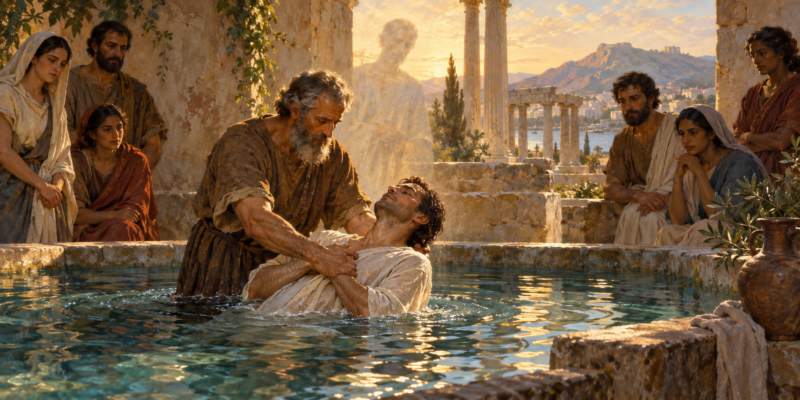
Baptisms for the Dead at Corinth
Baptisms for the Dead among early Christians is occasionally touched on in apologetics works, but like my earlier piece on female ordination and early Church structure I wanted to do a deeper dive on what the research literature had to say about the subject. I read/perused the articles below (I only had access to abstracts for some of them). My take-aways from this:
- The general agreement is that Paul in 1 Corinthians was indeed referring to proxy baptism. There are occasional speculations that it was something else, but those scholars always concede the fact that their take is a minority one.
- The more controversial issue is whether Paul approved of the practice. A lot of commenters are quick to point out that the language doesn’t require Paul to approve of the practice. He could have just been using their own practice to drive home a logical point. That’s true enough, but I didn’t see a lot of solid evidence or argumentation for the idea that he didn’t approve. The text really is silent on the issue, so the best they can say is that without any priors we don’t know, although a priori I think it would be weird for Paul to rhetorically invoke a practice that he saw as aberrant without referring to it as such.
- Early Christian commentators largely saw the practice as one of proxy baptism, but saw Paul as either not approving the practice or they were conflicted. However [my opinion], these early Church theologians were commenting over a century or two or three after the Corinthian practice, so it’s doubtful their insights reflected some close, inside information on the practices of the earliest Christianity.
- Some heterodox Christian groups like the Marcions practiced baptism for the dead, but a) as is often the case, we only know about the practice from their enemies, and b) they were doing so nearly a century after the Corinthian practice, so again it is unclear how much genealogical link there is between the Marcionate practice and the Corinthian one. The Marcionite practice was interesting: it was performed on people who were “investigating” Christianity with the aim of eventual baptism (“catachumens”), but who presumably died before they were able to get through the hoops. The deceased body of the catechumen was present at the ritual, but a living person was baptized for them.
- My own side comment–it’s noteworthy that 1 Corinthians is considered one of the authentic Pauline letters. It’s one of the earliest Christian documents, making baptisms for the dead one of the earliest confirmed rituals practiced by early Christian communities.
References
DeMaris, Richard E. 1995. “Corinthian Religion and Baptism for the Dead (1 Corinthians 15:29): Insights from Archaeology and Anthropology.” Journal of Biblical Literature 114 (4): 661–682.
Marecek, Petr. 2025. “Crux Interpretum in 1 Cor 15:29.” Studia Theologica 27 (1): 1–25. In Czech, with an English abstract.
Murphy-O’Connor, Jerome. 2009. “‘Baptized for the Dead’ (1 Cor 15:29): A Corinthian Slogan?” In Keys to First Corinthians:Revisiting the Major Issues, 242–256. Oxford University Press.
Patrick, James E. 2006. “Living Rewards for Dead Apostles: ‘Baptised for the Dead’ in 1 Corinthians 15.29.” New Testament Studies 52 (1): 71–85.
Stark, J. David. 2023. “Traditional Conflict Management: How Early Interpreters Address Paul’s Reference to Those Baptized for the Dead (1 Corinthians 15:29).” Religions 14 (6): 772.
White, Joel R. 2012. “Recent Challenges to the communis opinio on 1 Corinthians 15.29.” Currents in Biblical Research 10 (3): 379–395
Comments
One response to “Baptisms for the Dead Among the Early Christians: What Does the Literature Say?”
Interesting and all non LDS sources.