
Do Any Latter-day Saint Wards Own Handbells?

•

I posted a few weeks ago about English handbells in Latter-day Saint sacrament meetings. I have had a few conversations and questions about handbells, both before and since then, that are worth addressing over the course of a few posts. This first one is connected to both the previous post and a Reddit question I stumbled across afterwards.

Do any wards own handbells?

As far as I know, no wards own handbells. In every case I’m aware of, handbell performances in sacrament meetings were privately owned or owned by a Protestant Church.

After my last post about handbells, I saw a Reddit discussion where someone posted a picture in r/exmormon and asked, “Help- What is this symbol?” The author of the question attended a ward where they saw some equipment for a handbell performance (tables with covers, music stands, etc.) with the Malmark Bellcraftsman symbol on the table cover in the chapel. The question about the symbol itself was answered very quickly. However, some of them had to think through that they were “90% sure this is not a Mormon or Freemasonry symbol,” leading one commenter to joke, “You know your religion’s a cult when you have to decipher a strange new logo to see if it’s one of your own.”
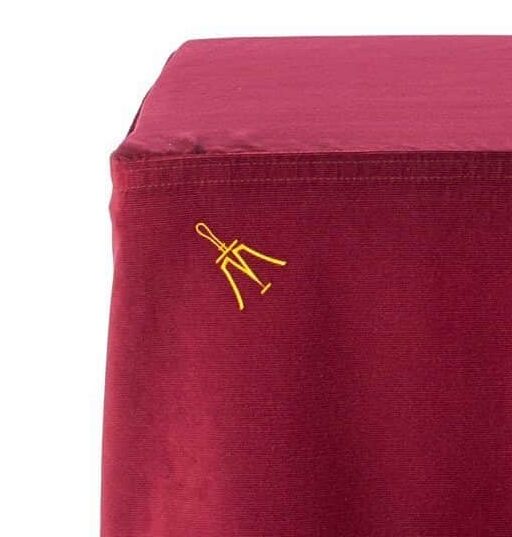
A picture of a handbell table cover from Malmark, like one observed in a Mormon sacrament meeting
An image of a Malmark table cover for handbells, like the one observed in a sacrament meeting in Layton Utah.

After the answer, the question’s author said that “It’s quite interesting this church had so many – there were like 8 tables with such table cloths. Maybe a member of another ward is the hand bell camp champ and these are all from their personal collection and not property of the church itself? Who knows?” A response from someone who seems to have experience from Protestant bell ensembles explained, “A handbell choir requires that many tables. … Churches I’ve attended played bells once a month max, because it’s a more intensive music offering than the choir. In the times we weren’t playing, bells were stored away – they’re pretty expensive and probably belong to the ward. After all, you can’t play them alone!” After a link to the product itself and a note that “That’s one expensive table cover,” another commenter said, “I promise these bells and table covers are privately owned. Unless they were purchased with permission from a Q15 by a rich donor. But most of the time ‘extras’ are denied because they have to keep things equal for all the wards and they’re sure as hell not providing handbells to the Rose Park or Taylorsville wards.” In response, the author of the original question noted that in their experience, “All wards are not equal,” and, “This church was in Layton Utah in a fairly wealthy area,” so might have had a set donated to the ward.

The handbell community in Utah is fairly close-knit, so I actually know who this would be, and they are indeed privately owned. The person who owns them was a member of the Bells at Temple Square, but the age limit for the ensemble is fifty. So, when he turned fifty a couple of years ago, he left the ensemble, but dearly missed ringing handbells. A wealthy neighbor and friend saw how much he missed it and bought a full set of bells and equipment to start an ensemble called the Bridgecreek Bells. (I wish I had a friend who was rich enough to do that for me!) Since then, he’s put together groups to play for special events at his church, and those of us in northern Utah who use handbells for sacrament meeting special numbers will often use those exact bells when the performances are north of Salt Lake City.

Handchimes are a closely related instrument that, while still pricey, is more affordable. These are stopped aluminum tubes with tines and a clapper, a bit like an oversized tuning fork. I have heard of a few wards where someone owns these instruments and uses them for music numbers or for music time in Primary. In every case I’m aware of, however, they are privately owned and shared with the church rather than owned by a ward.


Comments

12 responses to “Do Any Latter-day Saint Wards Own Handbells?”

  1. John Mansfield

    It’s that way with almost everything. A dozen years back our scoutmaster bought a nice trailer for the scouts. When he moved he passed title on to the next (and final) scoutmaster. It is parked behind the church, still his personal property. The 1990 ward budget equalization has in-kind gaps big enough to drive a drive a truck towing a trailer through, a trailer loaded with tables and dozens of bells, on its way to a lakeside vacation home belonging to a ward member that he is letting the church youth use this weekend.

  2. In 1961 (approximately) the Edmonton Alberta Canada stake had a dance band composed of about 10 musicians along the lines of a “Big Band”. We played for stake dances approximately every 2 weeks. There was not a church member who owned a set of drums but a couple of drummers. The stake bought a set of drums which were stored in the stake centre and were only to be used there for the church dances. I played in the band (alto sax) for about 5 years and the interest in the band died out. Being in my late teens I was not privy to who purchased them or of their disposal, but there was lots of interest in the band and the dances with the dances being well attended by young and old alike.

  3. R. Mark Melville

    This is tangential to the main idea of your post, but I’m always amazed how /r/exmormon can take something benign (or positive) and twist it into something sinister.

  4. R. Mark Melville, it is kind of funny to see that happen.

    Kent Gibb and John Mansfield, yeah. It’s difficult to seal off the use of private equipment at the ward/brand level, especially since it’s usually just someone trying to make sure people have a good experience. But that’s actually pretty cool that they bought drums for people to use.

  5. Honestly, the quality and impact of LDS Sunday School and Priesthood, has declined so badly – and has become so meaningless – that having an electric buzzer, a microphone, an intercom or a beautiful hand held (Sterling Silver) bell to call people to class (or to entertain), is of absolute no consequence; regardless of who owns it.

  6. LHL, English handbells are a different type of bell than those ones. They’re bronze and used for musical performance instead of signaling. I did see a humorous post somewhere recently, though, where the author was poking at the Sunday School change you reference through the lens of a man who was called as the ward bell ringer (as a “we can’t think of any callings where we would trust you but still need to give you a calling” position), who went over the top on ringing those signal bells to “magnify his calling”. I thought of joking that he could have fulfilled his calling by learning English handbell ringing and performing solo special music numbers in sacrament on them.

  7. I’m fascinated by the philosophical problem you’ve hinted at here. How do you do something different and wonderful (like having handbells in Church), when you are trying to avoid privileging some people over others. Even when the handbells are purchased by individuals, it still ends up with wealthier wards getting something that less-well-off wards can only dream of. But I like handbells and would LOVE to see them in Church!

    I don’t know how to solve that dilemma!

  8. LHL:
    “Honestly, the quality and impact of LDS Sunday School and Priesthood, has declined so badly – and has become so meaningless”

    Uh, I think I’ve been making suggestions about this in my posts over the past year….

  9. Chad Nielsen

    Yeah, it is a dilemma. In this specific example, I love handbell music and feel like there isn’t enough of it in the world, so my personal feelings are to encourage it wherever it can happen and to share it as broadly as possible. But I recognize that’s not always going to be the right answer!

  10. rogerdhansen

    Looking internationally, it would be great if the Church encouraged the use of local instruments. I’ve attended SM in several African countries. The integration of drums into church services would reduce the neocolonial feel of the meeting. In East Africa, the ngoma drum is widely available and quite inexpensive. I’ve purchased them for Branches to use in their youth activities. But it would exciting to see them integrated into the regular service.

    In Ecuador, Bolivia, and Peru, their locally made flutes have a beautiful and haunting sound. They would be a wonderful addition to Church music. Like African drums, they are quite inexpensive.

  11. Chad Nielsen

    Two posts forward in this series, I’ll talk more about the handbook, but they’ve given local leaders a lot more leway in deciding what instruments are apropriate at church. I suspect that African drums were one of the cases they had in mind for that shift. Though, I also wonder if there will be a lingering stigma on percussion instruments (well, other than piano).

Leave a Reply

Your email address will not be published. Required fields are marked *

This site uses Akismet to reduce spam. Learn how your comment data is processed.