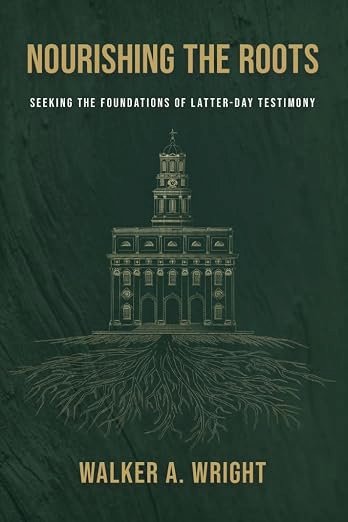
Walker A. Wright. Nourishing the Roots: Seeking the Foundations of Latter-day Testimony. Foreword by Steven C. Harper. Redding, CA: FAIR, 2026. 216 pp. Paperback: $15.95. ISBN: 978-1-971818-05-4.
Reviewed by Chad L. Nielsen
In the contemporary landscape of Latter-day Saint intellectual life, the defense of the Restoration has occasionally suffered from a hyper-localized focus. Apologists and critics alike often become mired in the “branches”—the minute, unresolved details of nineteenth-century polygamy, local administrative missteps, or specific textual variances—while neglecting the deeper, structural assumptions that govern how those details are interpreted. In his timely and accessible volume, Nourishing the Roots: Seeking the Foundations of Latter-day Testimony, Walker A. Wright performs a necessary work. Grounding his approach in a pastoral metaphor offered by Elder Dieter F. Uchtdorf, Wright argues that a resilient, intellectually honest testimony is built not by constant defensive pruning, but by watering the “roots” of a religious worldview: the existence of God, the historical reality of the resurrection of Jesus Christ, and the authenticity of the Restoration.
Philosophical Foundations and the Supernatural
One of the book’s central goals is to make room for plausible belief in the Restoration through engagement with philosophical and scientific foundations. Wright begins his cumulative case not with Joseph Smith or the Bible, but with the raw, basic features of reality. Using accessible pop-culture touchstones—such as Nathan Pyle’s Strange Planet comics, Bill Watterson’s Calvin & Hobbes, Ted Lasso, and the film Contact—he coaxes the reader into reflecting on the sheer mystery of existence, cosmic fine-tuning, and the problem of consciousness.
For readers who find formal logical proofs for Deity dry or unpersuasive, Wright is at least admirably self-aware regarding the inherent limitations of human logic. He acknowledges that formal arguments alone cannot “solve” the mystery of God or compel faith. Instead, his discussion is intended to create space for believing that the existence of God is plausible. Chapter 4 (“The Thin Veil”) then stands out as a particularly interesting section. By assembling cross-cultural data on modern miracles, exorcisms, and spiritual experiences, Wright works to establish that the universe is actively frequented by the supernatural, creating a hospitable environment for the historical and revelatory claims that follow.
Eyewitnesses, Non-Member Scholarship, and the Strangite Contrast
In the second half of the book, Wright turns to the historical “roots” of Christianity and the Restoration.
Chapter 5 (“He Is Risen!”) frames the Gospels as ancient Greco-Roman biographies and utilizes Richard Bauckham’s model of eyewitness testimony to evaluate the historical plausibility of the resurrection of Jesus, applying William James’s “white crow” principle to demonstrate that the early disciples sincerely believed they had witnessed the bodily risen Christ.
Chapter 6 (“Plates of Gold”) and Chapter 7 (“A Marvelous Work and a Wonder”) address the Book of Mormon’s historical origins. Wright highlights the lifelong adherence of the Three and Eight Witnesses to their testimonies, pairing this with convergent archaeological and linguistic data—such as the “NHM” Nahom inscriptions in the Arabian Peninsula and authentic Semitic/Egyptian names—to argue that the Book of Mormon behaves like an ancient document.
Through these chapters, Wright argues that traditional Christians who accept the New Testament Gospels as reliable witnesses of Jesus ought logically to consider the Book of Mormon, given that the historical and documentary evidence surrounding the Restoration’s eyewitnesses is vastly more abundant and recent. A major strength of these chapters is Wright’s active engagement with recent non-Latter-day Saint scholarship, responding to the arguments of figures like historian John Turner (Joseph Smith: The Rise and Fall of an American Prophet) and evangelical pastor Kyle Beshears (40 Questions About Mormonism).
However, this comparative argument reveals one notable omission: Wright would have strengthened his case by directly addressing competing nineteenth-century claims to scripture within the broader Restoration movement, such as those of James Strang and his Voree plates. Skeptics sometimes point to Strang’s witnesses to force Latter-day Saints to confront their claims about the Book of Mormon in a way that feels similar to pointing to the Book of Mormon’s witnesses for a mainstream Christian. Demonstrating why he feels that Strang’s metal plates and witnesses fail historical scrutiny compared to the Book of Mormon would have fortified Wright’s comparative framework against a notable counter-argument.
Chapter 8 (“A Still, Small Voice”) closes the volume by addressing the epistemology of revelation. Drawing on Plantinga’s proper basicality and Alston’s perceptual model, Wright argues that personal spiritual experiences—specifically the dialogic revelation promised in Moroni 10 and Alma 32—provide a rational, experiential basis for belief.
Conclusion
Nourishing the Roots is a necessary contribution in Latter-day Saint apologetic literature. Walker A. Wright has provided an intellectual, accessible, and robust framework for navigating modern questions of faith. It respects the intelligence of its readers, acknowledges the limitations of formal logic, and builds a case that the restored gospel offers a coherent way to answer ultimate questions. For any student of the Restoration seeking a thoughtful, accessible, and faith-building guide to the philosophical underpinnings of the faith, this volume is recommended.
For info on more books being published in 2026, see Mormon Studies Books in 2026.
Comments
4 responses to “A Review: Nourishing the Roots: Seeking the Foundations of Latter-day Testimony”
Sounds like an interesting book. I spent some time looking at the Voree plates a while back. They’re interesting, but kind of underwhelming as a counterexample.
Thanks for this very kind review, Chad!
In case it’s of interest, I do briefly touch on the Strang plates in Chapter 6, but only in the footnotes. I didn’t want to upset the flow of the chapter by putting it in the main body. I also have some metaphysical discussions in the footnotes of Chapters 1 and 3, specifically on the nature of intelligence and its relation to element. Since I repurposed the classical theism arguments for certain aspects of LDS theology (e.g., light of truth), I wanted to provide those for philosophically-minded people who might initially feel the tension between these arguments and our metaphysics.
Thanks again for reading and reviewing!
It sounds like Chapter 6 is a little weak. The evidence presented in the post doesn’t mention DNA, no evidence of Christ in the Americas, No evidence of major battles. Geography doesn’t match any place in the Americas. The evidence presented might be used to strengthen an existing strong testimony, But it won’t help the doubters or nonmember archeologists.
There are also issues with how it was translated. On my mission in the 1960s, we showed an illustration of JS literally translating the plates. Turns out JS didn’t even need the gold plates. The front of the book stated that the BoM was a history of the American Indians. (And it included those awful illustrations by Arnold Freiburg.)
The Church will have to address an increasing number of members who believe that the BoM is inspired historical fiction. Can they still have a real testimony?
I love those illustrations. And I love the Book of Mormon as someone that believes the BOM is evidence of revelation. That doesn’t make me fit in the sceptic camp and I can wave or enjoy the historicity camp but don’t think I’m fully there with examples that may stretch things a little too much.
I’ll add this book to the list so not to judge it based on its cover. Thank you.