
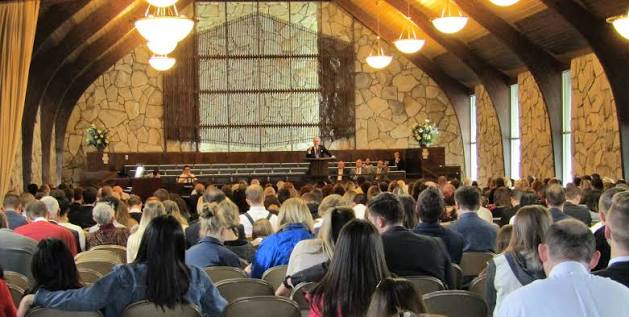
What is important in our meetings? Immediately, most church members will say the sacrament—which implies that the rest of sacrament meeting is just context. It is true that the sacrament represents the most (or perhaps only) important, or truly great, element of our theology and our practice. But we should probably think about what we mean by a “great work”.
We use the word “great” all the time, but rarely do we define what we mean when we use it. In most sports, we determine great by statistics kept of what happened during competition, and the great is then determined by looking at those statistics. In sports the GOAT is usually something that can be calculated.
Even in the scriptures, when we talk about a “great work”, what is mean isn’t always clear. Esther’s “great work” was influencing a powerful king to save her people—certainly great for her people, but likely irrelevant for, say, the Book of Mormon peoples. For us today, her “great work” is an example of what we can do, not something directly relevant to our lives. “Great” is then relative to who benefits. I dare say that the sacrament, and the sacrifice it represents, is the only (or one of very few) “great work” that is relevant to everyone.
So then, what about the rest of our meetings? Our classes and services? Beyond the sacrament are they important? I think this is actually an important question, since it implies how we should react to what happens in those meetings. If what is important and “great” is relative to each of us and our situations, how do we judge what happens there? How do we know what we should pay attention to?
All that assumes that we do need to judge, and that there is some universal standard for what needs to happen in our meetings and classes. Often we make assumptions about what is important or great based on the culture around us — the ideas and assumptions of the world. We expect entertainment, or a particular style of delivery, or to hear about expected topics. But none of these determine importance or greatness for everyone.
Given all this, perhaps we should be suspicious of the assumptions made about what is important. Under the influence of the surrounding culture, we make assumptions about what is important and what makes our experience at church good. And when that doesn’t happen, we assume that the talks or classes are “bad.”
Fortunately, we don’t have to adopt these assumptions about what is important and what is “great.” We can choose how we think, and make our own judgments about what is important — and tailor those judgments to what we need.
So, what things do you see as important in Church? How do you participate? Are you thinking about things the way that you want to? Or are you just accepting the assumptions of the culture around us?
In these posts I am trying to suggest that each of us can have better experiences at Church if we take responsibility for our experiences, and if we are open to learning from what happens by pondering it — by thinking about it in many different ways. We can choose to learn and benefit from what happens regardless of whether it fits our perception of what is “good.” Thinking about our reactions and what we understand allows for revelation and for better understanding.
In this vein, I like the statement that President Hugh B. Brown made in a 1969 BYU devotional, President Hugh B. Brown declared that the Church is “not so much concerned with whether your thoughts are orthodox or heterodox as we are that you shall have thoughts.” We should be carefully considering what we hear at Church, regardless of whether what we heard is right or wrong, orthodox or heterodox.
A lot of our thought depends on how we look at it. It is not different from what many artists figure out—they understand that how you see the world before you is more important than what you see. You might call it ‘active listening’ or shifting perspective. It just means that you see differently. And seeing differently reveals a different world.
In my case, I tend to focus narrowly, thinking about groups of words or sentences, sometimes taking them out of context and thinking about what they say, even if the speaker didn’t intend what I heard. It’s not at all like what we’re taught in school, where the focus is on understanding accurately and completely what the speaker or text says. Its about pulling out useful or inspiring thoughts in spite of what was said.
So, if you aren’t thinking this way, maybe try it next Sunday, or the next time you are in a class or meeting. If you have already thoughts inspired by what happened at church, what are they? How did you react to what happened in Church yesterday? What did you notice? Did you end up thinking differently? Do you think your reactions were what they should be? Were they looking for what God had to tell you? Did your reactions make things better?
This is the latest invitation for reactions to local meetings, continuing a series of weekly posts that started with my post on September 25th about how we receive what happens in Church meetings—sermons, lessons and anything else—and enter a conversation with them, magnifying what was said or adding what we think. In these posts I’m asking us all to think about how we listen and receive what happens at Church. If we only listen for mistakes, or things that bother us, what does that say about us? Is it most important to criticize others? Or to try to change ourselves?
The point here is that no matter how poorly prepared the speaker or teacher is, or no matter how what happens triggers us, or is objectively or doctrinally wrong, we can still find elements in what is said and what happens that inspires and edifies us. Even if church meetings aren’t conducted in a way that reaches us, we can take responsibility and find a way to feel the spirit.
So please, write down reactions and thoughts to what happened in Church. You might keep your own ‘spiritual journal’, or, if you like, you can post your reactions below. I’m adding my own reactions and thoughts as a comment to this post — instead of as a part of this post, because my reactions aren’t any better than anyone else’s.
Let me emphasize that this is NOT a place to criticize what is wrong with church or your fellow congregants. The point is to post what you learned because of what happened at Church or how that led you to think. It’s about the good things we can get out of Church, not the negative things that disturbed or upset us. It doesn’t have to be orthodox, traditional or even on topic.
If you like, make your response in the format, “They said or did this, and I said or thought that.” Even the things you dislike the most can be turned into lessons for what the gospel teaches we should do.
My hope is that these reactions serve as an example of a better way to treat what happens at Church instead of the perennial complaints about speaker or teacher preparation or ability, or complaints that the Church should do things differently.
Comments
22 responses to “A “Great Work” in our Meetings (Or What Did Church Lead You to Think About Yesterday), 8/2”
Here’s a few of my thoughts in reaction to what I experienced in Church yesterday (8/2):
“That undoubtedly makes the meeting more entertaining, but I’m not sure that’s always good. Are we there for the entertainment? Or for spirit? Of course you can have both, but I worry when you don’t.”
Kent, what I am about to say is said with love in my heart for you. This kind of attitude is exactly why so many of our talks, lessons, and meetings are like watching paint dry and why people were praising the Lord when our meetings got cut from 3 to 2 hours. We as a people have decided for some reason that boring meetings are obviously good and invite the Spirit. They aren’t and they don’t. As evidence in support of my position, I’ll point to Jeffrey R. Holland. He was far and away the most popular speaker in General Conference for decades (the last GA to be that good a speaker was Paul Dunn – I know that’s a bit awkward to admit). President Holland dared to be engaging and entertaining because he realized that his audience was all over the spectrum of belief and understanding. If he could get people to pay attention for more than 30 seconds, there was a much better chance that they would take something away from his talk. We need more of that attitude and more entertainment in our Sunday meetings not leas.
“Not a Cougar”
You are reading more into what I said than is actually there. I never said that “boring meetings are obviously good”. I am saying that I don’t think that whether or not meetings are boring is necessarily the point. We go to church for many reasons, and things happen in church for many reasons. Whether or not you enjoyed the talks isn’t necessarily among those reasons.
Please re-read the original post!! You are missing the important point. I have repeatedly said things like “Under the influence of the surrounding culture, we make assumptions about what is important and what makes our experience at church good. And when that doesn’t happen, we assume that the talks or classes are “bad.”
Let me challenge you a bit. What do you mean by boring? Or engaging? Is your definition of boring, or engaging something that comes from the gospel or is it from what you see on television or other entertainment venues? Is it possible that what you find boring and what someone else finds boring are different? Why does that happen? If it does happen, what does that mean for how we define “boring”?
I’m NOT saying that there isn’t such a thing as boring or engaging. I AM saying that we need to be careful and make sure we have defined what we are talking about.
I’m also asking where the responsibility for avoiding “boring” meetings lies? Does it lie with the speaker? With the audience? With those planning the meetings? With those who have trained or failed to train the speaker? If we avoid untrained speakers, how do we get trained speaker? In addition, are we being charitable when we make these claims?
Sorry, but you will need to do much better than simply claiming that many talks or classes are “boring” — I need to know why and how they are boring and what should be done to change that.
Kent,
I did in fact read your post, quite carefully in fact, and I stand by what I wrote. Blaming the audience for being raised in a culture that doesn’t prepare them to digest a talk from an ill-prepared speaker is just not a useful criticism. You have to take your audience as you find them.
As to what I mean by boring, while I don’t think it’s critical to define something we’ve all experienced, I’ll attempt to define it.
Boring meetings are often (though not always) characterized by lack of preparation, often relying on simply regurgitating conference talks or other sermons from General Authorities. Even when you can tell a speaker prepared long and hard on a topic, you can also tell that preparation was on learning the topic and not on how to most effectively convey it. Boring speakers display a lack of enthusiasm for either speaking itself (the oft-used trope of explaining how a member of the bishopric how to browbeat them into speaking) or for the topic being presented. The speaker plods along through the written talk in a largely monotone voice, ignoring any cues from the audience and often doesn’t even look up from the paper/device (they aren’t lively, they aren’t engaging). The speaker doesn’t attempt to introduce any novelty to the topic or approach the topic from a different perspective, but rather re-treads the same ground trodden by centuries of Latter-day Saint speakers and quotes the same scriptures and stories everyone else has used (if I have to hear one more talk about the tithing and the windows of heaven…). Boring speakers also fail to respect the time allotted ot them, somehow believing that the sheer length of the talk will somehow make it better. I’m sure there are many more characteristics I could name, but that’s a sufficient list with which to start.
Now, as to who’s fault it is, do we blame the leadership? Absolutely. How often and how seriously do our leaders at the Church, area, stake or ward level take training the membership in how to give a talk? It’s something we literally spend a quarter of our time on Sundays doing and yet I struggle to recall much of anything our leaders have done to try to improve the quality of our talks (I’m sure we could dig something up from a talk in the past but the fact that it’s not coming to mind, unlike say training on home teaching/ministering, suggests it has never been much of a priority). I suppose the leadership largely relies on modeling what a talk should look like in General Conference, but then many General Authorities aren’t very engaging either so I’d argue it’s a less than effective way to teach us.
As to how to hold training on talks, it would not be that hard to arrange at least one 5th Sunday Lesson a year on effective approaches to giving a talk as well as arranging for feedback after someone gives a talk. Could that lead to offense if the feedback is too harsh or be ineffective if the speaker is given nothing but praise, sure, but with support and imprimatur from the leadership, I believe it’s possible to do. It takes effort, but given how much time we spend together listening to someone else talk, wouldn’t that be time and energy well spent?
As to the audience, again, I understand that you want to put much of the burden on them to find something meaningful in any talk, but, I’m sorry, you’re asking too much. Sure, the Kents of the Church can absolutely do that, but most of those in the pews are not Kents. They are children and youth. They are adults who are there simply because their spouse wants them to be there. They are adults who are easily distracted and just looking for a reason to whip out their phone and ignore the speaker. Do we ignore those people and cater only to those able or willing to pay attention to a boring talk? Should the majority of our talks only be an acquired taste that require above average patience, concentration, and contemplation to access? I think not, and I also think that we can and should do better. That said, because we rely on the congregation for the majority of our speakers, there’s always going to be an upper limit to what you can expect, but don’t you think most of the talks we hear could be improved with a little more preparation and training? I certainly do.
Another idea for possibly improving the quality of talks and lessons….
In my experience, the decision to base all of our talks and lessons around General Conference addresses has been absolutely detrimental. I have heard that the talks and lessons are supposed to be about the topic, but that has not been done in my ward. The conference address usually IS the local talk or lesson. Maybe it’s because the speakers and teachers don’t want to take a chance of saying anything that might possibly be somehow different from the general authority, but we mostly end up reading the conference talk. “I can’t say it better than Elder ____, so I’m going to read his words.”
Honestly, I’d rather listen to my neighbor’s latest testimony about one of the Three Nephites saving members of her family when they did something stupid while snowmobiling. At least that’s a topic she genuinely cares about.
I would absolutely love some Three Nephite stories. The endless conference address lessons and talks is killing me.
Not a Cougar:
Where exactly was I “blaming the audience”??
I AM asking the audience to take responsibility for their actions. I am NOT saying it’s their fault that the talks aren’t good (whatever that means).
I must say it sounds like you are trying to avoid any responsibility yourself for how you listen to meetings. I listen to a lot of talks you would call boring, but I always manage to find some offhand comment that makes me think again about what is said. It can be a “boring” statement, but I manage to think about it differently than what was intended, and get something out of it.
EVERYONE involved in a meeting has responsibility for what they add to and what they get out of the meeting. I’m very frustrated with the attitude of “they didn’t prepare well, so I didn’t get anything out of church.” I know that is a common attitude.
I sincerely wish I could fix the problem with the lack of preparation and the lack of work by leaders in ensuring good talks. THAT IS NOT IN OUR CONTROL. Complaining about it, blaming the speaker or the leaders, doesn’t give you what you need. The only option that any of us (who aren’t speaking or who aren’t leaders) have is to change ourselves and how we think about what we hear.
The problem you are complaining about is a cultural problem. It means changing the training of speakers, the training and mindset of leaders, and it may mean some potentially bad things—like robbing newer or less educated members of the opportunity to speak in church. Is that really what we want?
I don’t doubt that many things could be done to improve our meetings. I have NEVER claimed that improvements weren’t possible. BUT, I think we can do a lot ourselves to improve how WE listen and participate in church. And, I suspect that doing so will actually lead to changing the culture in the way you are seeking.
PWS:
How is basing talks on General Conference talks different from basing the talks on the scriptures (especially since we actively teach that the words of the prophets today are scripture!!).
IMO, what you base the talk on isn’t the problem. It’s HOW it is done. If you are actively thinking and reacting to what the talk says —giving it a “the talk/scripture says” so “I say” or “I think” approach, you can have a good talk regardless. This is what I’m asking all of us to do mentally, react to what is said. If they say something wrong, think out in your head “this is wrong because”, or “they didn’t think about xx or yy”. And if they say something correct, “this is right because”…
If we are thinking that way, then our talks will end up that way as well.
The difference is that I don’t think I’ve ever heard anyone simply stand up and a couple of chapters of Isaiah. As I said, the talks are lessons are not based on the address. They ARE the address with a minimal amount of filler.
I think there are likely at least 2 reasons for the difference.
The address is already in a format that seems appropriate for a talk or lesson, so it doesn’t seem to need as much work to make it fit the occasion.
I also think our current culture of prophet worship makes it harder for some traditional members to think it’s acceptable to make any changes at all to something said in conference.
Sorry—read a couple of chapters
Kent, if I’m not mistaken, you are old enough to remember talks from Marion G Romney, who was in the first presidency in the 60s and 70s. His talks were basically just a concordance. He would read verbatim scripture after scripture with almost no interpretation or comment or insight. I remember thinking as a very young man how little I was getting out of anything he said. And I think that’s what PWS is referring to. Basing a talk on a general conference address is so much different than literally reading that talk. I can read the talk on my own anytime I want to. I don’t need someone to stand up in sacrament meeting and read it to me.
Kent, c’mon man. First, you’re badly misconstruing my point about the audience. To be very clear, I said that blaming the audience for not being raised in a culture that is prepared to do the heavy lifting you want them to do is not a helpful criticism. Your response to that was to suggest I was somehow accusing you of of the position that “it’s their fault that the talks aren’t good.” That’s clearly not what I wrote.
Second, you’re talking out of both sides of your mouth. In the very first sentence of your reply to me, you claim to not be “blaming the audience” and in the very next sentence you say “I AM asking the audience to take responsibility for their actions.” Maybe you don’t recognize it as such, but that is definitely blaming the audience for not engaging with a boring talk.
Ultimately, we see the same problem, but we have very different opinions on what the solution should be. I also happen to think that my proposed solution is the more workable solution. Do we need to limit who speaks? I think that bishoprics can certainly be more intentional about whom they select for a given topic, but I don’t think we have to artificially limit who gets to speak, especially if leadership provides training and emphasis on becoming a better speaker.
“The only option that any of us (who aren’t speaking or who aren’t leaders) have is to change ourselves and how we think about what we hear.”
It’s actually not. That people are choosing a third option (phones, etc) is the entire problem is. If it was as easy as you said to find the needed engagement in the current set-up, more people would be doing it. Because they are the very people who are present and want a meaningful experience.
Personally, my biggest problem is the lack of visual stimuli. I’m soooo not an auditory person. I’ve found that bringing something to do with my hands allows my busy-brain to be occupied so that the auditory part of me can listen. But doing small projects sitting in the church pews kills my back, so I had to give that up.
I’ve found that I tend to be able to listen better to speakers who modulate their voices – which is an unfair ask as most speakers are still working on the terror part of public-speaking.
Interestingly, I don’t seem to retain much either way. I can’t tell you who spoke last Sunday, other than it was a great speaker who did understand how to use their voice. And as I write this, it occurs to me that the reason I don’t retain is because the sacrament meeting is kind of irrelevant to me and my spirituality. I do remember several of my morning devotionals from this week (which are of course, written and thus visual).
PWS said:
I also think our current culture of prophet worship makes it harder for some traditional members to think it’s acceptable to make any changes at all to something said in conference.”
I think these are both good points. Scripture often needs interpretation, since it was almost always written for a different time and culture. GC talks need less of that. When speakers don’t do more than parrot the GC talk, I agree that’s not ideal. I’m not seeing much of that, but that doesn’t mean its not happening elsewhere.
KLC while I’m old enough to remember him, I hadn’t noticed that he did that — likely because I wasn’t listening closely enough then. I hope I have changed for the better.
You said: “Basing a talk on a general conference address is so much different than literally reading that talk. I can read the talk on my own anytime I want to. I don’t need someone to stand up in sacrament meeting and read it to me.”
Again, I don’t think I’ve heard anyone do that. But, to the extent that is happening, as I said above, I don’t think you or I can do much about it. Your choices are to check out, or find a way to get something out of it. What are you suggesting should be done?
Not a Cougar:
I think I misread what you said then. I didn’t see the claim about the culture. I agree that “blaming the audience for not being raised in a culture that is prepared to do the heavy lifting you want them to do is not a helpful criticism.” But I must still disagree that I’m blaming the audience.
My position is that most of us don’t have the ability to fix this. We aren’t involved in choosing the speakers, we aren’t training the speakers, we aren’t assigning the topics. There has been plenty of complaining about the quality of meetings, and I’m sure it will continue. What will it take for those complaints to be heard and changes made? I don’t know. I suspect it will be a while.
SO, what do we do in the meantime? Do we check out and ignore the talks (as it looks like ReTx does)? What is the benefit from that? At best we get a lousy experience at church and at worst we offend the speakers who may notice that we didn’t pay attention.
Shouldn’t I then suggest that there are ways of getting something out of the talks even when they aren’t well prepared or are simple regurgitations of GC talks?
I agree that we see the same problem. But unless you are in the bishopric or can persuade the bishopric to act differently, how does your solution give you or I any immediate benefit? At least with my solution we get something out of church now.
By all means continue to complain — to those who can make the necessary changes. I don’t think I have ever suggested here that changes shouldn’t be made or that things couldn’t be better. Instead, I’m trying to help provide a way to mitigate the effects now.
I hope to address the issue of responsibility in Monday’s post.
ReTx:
“ If it was as easy as you said to find the needed engagement in the current set-up, more people would be doing it. Because they are the very people who are present and want a meaningful experience.”
Well, I think the reason people don’t do it is more because our society models being an audience as being a passive observer who is supposed to be entertained. The idea that the audience can take responsibility for how they react and find ways of thinking differently about what they hear is not something that enters their minds. So I’m trying to point out a different way.
I do think some people are doing it. For example, I see some people writing thoughts in a “spiritual journal” or noting their thoughts in a diary of their experiences in church. I’ve found myself taking notes on my phone of things I thought of in response to what happens in church. Perhaps that would be a way of making the experience of church more visual and less auditory?
I should add a thank you for all these responses. They have been very helpful in refining my thoughts. I hope it doesn’t seem like I have all the answers here. I am only trying to suggest a way of making our experiences better without waiting for church leaders or the culture in general to change.
Hi Kent, I appreciate that you’re willing to engage with everyone who comments. I too have not personally been in a sacrament meeting where someone has literally read a general conference talk. That is because thankfully my ward does not ask people to use conference talks as topics for sacrament meeting talks. What I have seen many times is an ill prepared or just nervous person teach a priesthood lesson from a general conference talk by just reading large sections of it verbatim. So I have no doubt that the same thing is happening in sacrament meetings when leaders ask members to use general conference talks as topics for their talks.
Sorry Kent, I didn’t answer your final question. I think you are completely correct in what you have been saying since your original post on this subject. We do have very little recourse over someone else’s actions, whether those actions are leaders who are in charge of sacrament meetings or members who are asked to speak in sacrament meetings. They will do what they are doing regardless of us. We can become irritated, we can get angry, we can mentally check out, or we can try to find something of value in what is being offered to us. I think you’re being wise to keep reminding us that those first three options don’t contribute to our happiness.
I will own that I am completely checked-out during sacrament. It’s true.
Interestingly, I started writing in a journal during Sacrament several years ago. What happened (and part of this is I am a writer so the moment I put pen-to-paper, my brain goes into that mode) was that I ended up writing poetry. Some spiritual poetry, some not. But I found working out my own thoughts way more engaging than listening to the speakers’. Go figure. I still do that sometimes.
One of the things that keeps occurring to me though is that this whole problem is one of the reasons other churches use paid clergy who have some training or inclination toward public speaking. It’s also why using the physical church building to visually give the audience beauty and stimulation really helps too. And I’d throw in music that engages as well, as we have great hymns but don’t use them effectively.
I’m not worried about offending the speaker by not paying attention. The vast majority of speakers are too focused on getting through their talk to notice. Those that know watch for audience reactions/make eye contact, only do so for the first five to six rows or so. Including me on the last, It’s just too big of a room for more. (Speaking of Sacrament meeting.)