The Museum of Utah. Utah State Capitol Complex, Salt Lake City, UT. Opened June 27, 2026. Permanent and rotating exhibitions. Free admission.
Reviewed by Chad L. Nielsen
For over a century, the material culture of Utah’s complex and often fractured past has lacked a singular, state-level home capable of matching the scale of its history. While local historical societies, church-run museums, and specialized collections have preserved and presented pieces of the puzzle, the vast majority of the state’s historical artifacts remained obscured in basement storage vaults. The grand opening of the Museum of Utah in the summer of 2026, situated prominently on the plaza of the Utah State Capitol complex, represents the state’s first comprehensive attempt to curate its shared memory under a single, state-sponsored roof.
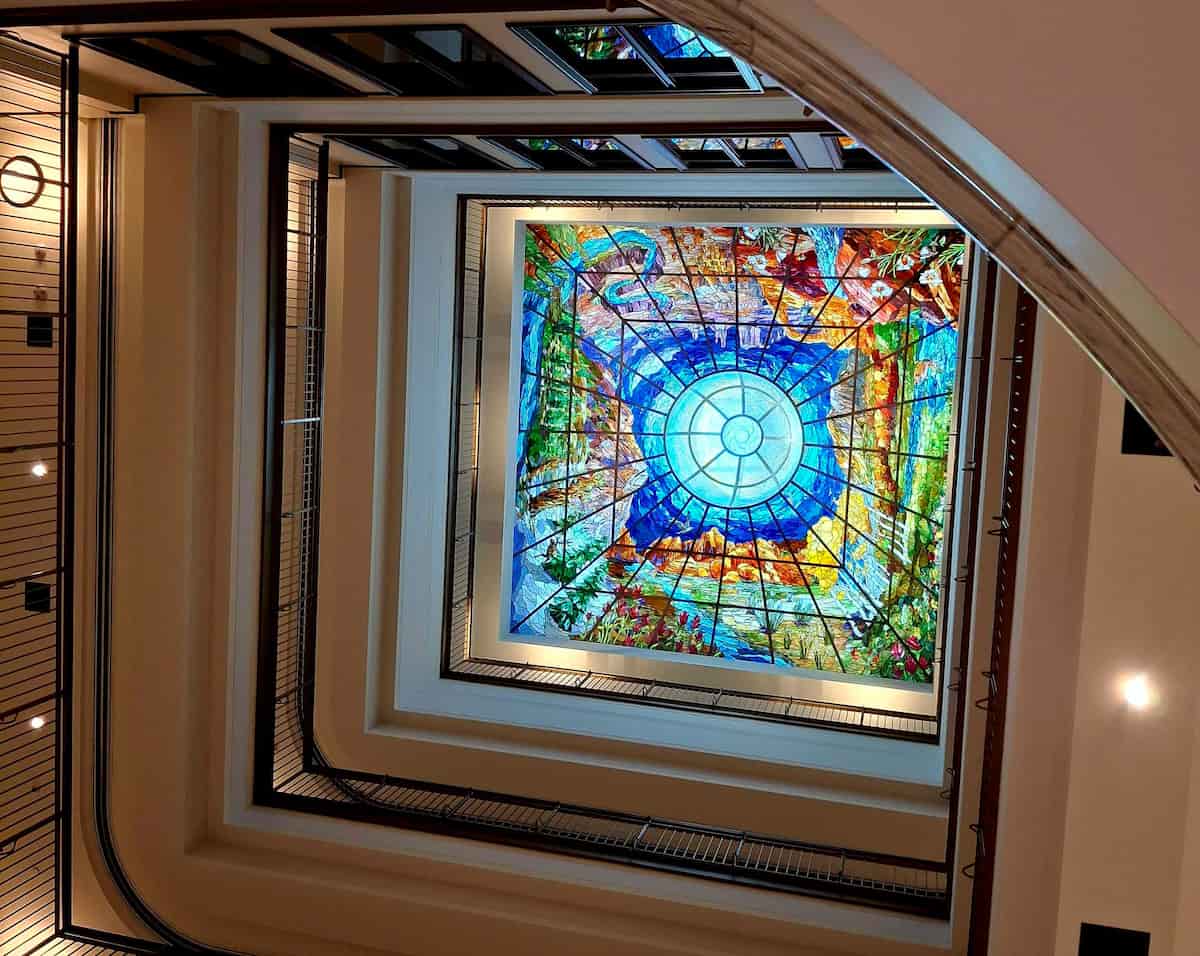
The physical structure itself prepares the visitor for this encounter; upon entering the lobby, one is greeted by an aesthetically stunning, massive stained-glass skylight depicting the sweeping vistas of the Utah landscape. The building is aesthetically pleasing in general, matching the Capital complex in its grand design choices.
The Four Pillars of Utah
The museum’s permanent galleries are organized into a clean, thematic blueprint divided into four primary exhibit halls: “Becoming Utah” (history), “Connecting Utah” (culture), “Building Utah” (industry), and “Inspiring Utah” (entertainment and innovation). This structural taxonomy prevents the massive collection from devolving into a simple cabinet of curiosities, allowing the visitor to trace how the environment of the Intermountain West shaped, and was reshaped by, its human inhabitants.
Rather than treating the arrival of the Latter-day Saint pioneers as the absolute “beginning” of Utah’s history, the galleries construct a spatial and chronological balance. The museum is careful to show that Utah history is not just a Mormon story, even though Mormonism is a key part of the story. The exhibits track the Native American experience from ancestral eras through the 20th and 21st centuries, for example, centering tribal voices and showcasing their continuous presence on the land. Artifacts from the Japanese community had a strong showing as well. Furthermore, the museum does not shy away from the darker undercurrents of the state’s past. The “Connecting Utah” and “Becoming Utah” galleries address difficult episodes, such as the Topaz Relocation Center—a World War II Japanese-American internment camp located in the desolate West Desert—and the dispossession of Indigenous peoples by Euro-American settlers. By balancing these sobering accounts of state-sponsored exclusion with uplifting sections celebrating the contributions of historic and modern refugees and immigrants, the curators avoid the twin pitfalls of hagiographic whitewashing and overwhelming cynicism. Mormonism’s influence is felt throughout as a major thread, but it is kept in careful proportion alongside a rich tapestry of other religious and ethnic traditions that have long made Utah their home.
Material Scaffolding: From Handcarts to the Digital Frontier
Where the Museum of Utah truly excels is in its display of iconic, historically significant artifacts that ground these historical currents in tactile reality. Scholars and casual visitors alike will likely find themselves “geeking out” over several key displays:
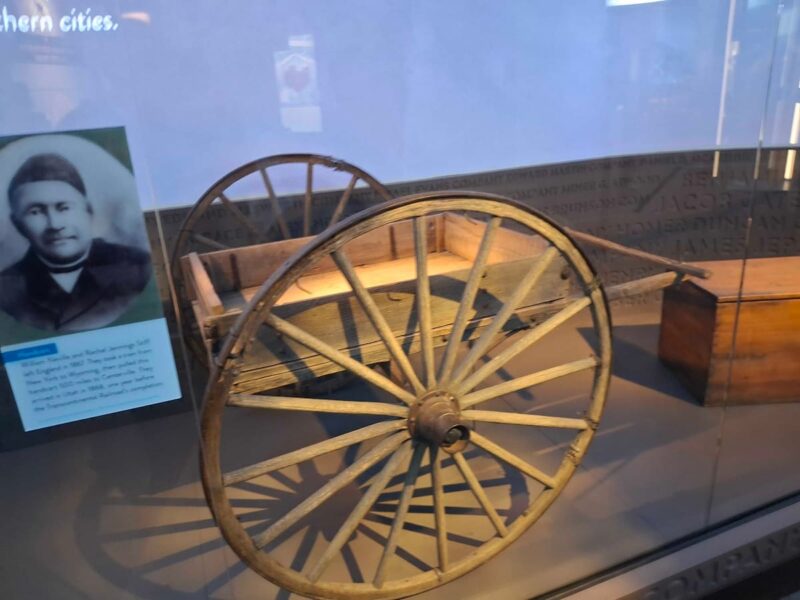
- The 1856 Handcart: A rare, original handcart stands on display, serving as a silent, powerful monument to the trials of the small number of emigrant companies that traveled that way and the gritty reality of the 19th-century gathering.
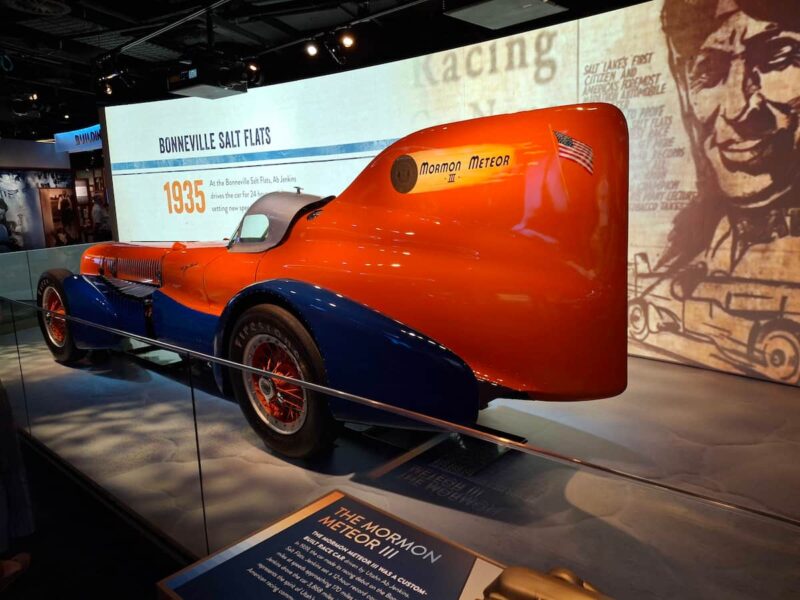
- The Mormon Meteor III: Ab Jenkins’s legendary (and quite large) Duesenberg record-breaker brings the speed-obsessed history of the Bonneville Salt Flats into sharp focus.
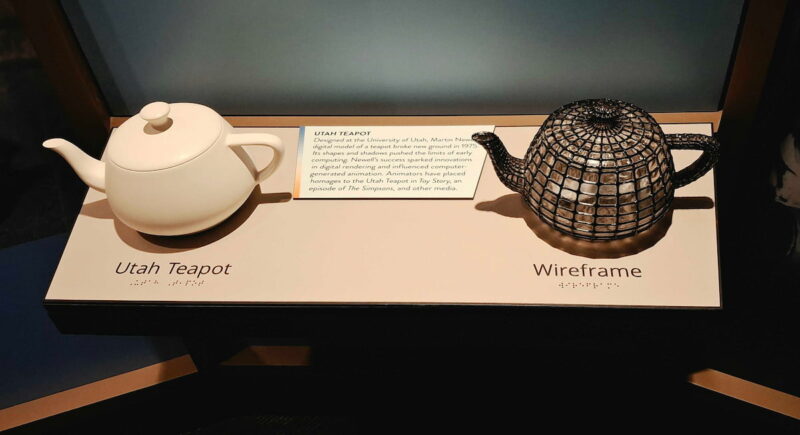
- The Utah Teapot: In a brilliant nod to modern innovation, the exhibit features the “Utah Teapot”—the iconic 3D model created at the University of Utah in 1974 that served as the foundational benchmark for the global computer graphics and digital rendering industries.
- The First Utah State Flag: The very first flag created to represent the state offers a tangible connection to Utah’s hard-won transition from a territory to the Union.
- Marty McFly’s shirt from the film “Back to the Future Part II”: The cowboy-inspired costume is on display as a homage to Utah’s prominence in filming westerns over the last century.
- Tabernacle Choir Artifacts: Music history is given a delightful human dimension through the inclusion of a retro, baby-blue choir dress from the 1960s/1970s and an original printing block for the state hymn, “Utah, We Love Thee,” used during the initial statehood celebrations. (I am, admittedly, biased in my excitement about things related to the Tabernacle Choir being on display.)
Tactile Engagement vs. Digital Overload
Modern museum design frequently suffers from “digital bloat,” where screens distract from historical artifacts. The Museum of Utah, however, achieves a remarkably successful equilibrium, utilizing technology to enhance rather than replace the physical and visual experience. In “Connecting Utah,” visitors can engage with a dynamic dancing space complete with instructive video guides or flip through digitally projected books to learn about gathering information from census data. It also includes a massive, interactive bookshelf where visitors can physically pull out sliding panel “books” that teach about prominent Utah authors. In the “Building Utah” section, the interactive approach is carried into the modern era with a playable, educational video game that discusses the surprising prominence of the video game development industry in Utah. An immersive theater further rounds out these tech-assisted offerings, keeping the younger generation engaged without sacrificing the historical weight of the physical objects on display.
Conclusion
The visit concludes in a small but thoughtfully curated gift shop that mirrors the thematic balance of the museum itself. The book selection is highly commendable, featuring a wide range of titles, including several by and about Native Americans in Utah (I was particularly excited to find an updated edition of a book by the Northwestern Band of the Shoshone Nation about plants that are culturally important to them, since I’ve been trying to get my hands on one for a while). My main disappointment about the gift shop is that the clothing section remains somewhat limited. The inclusion of postcard reprints of historic Utah scenes offers a nostalgic, highly affordable keepsake for historians of material culture.
The Museum of Utah is an extraordinary and essential achievement as “the Smithsonian of Utah.” It provides the physical and historical scaffolding necessary to appreciate the granular, multi-ethnic reality of the Great Basin. By displaying thousands of significant artifacts and placing them in a fluid, accessible narrative, the curators have created a space where both the scholar and the general public can grapple with the complex, shared legacy of the “Crossroads of the West.” It stands as an indispensable companion to any tour of the Capitol or Temple Square.
Comments
5 responses to “A Museum Review: The Museum of Utah”
This is a great category for new posts. Chad, we now need you to systematically visit museums and historical sites throughout the U.S. and/or internationally.
If that’s an offer to fund it, Jonathan, I’m game!
my family and i visited last week when i was off for the 4th holiday weekend. it was overwhelming in the best sense; we definitely walked out thinking “we’re gonna have to come back, there’s just too much to see and process in one visit”. highly highly recommend if you are in the slc or surrounding areas. worth a drive.
A highlight for me as I toured the museum was bumping into you!
I recently visited the Van Gogh museum in Amsterdam. It is a wonderful museum and should visited if you are ever in Europe. In
many ways it can be a very religious experience. If you can’t visit the museum, get a picture book biography.
My travels have transported me to locales that intersect with Van Gogh’s tortured existence. On my Mormon mission, I worked in the city of Mons, Belgium. Vincent lived there for a short time as a sort of missionary to the impoverished coal miners of the nearby Borinage. His failure there paralleled mine. And he decided to turn to being an artist.
In Paris, he was influenced by the work of Millet, an artist who specialized in painting rural peasants. I remember one of Millet’s works “The Gleaners” was used in a SS many years ago. Van Gogh himself painted many scenes of rural life: “The Potato Eaters.” He also made a large number of drawings depicting everyday life.
I have also spent time in Arles, France, where Van Gogh painted his gloriously colorful landscapes. Unfortunately, Vincent suffered from severe mental illness and, at a very young age, took his own life.
So why is all this religious? Why should we Mormon’s care. Vincent didn’t sell any paintings during his lifetime. He was supported by his brother Theo. Theo was married and had a son named Vincent. When Theo died, his wife and son worked tirelessly to preserve Vincent Van Gogh’s legacy. The majority of artistic works in the Amsterdam museum are from Theo’s collection.
How many of us would have the love for our brother to support him throughout his tortured life? Theo provides a wonderful example of brotherly love, and tolerance for severe mental illness.
Van Gogh should make us think about how we treat the so-called mentally ill. How can we can best relate to them without squashing the creativity inside them.
Vincent’s art should also make us question the art we put in our churches and chapels. The Church now has a list of 25 acceptable works. Most are boring illustrations. Perhaps a more diverse collection of creative religious and quasi-religious works would be more thought provoking. ThinkVan Gogh, El Greco, Rembrandt, etc. Or even some contemporary Mormon artists with a unique take on religiosity.
So spend a day in the Amsterdam museum or perusing a colorful coffee table book. Contemplate how all this relates to Christ’s life and message.