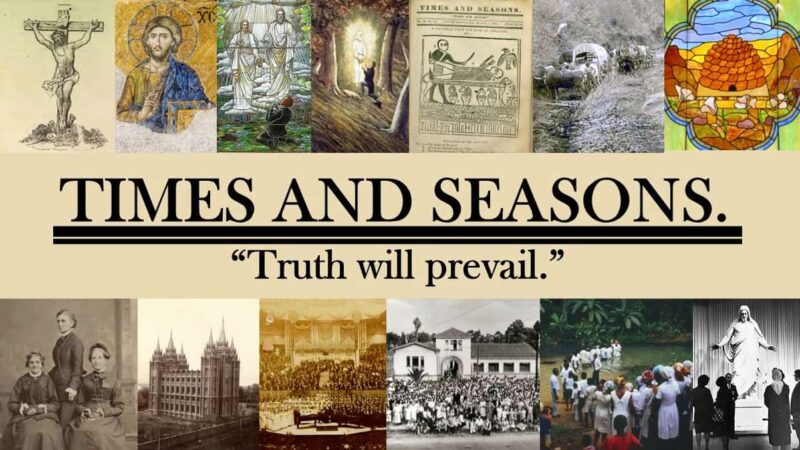
1—As many people noted, the government really shouldn’t be involved in deciding who is or isn’t a Christian.
2—I don’t believe leaving us off of the Department of Defense’s new list of Christian churches was a simple mistake. This was a policy announced by the Secretary of Defense himself. Cabinet secretaries have communications staffs that get paid to notice things like this in advance. Notably, the solution was not to apologize and add a few letters to our designation, but to drop “Christian” from everyone else. It’s apparently better for no one to be Christian, than for Mormons to be Christians.
3—Focusing on petty stuff like this, while we’re squandering American power built up over generations as American aircraft are going down while we lose a war in the Persian Gulf, is what makes Pete Hegseth such a bad Secretary of Defense. He is unqualified for his job and has constantly shown poor judgment.
4—Hegseth took his wife and six kids to Europe with him last week. That’s great! I firmly support taking your family to Europe. It’s a beautiful, interesting place, and you see things in a whole new way by having kids with you. If you’re going to be mad at Pete Hegseth, don’t be mad about this.
5—It’s useful to have a senator or three to represent your interests. It turns out that the separation of powers, checks and balances, and representative government are wonderful things. You might even call them inspired. Voters were unhappy, so senators made some noise, and policies changed by the end of the day (and before anyone had to answer awkward questions at their next oversight hearing, or any nominations got delayed).
6—Social media – which is full of the dumbest responses imaginable by the most superficial and thoughtlessly cruel people on Earth – has not been good for Mike Lee. Stewing in social media reinforces your most negative views and worst instincts. It’s not good for any of us. He needs to unplug.
7—Mike Lee is also not good at social media. He’s not a clever poster or gifted communicator, and he’s bad at apologetics and religious outreach. As a lot of people need to remind themselves, if you want to claim an LDS and/or Christian identity online, you have to walk the walk, both online and in real life. I try to be conscious of my own failings in this regard. Mike Lee should turn over the social media duties to an intern or a team of interns.
8—It’s depressing to see how many people are invested in Mormons not being Christians, including some who aren’t among the worst people in the world. There are some things we don’t really care about. Being known as Christians is not one of them.
9—Some people use wildly different standards to answer the questions “Is Donald Trump a Christian?” and “Are Mormons Christians?”
10—We have some decent insight on the issues that animate American Christianity today and the types of books that fly off the bookshelves of Christian bookstores, and “rigorous interpretation of the Athanasian creed” isn’t one of them. It seems to be an issue exclusively when it comes to pushing Mormons out of the tent. Over the last 70 years, we’ve seen a long list of teachings that conservative and liberal strands of Christianity are willing to compromise on, from unfashionable items in the Ten Commandments to Luther’s priesthood of all believers to the reality of the Resurrection – and you’re telling me that the one thing that matters above all else is a particular reading of a non-scriptural three-in-one paradox? Sure, okay.
11—It is true that “not everyone who says ‘Lord, Lord’ will enter the kingdom of heaven,” but the distinguishing factor is whether someone “does the will of my Father who is in heaven,” not formal allegiance to a creed that would be formulated several centuries down the road. “Where two or three gather in my name, there am I with them” seems fairly open-ended. Otherwise, Jesus asked would-be Christians to keep his commandments, love one another, be baptized, and take up their cross and follow him; the part about subscribing to a creed of uncertain authorship to be written some 400 years in the future didn’t make the cut.
12—If you read the history of Christianity, you’ll see most of Mormon weirdness has good Christian precedents; dismiss it as heretical if you want, but the ideas emerge from Christianity.
13—When the question of “Are Mormons Christians?” comes up, modern Protestants seem weirdly attached to creeds formulated during an era that a lot of Reformers identified as one where the church was under the control of Antichrist.
14—The secular Left has its share of bad takes, too. Like, “Mormons should have discovered the separation of church and state sooner” – buddy, we’ve got talks and articles and lessons on the boundary between church and state all over our website. Every congregation in the U.S. reviewed the Constitution less than two weeks ago during Sunday School.
14a—(My personal opinion on why reviewing the Constitution was such a priority is that it’s like that time on your mission when an elder does a Bad Thing, but details are scarce and rumors are flying, and the missionary gets sent to another mission, while his companion gets banished to a branch in a distant farming community with orders not to talk to anyone, and everyone has to review pp. 10-12 in the mission handbook and read Spencer Kimball’s “Lock Your Heart” in the next district meeting. When it comes to the Constitution, we done screwed up bad.)
15—Another uninformed secular Left response was, “Mormons are finally discovering that they’ll get left out in the cold under Christian Nationalism” – like, no, we’re very aware of that fact. We don’t all vote lockstep Republican. I’m so old I can remember when a Mormon was the Democratic Senate majority leader. There is no interest whatsoever in any form of Christian Nationalism among Church leaders or any member of note. The last time we had this discussion, the best anyone could come up with was some anonymous film reviewer on Substack. We get semi-regular articles in The Atlantic on the topic of “What has gone wrong with American Christianity,” with the latest entry published just this week. If the authors would take notice of the interesting stretch of American Christianity over here, they might discover a helpful point of comparison and useful evidence that the malaise in their own districts wasn’t inevitable. But that would require them to admit that Mormons might in some sense be Christians after all.
Comments
22 responses to “15 Thoughts on The Thing This Week”
Regarding point 15, you may be right, but I remember seeing some kind of poll showing that an unfortunately high percentage of LDS people in the Trump era endorse views that align with Christian nationalism. There was also “Deseret nationalism”. Not sure if that is still a thing.
I think this controversy would land differently if we hadn’t spent most of our history teaching that every other Christian denomination is in a state of apostasy and lacks divine authority. I see the current complaint here as essentially “why won’t you include us” from an institution whose foundational claim is that inclusion in their own community is the only one that ultimately matters. Our recent pivot away from this has not been well received.
There is no interest whatsoever in any form of Christian Nationalism among Church leaders or any member of note.
Consider Kai Schwimmer, who I would love to be able to dismiss as a member of no note, but no longer can. Since March, he has been the political director of College Republicans of America and, as of this week, a deputy clerk in the Utah County Clerk’s office with the specific assignment of bringing first-time voters to the polls. He has publicly refuted the notion that “Christian nationalism isn’t Christian” and supports a “one family, one vote” model of voting–in direct contravention of the 19th amendment, which Elders Cook and Christofferson explicitly endorsed in their recent video. Four months ago, he was a member of no note–now, he is gaining influence and making the news on a regular basis. You have been very consistent in sounding the warning up until now. Don’t start dismissing real threats now.
You’ve got three critiques so far, each valid in its own way, but overall the post is sound. So thank you for sharing these thoughts.
E., “DezNat” was based on sports fandom, not Christian Nationalism, and doesn’t seem to be a thing anymore. They are not missed. As far as the surveys, a lot of that research is, frankly, garbage. A lot of it is based on survey questions that amount to people wanting to vote for politicians who share their values, or want the their values to be more influential on a national scale. The actually concerning stuff, like limiting voting rights or citizenship, is much less common.
John, other Christian denominations are able to reject one another’s authority and key doctrines without denying their Christian belonging. I think they can manage it with us, too.
Last L., thanks, I hadn’t heard of Kai Schwimmer. I hope he enjoyed having two apostles tell every member of the Church in the U.S. during weekly meetings that his views are totally wrong. It can be repeated as necessary.
Agree with the point that Christians have been calling each other apostate and denying each other’s validity for centuries.
But our claim is exclusive restoration: not just “we’re right and you are wrong” but “we alone hold the keys and authority that make our ordinances the only valid ordinances.”
I think this is a much stronger claim than most intramural Christian disputes, and it does create some awkwardness in the Church now asking to be welcomed into a tent it has historically said it alone was authorized to pitch.
Jonathan, I’m not going to post a link, but check out the Wikipedia article on DezNat. I think you are mistaken.
“DezNat” was based on sports fandom, not Christian Nationalism.”
I cannot find anything to back up this claim.
Here are a couple of news articles that give a different point of view. They were the closest to neutral descriptions I could find. Which is not at all close to positive or complimentary. .
https://www.abc4.com/news/local-news/deseret-nation-alt-right-mormon-militants-or-twitter-truth-defenders/
https://kutv.com/news/2news-investigates/deznat-users-say-theyre-defending-the-church-those-they-target-say-its-not-christ-like
Other than this silliness, I very much appreciated the post.
We need to acknowledge that the creeds are important to other churches. Our Articles of Faith are descriptive (“we believe”) and we encourage our young people to memorize them so they learn about their faith. The creeds are confessional (“I believe”) and to recite them means something. My wife is a convert and had to memorize “all the creeds” (her words) for her Methodist confirmation. The implication was that she was welcome to join the congregation because she believed those things.
That’s not to agree that they should be so important. When the Lord told Joseph Smith that the creeds were an abomination, I doubt he meant the content of the creeds, but rather the undue focus Christianity put on them, even killing over them at times. I also blame them for reducing “faith” to “willingness to agree with particular truth claims,” something we haven’t entirely overcome in the Church.
I have no interest in being accepted into the club of “Christian Churches.” If they’d say we’re not “Creedal Christians” I’d cheerfully agree. But “Christian” has a plain English meaning that has nothing to do with creeds, and to insist that I’m not a Christian denies my relationship with my Savior.
The label “Christian Nationalism” generates more heat than light, but a lot of Church members are just fine with what the Trump administration has done to weaken the separation between church and state. I wish it were true that “Mormons are finally discovering that they’ll get left out in the cold under Christian Nationalism.”
But I completely agree that the Church as an institution and its leadership are fighting against it (I especially loved 14a). I don’t believe for a moment that having a constitutional scholar as prophet in the present moment is a coincidence, any more than having a doctor as prophet during the pandemic was a coincidence.
Side note: if you don’t want to fight wars in the Middle East, the time to object is when someone who literally has “Deus Vult” tattooed on his body is appointed as “Secretary of War.”
John, I think they are two separate issues. Should the Church make exclusive truth claims? I mean, I think it should, but some people disagree. Should other people accept that members of the Church are Christians? Again, I think they should. But when outsiders disagree, I’ve never seen them bring up the Church’s truth claims – it’s always the Trinity, new scripture, prophets, etc. As far as I can tell, it’s only in intramural discussion where the two issues get linked. And I think the linkage is illogical. Claiming exclusive authority is entirely unrelated to the question of who is and isn’t a Christian.
I don’t mean to defend DezNat. It was a stupid group doing stupid things, with the mistaken idea that it’s okay to be jerks online. But I can’t tell that they ever promoted any actual Christian Nationalist ideas (although that may have changed at some point), and I suspect their name was patterned on sports fandoms – like “Badger Nation” or “Schooner Nation.” Lots of things I don’t know, though, so please let me know if I’m mistaken about this.
RLD, the tension between creedal conformity and inner religious experience is one of those things that bounces back and forth in Christianity over the centuries, and I can see the value in both sides. Orthodoxy without personal conversion is sterile, while spiritual experience without doctrinal guidance can quickly go off the rails. So I don’t object to creeds as statements of belief, and their actual content is often compatible with our own doctrine – not accepting a creed often gets interpreted as rejecting the content of a creed, when the situation actually requires much more careful parsing. It’s logical to decide that we’re not good Catholics or Presbyterians because of failure to accept various creeds as authoritative, but as you suggest, the logic of making our status as Christians dependent on that isn’t working for me.
“It’s apparently better for no one to be Christian, than for Mormons to be Christians.”
You’re not wrong that there are undertones of that here, but I also would note that including the Church as Christian is still the government getting involved in deciding who is or isn’t a Christian, which undermines point one. I think it was the cleanest way to solve the issue, to just drop “Christian” designations as a part of the list.
That’s a fair point, Chad, and a better way to look at it.
Yes, fair point and thanks for the clarification. I guess my point is that I think the honest version of the “are Mormons Christians” question probably has to grapple with whether adding the Book of Mormon as canonized scripture and practicing polygamy for 50+ years puts the Church in a categorically different position than Baptists and Catholics arguing about papal authority. Regardless, it still doesn’t follow that the DOD list was anything other than cynically motivated and divisive.
I honestly believe the for the classification memo thing it may have been reviewed by a member in the chain or was just a mistake. An argument can be made having a slightly different classification with Christ in the name is better than being grouped with other mostly Protestant sub groups.
As someone who works on DOD/DOW policy the sausage made often comes out imperfect in the process. Hegseth likes his right wing Protestant faith but I don’t see a conspiracy.
I think we often argue about the wrong things with Hegseth. Making fun of his past alcohol is misguided.
I think his politicization of the military and self promotion are eerie and uncomfortable to experience. He uses his speeches to take shots at immigrants, sexual minorities, and his actions are done with the interests of white men in mind. The DOD looks like America and is more integrated than any other part of our country and he is working to try to change that.
In the future we’ll find out more about how Pete Hegseth administers and when house oversight strengthens. I am personally concerned most with the false doctrine and worldliness he teaches:
Hegseth: “our diversity is our strength” [is the] the “single dumbest phrase in military history
Elder Dieter F. Uchtdorf of the Quorum of the Twelve Apostles taught that “the diversity of persons and peoples all around the globe is a strength“
Hegseth says: “History teaches that those willing to wage war to defend peace are the only ones who actually deserve it”. This idea of limiting who deserves peace doesn’t fit with the Gospels or Alma.
President Nelson taught:“Too many pundits, politicians, entertainers, and other influencers throw insults constantly. I am greatly concerned that so many people seem to believe that it is completely acceptable to condemn, malign, and vilify anyone who does not agree with them.”
President Oaks teaches: “Years later, President Howard W. Hunter described this same love of God toward His children: “The world in which we live would bene?t greatly if men and women everywhere would exercise the pure love of Christ, which is kind, meek, and lowly. … It has no place for bigotry, hatred, or violence. … It encourages diverse people to live together in Christian love regardless of religious belief, race, nationality, ?nancial standing, education, or culture.”
The memo doesn’t really matter. It’s minor and seems like bread for circuses and has fostered mostly superficial online chatter. The broader issue for me is how is the executive branch including the DOD/DOW doing and how does it sit with the Gospel and prophetic guidance.
This issue is much ado about nothing. The Church’s name is much too long for lists like this. And Jesus-Christ is in our name. If we are going to get worked up about something there are much more important issues.
And the importance of word Christian has been greatly devalued. There are just too many awful groups and individuals who consider themselves Christian. Our current U.S. President is an example of this.
Makes me think of how “the idea of eternal families is non-Biblical” when it comes to “Mormons aren’t Christian” literature, and those same “Christians” will turn around and tell people “accept Christ so you can be with your families in heaven.”
Like how in “The Case for Christ” (one of the better Christian movies out there), how one character declares “The Resurrection means I will be with my wife again” – but my thought when seeing that was, if he saw a “Mormon” say something like that, he might trot out “there’s no marriage in heaven!” anti-Mormon trope.
Also, DezNat was, to my understanding, based on Christian Nationalism. with DezNat short for “Deseret Nationalist/ism.” They are not missed.
I liked the fact that we weren’t included in the DoD’s updated list of Christians. When we say Church History we mean 1820’s – 1880’s. When other churches say Church History they mean 200’s – 1600’s. There’s a lot of “church history” that we never cover. The Creeds are a really big deal to them. Given that defining what a Christian is, is a really big deal of the Creeds. And it’s something that’s barely on our radar at all.
DezNat was Christian Nationalism, but was one that Mormons could do.
Personally, I don’t really get how anyone can claim that “Mormons are finally discovering that they’ll get left out in the cold under Christian Nationalism”. It’s almost like the poster doesn’t understand the concept of “voting for the less two evils” idea some people use to justify their vote, Trump or otherwise. And believe me, I REALLY DID NOT want to vote for Trump.
In the America I grew up in, I didn’t have to care if the current presidential administration thought we were Christians or not. Even if they didn’t like us, we were protected by the 1st amendment, the rule of law, and the general consensus that people have the right to pursue happiness in the way they see fit. That’s all up in the air now. We have leaders in Washington who think it’s an appropriate use of government to promote their particular brand of Christianity and pressure people to live it. They’re fans of Viktor Orban and Patrick Deneen–and we’ll get more of them if J.D. Vance is Trump’s heir. They’ve abandoned the classical liberalism of the founders and think it’s the government’s job to teach people how to live, for their own good.
I doubt that Latter-day Saints will be persecuted individually the way the administration currently persecutes immigrants, trans people, or those involved in the legal cases against Trump. But look at how they treat institutions they consider enemies, like universities, the media, law firms, or corporations. That’s all too plausible.
Of course they can’t afford to treat us that way right now. As Jonathan says, it’s good to have senators–and enough voting power to make a difference in a closely divided country. The fact that so many members continue to vote for Trump and Trumpists is probably protecting us, for now. If we ever stop voting for them, or if they gain enough power that they no longer need our votes, then watch out. The trick is for the former to happen before the latter does.
The solution is not for us to convince them that we are Christians and should be part of the “in” group. That’s never going to happen. The solution is to get back to religious freedom, pluralism, and classical liberalism so we don’t have to care whether they think we’re Christians or not. I keep hoping Republicans will reject Trumpism in their primaries–a two-party democracy needs two healthy parties. But if that fails, I hope more members will think carefully about what is really the lesser of two evils.
This! This!
Our 5th Sunday discussion was led by a retired federal judge in my ward, who’s now temple president and has been stake president, etc. The point I tried to make a few times is that for all the Church’s talk of religious freedom, etc., in Utah there’s an even stricter standard in the state constitution for church-state separation that has basically always been ignored.
In 1992, the U.S. Supreme Court ruled against prayer at high school graduations. Elder Oaks came right out with an article that quoted David O. McKay that ending school prayer cut the spiritual umbilical cord between schools an students, and said that American tradition had always included public prayer. (Never mind Jesus’s direction to pray in our closets and not make outward public appearances.)
Now President Oaks complains quite often in Conference, etc. how some member parents are not letting their children play with non-member children. Gee, I wonder where that started? President Hinckley wanted to have it both ways, between being good to our neighbors (member or non-member) on the one hand, and maintaining the existing church-state Gordian knot on the ground in Utah on the other.
To be fair, the folks I crossed paths with at BYU and on my mission had very different views on appropriate church-state separation, depending on whether or not they had grown up in Utah. And Elder M. Russell Ballard came out in General Conference about being good neighbors, and acknowledged that what happens with the Church in Utah is a very small part of the Brethren’s big picture.
“Now President Oaks complains quite often in Conference, etc. how some member parents are not letting their children play with non-member children.”
One thing that AI is really good at is giving it a defined data set and asking it to analyze it. I asked Perplexity AI to go to the churches website and look at all of the talks that Dallin Oaks has given in general conference that mentioned nonmember children playing with member children. It could only find a single example, a talk he gave in October 2014. Here is what he said;
“Too often non-Mormons here in Utah have been offended and alienated by some of our members who will not allow their children to be friends with children of other faiths. Surely we can teach our children values and standards of behavior without having them distance themselves or show disrespect to any who are different.”
So John Tabor, why do you have to make things up to try and make your point? Dallin Oaks hasn’t complained “quite often” in conference about this issue, he mentioned it once 12 years ago. And isn’t what he said exactly what we would want to hear? Why is Oaks the bogeyman here?
He has brought it up, maybe more as a statement than a complaint, much more recently than that. I was surprised when he mentioned it at the Christmas devotional last year. It hadn’t been that long since the time before that, and it had nothing to do with Christmas, let alone anything in that talk.
And please, spell my name right next time.