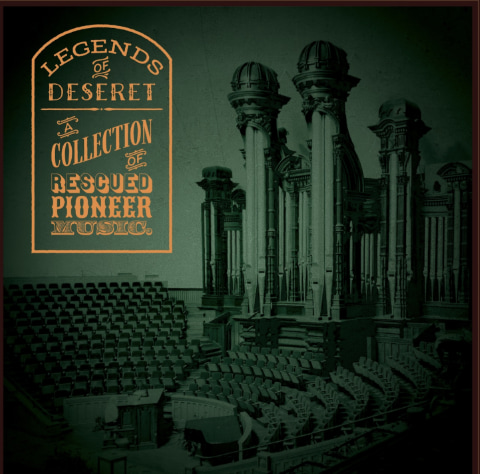
For the nineteenth-century Latter-day Saints, music was not merely a leisure activity; it was a spiritual and social technology used to raise the spirits of a people in an arid, isolated, and challenging landscape. In a remarkable new recording project titled “Legends of Deseret: A Collection of Rescued Pioneer Music,” published by Tantara Records, BYU Trumpet professor Randy Lee brings a forgotten chapter of this musical heritage to vibrant life.
As someone who has spent considerable time “geeking out” over the history of Latter-day Saint artistic culture, I found this album to be a fantastic project and historical resource. Lee has done the gritty archival work that historians dream of, uncovering original 19th-century manuscripts in the Daughters of Utah Pioneers (DUP) museum and the Church History Library and bringing them to life on the stage. The result is a sonic bridge that spans nearly 175 years. And I found the music itself to be genuinely enjoyable.
Rescuing the Masters: Thomas and Careless
The project highlights the work of two English-born converts who served as the architectural anchors of early Utah music: Charles John “CJ” Thomas (1832–1919) and George Careless (1839–1932). Both men were classically trained in London before gathering to Utah, bringing with them a professional polish that Brigham Young was eager to utilize.
The music Lee has rescued is primarily in the style of late nineteenth-century European dance music—polkas, quadrilles, and redowas—reflecting the sophisticated ballroom culture these men left behind in Victorian England. Some of my favorites included:
-
“The Geranium Polka” (1851): One of Thomas’s early London hits, this orchestral piece harkens back to elegant balls and dapper gentlemen. Its prominent cornet role and triple-tonguing are handled masterfully by Lee and the BYU Philharmonic.
-
“Violette”: A charming, handwritten manuscript of Thomas’ music found in the DUP museum, this piece showcases a rare instrumentation (flute, clarinet, violin, cello, and cornet) that feels like an intimate glimpse into a long-lost stage production. (I also felt like this is the type of music that Walt Disney was using for nostalgia on Main Street Disneyland.)
-
“La Mandolina”, Spanish Dance: A catchy fandango in three that Thomas likely arranged from a popular tune of the day, featuring delightful compositional embellishments.
The Capstone March and Temple Square
The album’s undisputed historical highlight is “The Capstone March” (1892). Dedicated to the First Presidency by C.J. Thomas, this march was performed by John Held’s Military Band during the legendary Salt Lake Temple capstone ceremony before an audience of some 40,000 people.
Intriguingly, the score was reportedly deposited inside the temple capstone itself—the very ball upon which the Angel Moroni stands. When the capstone was opened in 2020 for renovations, many artifacts were found damaged; fortunately, Lee was able to utilize a surviving score from the Thomas collection in the DUP to record this version with the BYU Wind Symphony. With the Salt Lake City Temple’s open house approaching this next year, this track feels especially significant as a tangible connection to the building’s original dedication.
A Note on “Faith in Every Footstep”
From a strictly historical perspective, I question the inclusion of “With Faith in Every Footstep.” K. Newell Dayley wrote this piece in 1997 for the sesquicentennial celebration of the Saints’ arrival in the Salt Lake Valley. While it is a modern anachronism on an album otherwise dedicated to “rescued” 19th-century works, the 2025 arrangement is a lovely tribute to the legacy of the composers featured elsewhere on the disc. Latter-day Saints will enjoy this performance of a hymn that was recently added to their hymnal.
Conclusion
Lee’s project is a masterclass in how to combine academic research with artistic performance. (Frankly, I am jealous and would love to be able to do a project like this.) By recording these works with BYU ensembles, he has ensured that this music is no longer just a series of “silent” notes in a museum box. It is a joyful, toe-tapping reminder that the pioneers were a people of profound culture and skill. For anyone interested in the lived experience of early Utah, Legends of Deseret is an essential listen.
Comments
3 responses to “A Review: Legends of Deseret Album”
Violette was probably written for that combination of instruments because it was the composition of the ensemble he was writing for. See the 1868 Salt Lake Theatre Orchestra (as pictured in the Juvenile Instructor of April 1924): https://archive.org/details/juvenileinstruct594geor/page/175/mode/1up
Are there some liner notes anywhere?
They have some that are going through final proofs. I know that they will be releasing them with the physical CDs. They have put a PDF of liner notes with the digital versions of previous albums, so I’m hoping they will just add those retroactively.