
Unlike my recent posts about members and masturbation and abortion that leveraged the 2015 Relationships in America Survey with a relatively large subsample of Latter-day Saints, a lot of ink has already been spilled on the issue of Latter-day Saints and pornography use.
The Mormons-as-hypocritical-pornography-users canard started with a single, early (2009) study that showed Utah was the number one pornography using state. However, that was one study using a particular dataset drawn from a particular paid subscription company when the vast majority of porn is freely available, so it probably wasn’t representative; additionally, when the data was broken down by county it became difficult to argue that it was a Mormon thing.
As additional datasets have become available it has become increasingly clear that Utah is one of the lower pornography using states per capita. I’m not going to rehash the whole history of the pornography-using Mormon boogeyman, but this is a good summary, and at this point you kind of have to want it to be true to still think that Latter-day Saints consume more porn than other people. Like how the age of fossils doesn’t rely on one dating method but multiple that all confirm each other precisely, various forms of evidence all point towards Latter-day Saints consuming less porn than average.
However, to my knowledge nobody has tested Latter-day Saint pornography use using self-report. The Relationship in America Survey asks “When did you last intentionally look at pornography?” For frequency questions it’s been shown that the “when did you last do X” is a more accurate way to gauge frequency than a direct “how often do you do X” question, under the premise that sure, you might have just looked at porn for the first time in years yesterday, but all things being equal the last time you looked at it is probably strongly related to how frequently you do.
So what do we find?
Pornography Use by Gender and Latter-day Saint Status (%)
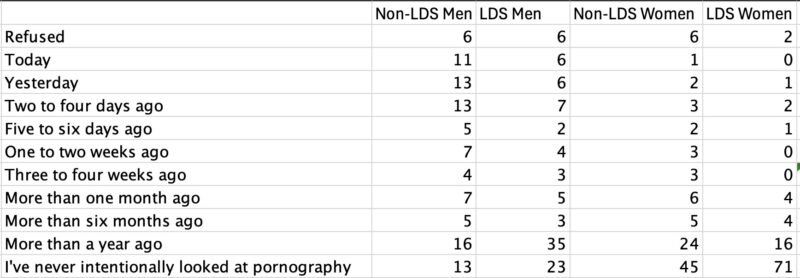
This is one of those inkblot test results. One can easily look at this and say “ha, 3/4 of Lattter-day Saint men have intentionally looked at pornography at some point in their life!” And that would be true. However, one could also point out that Latter-day Saint men watch pornography much, much less than their non-Latter-day Saint counterparts. Specifically, while more than half of non-Latter-day Saint men have intentionally looked at pornography in the past month, about half as many Latter-day Saint men have. If we say that somebody who looks at porn every day or two is a porn addict (fine, fine, “problematic compulsive use” if the phrase “porn addiction” triggers you), then that’s probably about one out of ten Latter-day Saint men.
Of course, a quarter of Latter-day Saint men in the past month, and one tenth as more habitual users isn’t great, but it’s clear that the narrative that pornography use is caused by religious repression doesn’t really pan out (honestly, people coming up with convoluted psychoexplanations for why men view pornography are way overthinking it).
Of course, women look at pornography too. (Occasionally you run into people who are uncomfortable with the fact that female sexuality is different, but it is, and there is a cartload of evidence for that fact, it’s not all just gendered double standards and response bias). Still, here about one out of seven non-Latter-day Saint women have intentionally looked at pornography in the past month, while for Latter-day Saint women it’s about one out of 25.
So, while there is obviously too much pornography use going on among members (especially men), like masturbation it’s not ubiquitous like some like to imply, and the Church’s anti-pornography messaging and emphasis is probably leading to less pornography use, and not, in some weird Freudian reaction, more.
Comments
22 responses to “How Many Latter-day Saints View Pornography?”
Another interesting post, again suggesting that religious teaching does affect behavior. Did the survey offer any kind of definition of pornography, or did it just expect respondents to know it when they see it?
No, it was a “know it when I see it” kind of thing. It is in fact famously hard to define for all of us, not just Supreme Court justices.
I was just made aware that Mormonr has a piece on the Utah porn myth that is another good source (and has some additional studies), so in the interest of listing all the Utah/LDS porn studies in one place, here are a few more: https://mormonr.org/qnas/y4j20/masturbation#q-vd6aC75fvRg05KO0Xs80.
(First off—heads up that I no longer attend an LDS church, and haven’t for nearly three years. I just pop by now and then out of curiosity.)
Honestly, this isn’t particularly surprising to me. I don’t think I’ve seen any actual evidence beyond the paid subscriptions that the numbers are higher. The only actual data I’ve seen just suggests that levels of *distress* about pornography are much higher among conservative religious groups, which makes more sense.
On that note, I have wondered in this and the other surveys how useful the LDS v. non-LDS distinction is, given how diverse the second group is. There are definitely enough members of other very conservative religious groups (or just with very conservative upbringings within broadly more liberal denominations) to contribute disproportionately to the 30% of men who haven’t masturbated in the last month, for instance—I suspect it would be higher if you excluded all the other groups who are actively trying not to.
I also just tend to doubt whether, even if you think these are practices worth discouraging*, the cost is actually worth it. Having adult men question children (often alone in a room together) about whether they masturbate or watch pornography is crazy, and would be viewed as creepy and abusive in any other context. The general culture of sex-negativity (token paeans to the goodness of marriage notwithstanding) can also backfire badly when people actually marry. My own partner and I both grew up LDS, and it seriously messed up our ability to have a healthy sexual relationship or even talk about it openly for years. I often think about how much easier it would have been if one of us (especially her) hadn’t been raised with that messaging. I normally have pretty warm feelings towards my upbringing—this is the one thing I feel really, deeply bitter towards the church about. Obviously it doesn’t hit everybody the same (I knew plenty of male missionaries who were bull-headed enough to basically just ignore the messaging) but it can be pretty bad. I don’t know if messing up children’s self-perception and view of sex for decades is worth it so that you can feel proud about your kids not masturbating or watching porn or whatever.
*I don’t see any problem with masturbation, and honestly found the stat about more than half of all LDS women never having even tried it more than a little sad, but I’m also generally not a fan of pornography—it tends to really lean into and promote a lot of quite bad sexist and patriarchal stereotypes.
“The only actual data I’ve seen just suggests that levels of *distress* about pornography are much higher among conservative religious groups, which makes more sense.”
That’s true.
“On that note, I have wondered in this and the other surveys how useful the LDS v. non-LDS distinction is, given how diverse the second group is.”
That’s also true to an extent. If I were doing a full-fledged article I’d also look at religiosity to see how much of the LDS effect is really just a proxy for that (controlling for religiosity we might be more likely to look at porn for all I know), then throw in the standard controls, etc., but for stuff like this the top level, zero order “Do LDS look at porn a lot relative to others” is interesting in its own right.
“The general culture of sex-negativity (token paeans to the goodness of marriage notwithstanding) can also backfire badly when people actually marry.”
I have no doubt this happens, I’m not doubting your valuable personal experience, and organized religion isn’t perfect in how they handle the erotic (it could be less guilt-based, especially back in my and probably your day), but nowadays I think that in the aggregate people tend to overplay the “religious people are debbie downers about sex and it messes them up” line. Having religious parameters can have its sexual benefits. Of course some people’s wedding nights weren’t great, but on the whole it probably works out better as a first time than the backseat of a car after being pressured by a JV high school football player. I suspect that the 90s were peak libertinism-is-the-road-to-sexual-flourishing, but now even secularists are backing off from that. More quantitatively, me and others have found that religious tend to be more sexually satisfied than the non-religious (https://journals.sagepub.com/doi/abs/10.1007/s13644-019-00395-w). Also as an aside, using the same dataset as above I actually looked at whether members have more marital sex and they aren’t (hence no blogpost on that), but they’re not having less either.
More valuable would be a measurement of how many marriages are healthy, loving, and lifelong when pornography use of the spouses is not vilified and mutually understood to be an important tool in the individual and shared sex lives of the married couple. As a middle aged person in a very happy and healthy LDS marriage that has persisted for decades and grows stronger by the year, I can report that pornography has been a crucial component to our relationship for all the obvious reasons (differing libidos, stressful seasons, pregnancy/parturition/child-rearing, health issues, perimenopause/menopause, etc.). Many years ago we had some honest conversations with each other and decided to let go of accumulated religious shame and expectations…and presto! Seriously one of the best things we have ever done as a couple. Is this sinful or immoral? We absolutely can say it is not. We have a lovely and mutually respectful relationship, healthy and thriving kids all interested and active in the church, and an exciting sex life together that is fully ours and better now than in our 20s. We are your most basic looking church members in the pews, and nothing about us says anything but normal, boring, happy 40-50 somethings, because we are normal, boring, and happy.
I don’t know because I respect boundaries and I love for others to have their privacy and choices remain fully theirs, but I am guessing that many, many healthy and happy marriages are pretty much like ours, all across Utah and beyond. The broad brushstrokes of pornography use=evil/moral failure is too broad and unproductive. Unhappy marriages undermined by guilt, suspicion, and unaddressed biological realities are a far worse problem in my life experience.
Using pornography is sinful and immoral, also evil and a moral failure. If one spouse feels more libidinous, using pornography to raise sexual arousal even more does not make any sense whatsoever. People can quibble about lots of things, but not this. The Church’s hard stance against pornography is correct.
Jonathan Green,
So you gouge your own eyes out and self-castrate and have sold all you have and given to the poor? Of course you haven’t. And those are basic teachings of Jesus. You have compromises that don’t just work, but make your life better and sweeter than being completely indigent and at least partially without sight. Your extremism about pornography usage between two loving and committed MARRIED adults says more about your own issues than it does your religious convictions. People with your particular malady of compulsive self- and other-shaming make me sad. We’re over here living our best LDS lives, temple recommend holding, tithe paying, enjoying how all our kids have opted to embrace their faith and religious commitments, and not feeling the slightest bit evil about how pornography is part of our marriage. Seriously, I am flummoxed by the tone of scrupulosity in your response. Oh well, live and let live!
“The Church condemns pornography in any form. Pornography use of any kind damages individual lives, families, and society. It also drives away the Spirit of the Lord. Church members should avoid all forms of pornographic material and oppose its production, dissemination, and use.”
-General Handbook: Serving in The Church of Jesus Christ of Latter-day Saints 38.6.13
You can disagree with the church on the matter if that’s how you feel. But that’s literally the official position of the church. And I don’t think the church is going to take your pornography usage lightly, even if you and your spouse genuinely don’t think it’s harming either of you personally.
Here’s a basic teaching: “Whosoever looketh on a woman to lust after her hath committed adultery with her already in his heart.” If you think I’m judgy, wait till you get to explain the time you tried to persuade people that using pornography was good and healthy.
Assuming you’re real, I think there’s a good chance you’re setting yourself up for some massive problems down the road. You’ve persuaded your wife to ignore your porn habit and maybe indulge in her own. What happens when she starts feeling guilty after a talk at church or General Conference or a temple recommend interview? Libido is not the only thing that can be imbalanced in marriage; so can a sense of guilt. Are you going to prevent her from seeking guidance from the bishop? How does this play out when the bishop asks for your side of the story? If your marriage crumbles, for this or any other reason, how does your sophisticated take on pornography sound at a custody hearing?
Lusting after other women is not something that should be normalized as part of a healthy marriage. Husbands, love your wives. Your real wife, not some airbrushed fake or AI hallucination.
I think members would be surprised that porn partakers are typically allowed to hold temple recommends. (if it is not extreme or hurts the spouse) Masturbaters are as well. Not long ago, leaders/members in the church were allowed (required) to have multiple wives. If our minds and belief can tell us that having sex with multiple women in the name of religion is holy, then maybe using porn to help a marriage cant be all that bad. IMO. Maybe Brother Anonymous has found a good use for it. Some who view porn may lead to adultery. Some who view porn may prevent adultery. In a perfect world we all get married and comply to the churches policies 100%. I say policies because we used to be ok with multiple wives, drinking booze, smoking/chewing, not following the laws of the land etc. Now we are hell-bound for doing those same things.
Looking at a woman to lust is an important teaching to help us from committing the real (bigger) sin of fornication and adultery. Coveting is also a preemptive “bigger sin” stopper of say, stealing.
Lusting is not the sin of adultery anymore than wishing your neighbor was dead is as bad as actually killing your neighbor.
Bad thoughts is a sin but not the same as the sin of doing bad things.
Can I lust after my wife? Is it the lust part that is bad or just the other woman part bad? Both?
What is the bigger sin, Lust or hate? Porn or violence? Is divorce or porn the bigger sin?
There are degrees of sin that we all deal with. Zero sin is ideal but not realistic for most.
Even tho I would not live or suggest someone live the way Brother Anonymous does, I am happy that this is working for them and hope it continues to until they can live the higher law most commenters seem to be living.
Didn’t Hinkley say we (church leaders) probably should not have “vilified” viewing porn so much in a conference talk?
What about the no oral sex between married people teachings of the80s, that it was an impure and unholy sexual act? That stricture was never officially rescinded, and it came from the top leaders of the church. And what about the absolutist and frequently repeated condemnation of the evils of using birth control within a marriage? That has never been officially rescinded either, and it came from top leaders of the church for generations. By my moral calculus, these acts would have a case for being far more evil or immoral than a couple that utilizes pornography within their marriage. But I am guessing that Jonathan Greenwood and Matthew B have ignored both teachings for the good health of their marriage and because they have decided as married partners that they know best for their relationship. What is more, I am guessing that if they were totally honest, both would admit that one or both of those teachings from the highest leaders of the church were wrong and harmful. What accounts for this?
The intent of Jesus’ teaching is clear: we should not have sexual thoughts or feelings about anyone but our spouse. Now, like many of the teachings in the Sermon on the Mount, this is a star to steer by rather than a destination we should expect to reach in this life. I’m in no position to judge anyone. But Jesus’ promise is that he can make us perfect in time–if that’s what we want.
(Note that this is a commandment from the Savior in the scriptures. It is not comparable to some church leaders expressing their opinions on oral sex back in the 80s. Past teachings on birth control have been replaced by section 38.6.4 in the Handbook.)
That we are (or should be) completely dependent on our spouses to fulfill our sexual desires is a feature, not a bug. Sexuality is designed to help couples cleave to one another. Physical intimacy should be a profoundly vulnerable and unselfish encounter with a complete person: body, soul, and agency. And not just any person, but the person we will share our entire lives and our eternities with.
I can see how using pornography as a couple is far less destructive than using it alone, but it’s still separating sexuality from a complete relationship with a complete person.
On “porn addiction” vs. “problematic compulsive use”: if you want to help someone with a problem, it helps to have an accurate understanding of the problem. Sometimes the details don’t matter: the Church’s Addiction Recovery Program works well for many people struggling with pornography because, despite the name, its approach isn’t specific to addiction. It’s really about crowding out darkness with the light of Christ. But it can help to have some understanding of the unique neurochemistry associated with sexuality, which is not the same as the neurochemistry associated with classic addiction. For example, the “drop” that some people experience after using pornography has a neurochemical component, and it shouldn’t be taken to mean either “Religion has ruined my ability to enjoy a harmless pastime without shame!” or “Now that I’ve realized how awful porn is I’ll never be tempted by it again!”
It seems to me that some people are invested in pornography being “addictive” because they think that will make it sound scarier to youth. But we need to be worthy of their trust–the last thing someone who is striving to repent of problematic pornography use needs is to think “Wait, I’m not experiencing withdrawal symptoms. Were they lying to me about pornography being addictive?” The real consequences of using pornography should be persuasive enough if we teach them clearly.
That stricture [on oral sex] was never officially rescinded
The “stricture” was contained in a single letter to bishops and stake presidents in the early 80s. You can search the Church website from front to back and you will not find that letter or any reference to it. The vast majority of adult members have never heard of it and I suspect that most would not believe you if you claimed, in their presence, that it was ever issued. Even during the single recommend interview that I underwent while it was in effect, the bishop was unwilling to say it out loud and it was not until I saw a copy of the letter years later that I finally understood what he was talking about. I don’t know precisely how the letter was rescinded, but I can think of few things during my lifetime (perhaps the POX) that have been promulgated and as thoroughly rescinded as that letter.
If your response to extremely clear teachings and scripture about pornography is whataboutism, then your capacity for moral calculus is badly impaired and I wouldn’t rely too heavily on it. This isn’t the odd cup of coffee we’re talking about here, but pornography. An industry that exploits the most basic human instinct, selling a promise of unlimited sexual pleasure without negative consequence and sexual congress severed from human and eternal relationship. You can’t consume it without letting it rewire neural pathways that affect how you see and relate to everyone you know.
I don’t care about your failings and imperfections; there’s a whole plan for that. But promoting marital pornography use as some kind of solution? That’s a load of cr*p, and it’s a giant red flag that you can’t see it.
If Brother Anonymous and his spouse were swingers to keep the marriage going then the stones being thrown here may be more justified. Porn in a marriage may not be the gospel plan, or any marital plan, but if it is not keeping them from the temple then I think his view on how it works for them is warranted. He is clearly not suggesting that everyone should live this way.
To Last Lemmings point, in the past there were lots of official policies that were only privy/sent to Bishops and up. Not sure if that is still a thing or not. Some of these letters sat around for years leaving leaders to wonder if they were still a thing. A couple that come to mind is the “no children bearing testimonies in sacrament, not asking members to turn to scriptures during there talks in church, not using props of any kind during your talks in church. (these were all read over the pulpit but it makes my point) Are they all still valid?
If coffee/booze keeps you out of the temple but porn doesn’t……hmmm….
I am not saying porn is NOT a sin but just saying that it may not be a serious sin in the churches view, anymore.
I am saying coffee/booze/smokes is not a sin and should have never become such IMO. Anyone eat meat this last summer and still got a temple rec?? I have a stone to throw at you! ;)
Any current YSA bishops or SP in here? I have heard there are no councils (or whatever they are called now) for YSA’s who fornicate. Maybe for habitual fornicators there is?
Yikes! You guys are rough here. But that’s OK, it’s your space. About that oral sex letter—you may be right that it was but one letter. It had a long afterlife however. I heard Randy Bott teach it at BYU with my own ears, and before that may home bishop do the same. It wasn’t unknown, not in the slightest. Literally thousands of Bott’s students must have heard it taught for probably 20-30 years. And I believed him and trusted him. Why wouldn’t I back then? My spouse, they got the same teaching at Rics multiple times in multiple religious education courses. They believed it too, as did thousands of others through the 80s and 90s and beyond. So don’t act like it was a fringe thing. We both entered marriage with the baseline understanding that it was absolutely a sin for married couples. YMMV.
I notice that Jonathan didn’t respond to my question about why he presumably has ignored the generations long teachings against using birth control. He dismissed it as whataboutism. That’s a dodge. My guess is that he and his wife decided to ignore or adapt those very, very strict and precise teachings that came straight from the very highest authorities. And I also guess that he and his wife have taught their children to do the same. Creating life and bringing children into existence is like a million times more impactful a moral decision than pornography use in a marriage. So why ignore the teachings about the one and be so absolutist about the other?
As for marital pornography use, I think you overestimate or are engaging in some lurid imagination about what that might look like in a long term marriage. We are not young! We can barely stay awake past 9:30, and neither of us has any extra energy for anything crazy. Someone mentioned swinging! LOL. Ew, just no. Erotic material in our marriage is more like an aid, or accelerant, or helpful shortcut when that is beneficial. And, Jonathan, you do realize that most people have very basic desires and have the opposite of the kind of reactions to exploitative stuff you seem to imagine comprises all pornographic or erotic material? Your response seriously gives me the creeps.
I think some talking at cross-purposes is occurring here. Maybe I can craft a few Q&As on which there might be universal agreement…
Does the church counsel its members to avoid pornography? Yes (well, yes in the recent past but not as much lately).
Is viewing pornography a sin? Maybe, maybe even probably, but inasmuch as the current handbook states that viewing pornography is not a basis for church discipline, I suppose it is not a major sin. Our scripture is silent on the matter, and God has never provided a complete list of all possible sins especially for private matter — indeed, God’s concept of sin may differ from the church’s concept (and the church’s concept may change with time), and the church’s concept may differ from an individual member’s concept (which also may change with time). For a great many matters, especially small matters, the same identical action might be a sin for one person in a particular circumstance and might not be a sin for a different person or a different circumstance.
Can one who views pornography hold a temple recommend? Yes, at least since the change in questions in 2019; provided, the applicant can affirm that he or she is striving for moral cleanliness. Viewing pornography might be unclean and/or unchaste, but is not a violation of the church’s Law of Chastity.
JI, that’s an atrocious attempt at a summary. The position of the Church remains: “The Church condemns pornography in any form. Pornography use of any kind damages individual lives, families, and society. It also drives away the Spirit of the Lord. Church members should avoid all forms of pornographic material and oppose its production, dissemination, and use.” You’re collapsing the vast distance between “doesn’t need to face a formal disciplinary council” and “worthy to enter the temple.”
Scripture is absolutely not silent on this; please review the Sermon on the Mount if you are unfamiliar with it.
People have a way of remembering the past to suit the needs of whatever argument they’re engaged in online. I don’t know precisely what age this anonymous is intending to depict, but the target seems to be a bit younger than my own. And yet I never heard of the letters he claims were famous despite all my BYU religion classes, or the strict and precise teachings supposedly coming from the top. You could fill prescriptions for birth control pills on campus at BYU by the mid-90s at the latest, and likely earlier.
Birth control is also an entirely separate issue, and has no bearing on this discussion. I haven’t met anyone whose life was ruined through use of birth control. I could point out several lives ruined by pornography. It has as much place in marriage as huffing glue has in your weekly meal planning.
I suspect it’s things like this letter that prompted the Church to tighten up what counts as an official Church position and be more transparent about those positions–in particular by making the Handbook public. We could quibble about what exactly is official, but “Something my institute teacher said was in a letter 40 years ago” clearly is not.
Want to know the Church’s actual position on pornography or birth control? Read section 38.6 in the Handbook, “Policies on Moral Issues.” (All members really should be familiar with 38.6.) Want to know if fornication will lead to a membership council? Read chapter 32 in the Handbook. Want to know the Church’s position on oral sex? Read 38.6 and note that it’s not there. Check the scriptures, the Family Proclamation, For the Strength of Youth (unlikely), recent general conference talks, the Church website, and anything else you might consider authoritative; note that it’s not there either. Conclude that the Church has no position on oral sex. Because if it did, it would put it somewhere that we’re encouraged to read.
It’s not entirely cut and dried–the status of old conference talks is pretty ambiguous, for example. But it’s not nearly as opaque as you’d think from the discussion here.
Upon reflection on this thread, I have edited my Q&As…
Does the church counsel its members to avoid pornography? Yes
(well, yes in the recent past but not as much lately).Is viewing pornography a sin? Maybe, maybe even probably (especially considering the Lord’s instruction in Matthew 5:28), but inasmuch as the current handbook states that viewing pornography is not a basis for church discipline, I suppose it is not a major sin in comparison with some other sins. The church does not equate viewing pornography with actually committing adultery.
Our scripture is silent on the matter, andGod has never provided a complete list of all possible sins especially for private matters — indeed, God’s concept of sin may differ from the church’s concept (and the church’s concept may change with time), and the church’s concept may differ from an individual member’s concept (which also may change with time). Fora great manysome matters, especially small matters, the same identical action might be a sin for one person in a particular circumstance and might not be a sin for a different person or a different circumstance.Can one who views pornography hold a temple recommend? Yes, at least since the change in questions in 2019; provided, the applicant can affirm that he or she is striving for moral cleanliness. Viewing pornography might be unclean and/or unchaste, but is not a violation of the church’s Law of Chastity.
I appreciate the discussion.