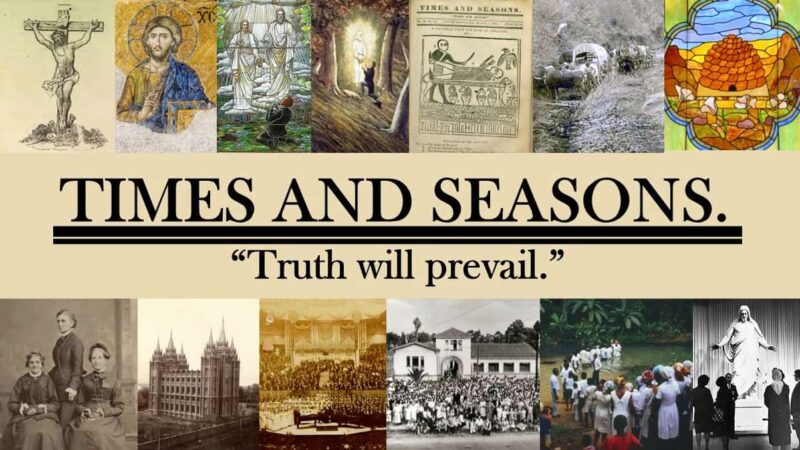
Mystery seeking is an essential part of Mormonism’s founding narratives. Part 2 of a three-part series beginning with What Can We Learn from Visions of Glory?
Speculating about the afterlife is integral to who we are as Latter-day Saints. The Church’s proselytizing program puts questions about “our Heavenly Father’s plan” in the center of its curriculum. In part 1 of this short series, I introduced Visions of Glory—a book whose protagonist, “Spencer”, depicts elaborate visions about the spirit world and the end-of-times, and is suspected to have inspired recent Mormon ne’er-do-wells.
The head-scratcher is that Spencer appears to have been heeding what he believed Church leaders were teaching—and the project got away from him.
Simply denouncing the book, however, preempts the opportunity to understand how it came to exist in the first place. In 1830, Joseph Smith’s Book of Mormon introduced his followers to the first extra-biblical peek into the afterlife: .
.. there is a space between death and the resurrection of the body, and a state of the soul in happiness or in misery until the time is appointed of God… The soul shall be restored to the body, and the body to the soul… Alma 40: 21, 23.
Two years later, Joseph gave the Saints the following revelation:
I, the Lord, am merciful and gracious unto those who fear me… And to them will I reveal all mysteries, yea, all the hidden mysteries of my kingdom… Yea, even the wonders of eternity shall they know, and things to come will I show them, even the things of many generations. D&C 76: 5, 7-8
Joseph pursued these mysteries vigorously throughout his life and encouraged his followers to do likewise.
In 1844, Parley Pratt wrote and presented a short story called The Angel of the Prairies to the secretive Council of Fifty. Pratt’s story is fiction but cast in the mold of a florid vision. It tells of a young New Englander exploring the West beyond the Mississippi river. An angel appears and invites him to see the future of the frontier. Together the young man and the angel fly across the prairies; he is given a “glass” through which he’s able to see “the entire country from sea to sea”, and is shown a panoramic picture of history.
By this point, the Saints had endured a decade of religious persecution, and Joseph’s “general council” was investigating options for moving the Church outside the borders of the United States. Thus Pratt’s story reads like an early Mormon dream-come-true: his explorer watches as the “seat of empire”—the focal point of global influence—moves from ancient Egypt to Rome, then to Europe, then to the United States, and finally, rests in the West with the Saints:
I beheld an immense city, extending on all sides and thronged with myriad’s of people, apparently of all nations. In the midst of this city stood a magnificent temple, which in magnitude and splendor, exceeded everything of the kind before known upon the earth. … ‘This,’ said the Angel of the Prairies, ‘is the sanctuary of freedom, the palace of the great King, and the center of the universal government.’
Prairies is run through with Book of Mormon and Nauvoo allusions: mists of darkness, Native Americans elevated to glory, secret passwords, and a “Grand Presiding Council” holding the “keys of power to bear rule”.
One year later, Joseph’s scribe William Phelps introduced a similar work, curiously named Paracletes. Translated as “Advocate” or “Comforter”, the word “parákl?tos” is Greek and appears in the New Testament. Phelps’ story is short and ambitious—it depicts the Mormon “plan of salvation” as played out on one of the universe’s many worlds: Idumea. According to Samuel Brown:
Essentially all of the critical [Mormon] beliefs are present in the story: a plurality of anthropomorphic Gods led by one called the ‘head’ of the Gods, divinized humans, the equivalence of angels and humans, an interconnected Chain of Being comprising planets, epochs, and godly beings without beginning or end, and a supernatural Adam who took stewardship for earth’s creation and its inhabitants in collaboration with other Gods.
As Brown suggests, the story’s title invokes a vision of a “multiplicity of kingdoms, or spheres for action”, where every individual is on a path to godhood.
So much of Mormon literature has continued to develop these themes: Added Upon, written by Nephi Anderson in 1898, was one of the earliest and most popular LDS fictions to depict our pre- and post-life existences. Anderson’s novel promotes a doctrine Mary Lightner claimed Joseph Smith taught her privately: “I was his before I came here. … I was created for him before the foundation of the Earth was laid.”[1] Joseph did not originate the notion of “spiritual affinities” or “kindred spirits”—concepts that inspired Added Upon, Saturday’s Warrior, My Turn on Earth, and many others—nor did he live long enough to formalize the doctrine in scripture.
Meanwhile, Church leaders have taught about the dangers of spiritual freestyling since the Church’s founding. In 1852, Brigham Young drove a wedge between those living the “simple, unadorned truth” and those who “desire to know a great deal of the mysteries”. He advised those straying from the “body” of the Church to “let mysteries alone”.
Ironically, in the same speech, President Young introduced the now infamous and confusing Adam-God theology: “One thing has remained a mystery in this kingdom up to this day… [Adam] is our Father and our God, and the only God with whom we have to do.”
I understand standard Mormon objections: President Young has the right to talk about whatever he wants; Paracletes is just a story. But as Abinadi Pratt of the Deseret News said about Parley Pratt’s Angels:
The thrilling and interesting narrative contained in this little book, though setting up no claim to being an authentic or infallible prophecy, yet probably contains as much condensed truth and as little fiction as any work in any age…
So long as we continue to use personal revelation to understand our place in God’s plan, our Mormon doctrines—top-down and formally constituted—will remain in tension with bottom-up speculation and charismatic spiritual experiences.
(Part 3 will weigh spiritual risks and rewards and directly address the subject of revelatory guardrails.)
- Compton, In Sacred Loneliness, 212
Comments
11 responses to “What Can We Learn from Visions of Glory? Part 2”
This reminds me of a number of quotes. Brigham Young said that before joining Mormonism, he was frustrated with a popular Methodist preacher, Lorenzo Dow, for preaching “only morals” and not mysteries. I found some early quotes on Mormon success on the attracting converts who wanted such things.
In his introduction to his publication of John Dee’s secret spirit diary, Meric Casaubon, condemned Dee and Plato for seeing out such mysteries. “Plato’s writings are full of Prodigies, Apparitions of Souls, pains of Hell and Purgatory, Revelations of the gods, and the like.” Aristotle was better “because he did not think that it was the part of the Phylosopher to meddle with those things that no probable reason could be given of.”
Joseph Smith was staunchly on the mystery side. “I cannot believe in any of the creeds of the different denominations, because they all have some things in them I cannot subscribe to though all of them have some thruth [sic]. but I want to come up into the presence of God & learn all things but the creeds set up stakes, & say hitherto shalt thou come, & no further.—which I cannot subscribe to.” October 15, 1843
It also reminds me of a conversation I had on my mission with a woman who’d converted a while before and was interested in a book Deseret Book was selling on what the gospel teaches us about aliens. My comp and I weren’t really into it and one of us said something about this not being necessary for salvation. “Don’t tell me that!” she fired back. “That’s why I left the Baptists because they were always saying that.”
So … where are the boundaries?
These stories are certainly relevant to understanding the context of Visions of Glory, but there’s a big difference between a fictional speculative story and a purported revelation. A speculative story invites the reader to evaluate each element of the story for truthfulness. A purported revelation invites the reader to evaluate the revelation itself–who received it, the circumstances of its reception, etc.–and if they accept the revelation as authentic then they accept all of its elements as truth.
(This almost shouldn’t have to be said, but the rules for evaluating purported revelation ought to be familiar to every Church member and Visions of Glory obviously breaks them.)
Stephen and I must have been writing at the same time and my final parenthetical was not meant to dismiss his question about boundaries. I do think it’s pretty straightforward though.
I’m always down to discuss what the gospel tells us about aliens. I could imagine writing a fictional story based on my speculation. You could then evaluate whether you think I got it right. I could even publish it.
If told you to keep it quiet, but I’d received a revelation about aliens, you should be skeptical. But it might be true.
If you asked me if you could publish my revelation about aliens to the Church and I said yes, you should think “Uh oh, this person either doesn’t understand or doesn’t accept how revelation actually works. I’ll bet his revelation isn’t real anyway.” Real revelation to the Church comes through established channels and follows established procedures.
If you think the Holy Ghost is telling you to publish my revelation to the Church, you’re wrong. If I claim a General Authority told me I could publish it to the Church, I’m wrong. Maybe it was a misunderstanding, or maybe I’m being deceptive. In the unlikely event a General Authority actually said it, he didn’t have the authority to do so and it’s still meaningless.
Every member of the Church knows, or ought to know, 1) who they can receive revelation for, and 2) who can receive revelation for them. Any purported revelation that breaks those rules, whether it’s personal or something like Visions of Glory, is a mistake. We all make mistakes, even about revelation we receive, and those rules limit the consequences of our mistakes.
Translatio imperii culminating in Deseret. Great stuff.
RLD, I’d qualify that a bit. If a person is claiming to receive revelation, then it does present an urgent problem of authenticity. But if some form of media claims to record revelation, people are pretty capable of treating it as interesting, while deferring any decision about its authenticity.
I suspect that most revelations and visions, including canonized ones, including the first vision, only give us an infinitesimal glimpse. And the light from that sliver, we necessarily perceive it according to our own understandings and dispositions.
It may feel so real, that we assume it must be universal and want to proclaim it far and wide, when really it’s tailored to us, to help us learn our next line or precept.
I can believe that none of the descriptions in D&C 130 are literal, while still believing that they are true and finding meaning and learning. Sometimes, to our peril, we forget the nature of symbolism.
bhbardo, your questioning the universal applicability of a person’s revelation rings for me. Strange religious experiences are foundational to many people’s connections to God, and being flexible as you’re arguing takes pressure off us for demanding authenticity.
RLD, thanks for the comments. Aliens and the gospel _does_ sound fun! The truth is Church members and leaders *alike* wrestle with revelation and uncertainty. Joseph Smith exhibits this throughout D&C (e.g. 46:7). Wilford Woodruff felt inspired to enact the 1890 manifesto, while simultaneously doubting it as a revelation.
Jonathan, can you say more about the difference between the urgency of a personal encounter vs. a recorded manifestation?
Kendall, I’m just thinking about the visionary texts and popular prophecies from my research. It’s common to talk about how a text constructs its own authority, but with this kind of material, another strategy is to diminish their own authority. A text that successfully claims to record a vision of urgent importance for the whole world can contribute to the author getting canonized, but if it fails, the text gets suppressed or declared heretical and potentially multiple people end up in trouble. So raising the stakes is a high-risk strategy that often doesn’t pay off.
On the other hand, a text can instead claim to have been recorded long ago in a distant land or make other moves to lower the stakes of its authenticity. It might still seem interesting and relevant to the current situation, but represent less of a potential challenge to whoever certifies textual acceptability. It’s never going to get mass distribution as canonical literature, but it has a better chance of avoiding censure.
And to get back to your question, I think it’s a lot harder for a living human being to pull off the low-stakes strategy. It’s hard to say you’re seeing visions of the afterlife without implicitly making the claim that you have extremely valuable information that everyone should listen to. It’s hard to avoid raising all the concerns RLD mentions.
I haven’t read VoG so I can’t say much about it specifically, but if it had claimed to have been recorded in the 19th century and to have been discovered only recently, my guess is that it probably could have avoided a good amount of controversy.
That’s super interesting, Jonathan, thanks. The more concrete the prophecy, the riskier. I hadn’t thought about the impact that recency has on risk as well.
I have watched the fear and “prepperism” that Visions of Glory has in many of its readers. This issue should be addressed. I have good friends who are now cashing out their 401k’s to hunker down in preparation for the Second Coming. Others have moved away from Utah, which apparently will be the epicenter of destruction, leaving their friends and family behind. I have some serious concerns about this book.
I’m suspicious of “mysteries” that have to do with the latter-days. There’s a lot of low hanging fruit there that anyone can get there hands on. But what about the mysteries of the Kingdom? Or the doctrines of the priesthood? Or the wonders of eternity? It’s not as easy to come up with stuff on those topics.
That said, I think the primary reason why we don’t hear as much about the real mysteries is because those who know them don’t talk about them–and conversely, those who would talk about them don’t know them.
“On the other hand, a text can instead claim to have been recorded long ago in a distant land or make other moves to lower the stakes of its authenticity.”
That checks out: The Book of Mormon follows that pattern, and the missionaries do indeed encounter people all the time who say they like it and it contains truth, but they don’t accept Joseph Smith as a prophet or have any interest in joining the Church he restored. Of course then the missionaries tell them they’re being logically inconsistent, and if they believe The Book of Mormon is true then they should accept Joseph Smith as a prophet. I don’t know if that affects members’ responses to something like VoG or not.
@Jack: What bugs me about end-times speculation is that it rarely prompts people to do good. Sure, there’s a bit of “stay faithful or else,” but it mostly congratulates people for being part of the elect and tempts them to rejoice in the imagined suffering of everyone else. Pondering any of the other mysteries you mention is much more likely to inspire the ongoing mighty change of heart.