Nielsen, Chad L. A Barn Full of Angels: The Spiritual World and Pioneer Journey of Zerah Pulsipher. Greg Kofford Books, 2026.
[Our very own Chad Nielsen]!
A Barn Full of Angels: The Spiritual World and Pioneer Journey of Zerah Pulsipher explores the extraordinary life of an early Latter-day Saint whose faith was shaped by visions, spiritual encounters, and unwavering conviction. Born into the religious ferment of early nineteenth-century America, Zerah Pulsipher experienced what he believed were visitations from angels, confrontations with unseen powers, and personal revelations that guided his conversion to Mormonism. From a defining vision in his barn that confirmed the Book of Mormon to a lifetime immersed in an “enchanted” spiritual world, Pulsipher’s story offers a rare window into how ordinary believers understood heaven, hell, angels, and demons as active forces in daily life.
At the same time, this deeply researched biography situates Pulsipher within the gritty realities of the Latter-day Saint pioneer experience. As a president of the Seventy, missionary, migrant leader, and family patriarch, he helped translate prophetic vision into lived reality—organizing mass migrations, enduring persecution, navigating plural marriage, and building communities across the American frontier. Written with both empathy and critical rigor, A Barn Full of Angelspresents Pulsipher in all his complexity: faithful yet flawed, visionary yet pragmatic. The result is a compelling “history from the middle” that illuminates the spiritual imagination, institutional growth, and human costs of early Mormonism through the life of one remarkable man.
Crosby, Richard Benjamin. Latter-day Eloquence: Two Centuries of Mormon Oratory. University of Illinois Press.
The epic story of the Church of Jesus Christ of Latter-day Saints cannot be told without including its dedication to speechmaking and eloquence. Richard Benjamin Crosby and Isaac James Richards collect important speeches from a broad range of sources that highlight the history, diversity, and centrality of public speaking in Latter-day Saint life. An expert introduces each speech while offering perspective on its place in Latter-day Saint history. The collected works express a diversity of viewpoints and experiences at odds with the notion that Latter-day Saints speak in a single voice while declaring the significance of the Latter-day Saint faith in their lives. Essential and one-of-a-kind, Latter-day Eloquence provides a foundational reference for the study of Latter-day Saint rhetoric and oratory.
Haws, John Ben. Richard Lyman Bushman: A Mormon Ambassador. University of Illinois Press, 2026.
As a historian, theologian, and mentor, Richard Lyman Bushman greatly influenced the shaping of how those inside and outside the Church perceived Latter-day Saint history. J.B. Haws’s examination of Bushman’s life and thought tells the story of a scholar with a foot in both the LDS faith and secular society, and his efforts to bridge their two very different worldviews.
Bushman integrated his acquired fluency and comfort inside academia with his native understanding of the Church of Jesus Christ of Latter-day Saints. In his work, he translated, interpreted, and explained the LDS faith to the wider world. His professional status strengthened his arguments for an honest, transparent, and responsible approach to Church history. His devoted religious practice convinced his co-religionists of his sincerity. To his academic colleagues, Bushman advocated for a religious perspective in scholarship, while widespread respect for his work opened the door to his ideas.
Perceptive and illuminating, Richard Lyman Bushman explores the far-reaching contributions of an important LDS historian, theologian, and teacher.
Jones, Meg Leta, and Joyce Zhao. “Computing Kinship: How Genealogy and Religion Shaped Our Digital Infrastructure.” Technology and Culture 67, no. 2 (2026): 403-431.
Accounts of digital infrastructure have privileged corporate, military, and countercultural origins, but this article identifies genealogy and religion as central—if overlooked—sites of infrastructural innovation. Focusing on twentieth-century developments among microcomputer hobbyists and the Church of Jesus Christ of Latter-day Saints (LDS Church), the article draws on archival analysis of hobbyist newsletters and Church publications. It shows how genealogists built nationwide networks, negotiated technical constraints, and helped shape durable data standards and systems for networked information sharing. By demonstrating how Mormon theology materially informed system design and implementation, the article reframes digital infrastructure as an outcome of domestic, religious, and kinship practices rather than Silicon Valley alone.
Byman, Daniel. American Pogroms: How Forgotten Massacres Shape America. Oxford University Press, 2026.
This book opens with the 1903 Kishinev pogrom as a lens for understanding the roots, nature, and enduring impact of communal violence, showing how pogroms emerge when dominant groups seek to reassert control over minorities amid social change. It traces the spread of mob violence across American history—from anti-Mormon and anti-Catholic riots to massacres of Black, Chinese, and ethnic Mexican communities—revealing how elites, media, and myths of self-defense repeatedly justify terror against those who challenge racial and religious hierarchies. The book defines pogroms as one-sided, mob-led assaults that advance political and social control and argues that such violence, often condoned by authorities, reshaped American demographics and power structures while being erased from national memory. It also explains why mob violence declined after the 1920s, crediting professionalized policing, more objective media, and growing cultural tolerance, while warning that renewed polarization and partisan reporting may revive old dangers. Finally, the book urges historical reckoning and vigilance, contending that learning from America’s forgotten pogroms is essential to safeguarding democracy and preventing their return.
Wyne, Gwendolyn. “Polygamy’s Genesis: Examining Claims of an Early 1830s Polygamy Revelation.” Journal of Mormon Polygamy 2, no. 2 (2026).
GPT-generated abstract.
This article reexamines the longstanding claim that Joseph Smith received a revelation sanctioning polygamy as early as 1831, particularly in connection with his translation of the Bible. Tracing the development of this narrative from early reports about proposed “matrimonial alliances” with Native Americans through later nineteenth-century recollections by W. W. Phelps, Brigham Young, Orson Pratt, Joseph F. Smith, and others, the article argues that the 1831 polygamy-revelation tradition rests on sparse, retrospective, and often institutionally motivated evidence. It further contends that Joseph Smith’s early 1830s teachings, revelations, and Bible translation do not show an emerging openness to plural marriage, but instead consistently uphold monogamy and condemn polygamy and its practitioners. By comparing later apologetic narratives with contemporary documentary evidence, the article supports the 2025 revision to the Doctrine and Covenants Section 132 heading, which removed the specific 1831 date and acknowledged greater ambiguity about when Smith came to know the principles later associated with plural marriage. The article concludes that the early-1830s polygamy narrative likely emerged from later reinterpretations of an unrelated 1831 revelation concerning Native American missions and marriage.
Driggs, Darla. “We Do Not Doubt Our Mothers Lived It: An In-depth Look into the Lives of my Fifteen Polygamous Foremothers and their Sister-Wives.” Journal of Mormon Polygamy 2, no. 2 (2026): 119-171.
Chat-GPT generated abstract.
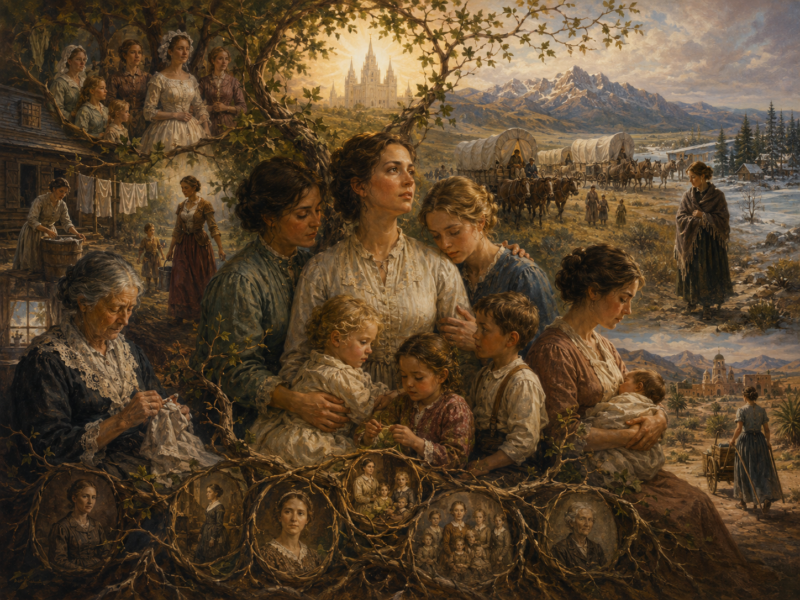
This article examines the lived experience of nineteenth-century Mormon polygamy through the family histories of fifteen polygamous foremothers and their thirty-two sister-wives. Drawing on genealogical records, census data, birth and death certificates, family biographies, and inherited stories, the study treats family memory not simply as evidence to be accepted or rejected, but as a source that reveals how plural marriage was remembered, justified, minimized, and sometimes concealed. Through a question-centered method, the article explores how women entered, endured, adapted to, or exited plural marriage across settings including Nauvoo, the Mormon migration, Utah, Mexico, and Canada. Particular attention is given to women’s silences in the historical record, age disparities, domestic dependency, widowhood, orphanhood, immigrant vulnerability, sister-wife relationships, childbirth, separation, household labor, and the emotional consequences of sharing a husband within a religious system understood by participants as divinely commanded. Rather than presenting polygamous women as a single type—victims, believers, resisters, or heroines—the article argues that their experiences were varied and situational. Some women found resilience, kinship, and religious meaning, while others experienced loneliness, displacement, or marital strain. By centering women’s fragmented records and asking what their absences reveal, the article contributes to a fuller understanding of gender, memory, power, and everyday religious life in Mormon plural marriage.
Christensen-Duerden, Chenae, Sarah M. Coyne, Loren Marks, Erin K. Holmes, and Ashley Larsen Gibby. ““I Worked Really Hard to Know Who I Am”: A Qualitative Study of Identity Development in Latter-Day Saint Women in Midlife.” Genealogy 10, no. 2 (2026): 54.
Although identity development is often framed as a task of adolescence, identity continues to evolve across the life course. Midlife, in particular, involves significant role change, reflection, and meaning-making, yet women’s midlife identity development within religious contexts remains understudied. Using life course and narrative identity frameworks, this qualitative study examined how women navigate identity shifts during midlife within a family-centered faith context. In-depth semi-structured interviews were conducted with 30 women aged 38–69 who identified as practicing members of The Church of Jesus Christ of Latter-day Saints in six countries. A grounded theory analysis revealed three interrelated processes, identity disruption, re-evaluation, and revision, while anchoring identity in core sources of meaning. Faith and purpose provided continuity across transitions, supporting coherence, resilience, and growth. These findings challenge deficit-based models and position midlife as a generative period of ongoing identity development.
Comments
2 responses to “Cutting Edge Latter-day Saint Research, May 2026”
Once again, thanks, Stephen, for pulling these together. They all look interesting.
They do; this is an interesting crop this month.