A popular choral piece for Christmas performances (at least in Utah) is John Rutter’s Candlelight Carol. It is a beautiful piece, but one thing that has struck me as interesting is that when it is performed in Latter-day Saint circles, there is a line that tends to be modified.
While the desire to ensure our hymns reflect our doctrine is admirable, I believe the need for this specific modification is debatable. In fact, by redacting the text, we might be missing out on a profound theological truth about the Savior.
The Controversy: Why Do LDS Choirs Change the Lyrics?
The third verse of Rutter’s piece reads as follows:
Find him in Bethlehem laid in a manger
Christ our redeemer, asleep in the hay
Godhead incarnate and hope of salvation
A child with his mother that first Christmas Day
More often than not, copies I have found at wards and stakes around Utah cross out the phrase “Godhead incarnate and hope of salvation” and replace it with alternative text.
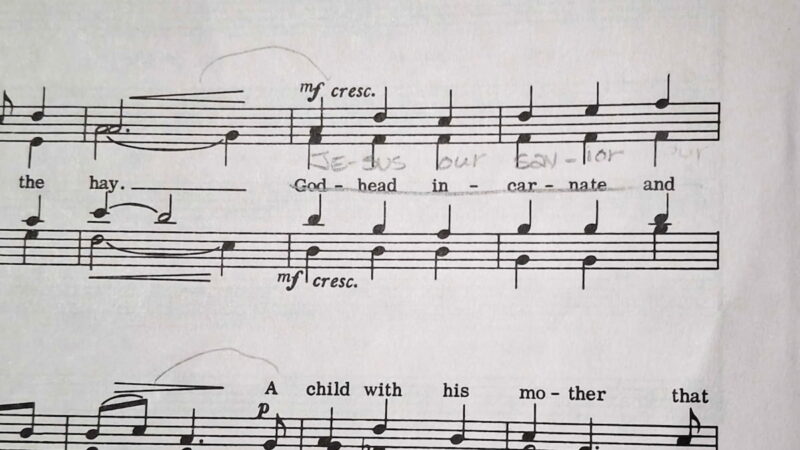
The reason for the redaction is likely theological anxiety. To many Latter-day Saints, the phrase “Godhead incarnate” smacks of creedal Trinitarianism—specifically the belief in one God (one “essence” or “substance”) existing in three persons. Because Latter-day Saints are hypervigilant about maintaining the distinctness of the three members of the Godhead, lyrics that sound like they “merge” the three into one are often viewed with suspicion.
However, despite our differences with traditional Christianity regarding the Trinity, I believe that referring to Jesus as the “Godhead incarnate” is not out of line with our theology. Even if we do not affirm that the three members are one substance, the scriptures and our own theologians suggest that Jesus is indeed an embodiment of the Godhead.
“The Fulness of the Godhead Bodily”
We find a powerful precedent for this language in the writings of the Apostle Paul. In his epistle to the Colossians, he warns the saints against being taken captive by human philosophies, pointing them back to the nature of Christ:
“For in him the whole fullness of deity dwells bodily, and you have come to fullness in him, who is the head of every ruler and authority.” (Col. 2:9-10, NRSVUE)
The King James Version renders this more familiarly for our context: “For in him dwelleth all the fulness of the Godhead bodily.”
Here, Paul offers a passing but critical reference to how he understood Jesus’s nature. In a Restoration perspective—where God, Jesus, and the Holy Spirit are distinct beings—this verse can be interpreted to mean that Jesus represents the entirety of what it means to be God. He possesses the attributes, power, and authority of the Godhead while also having a body of flesh and bone.
Meaning of Godhead
An issue at play here is that the term “Godhead” has a slightly different meaning than how we usually use it. For example, BYU professor Jason Combs noted that while “the way we use the term Godhead in Church today is practically as a substitute for the word Trinity,” and it appears in the King James Version of the Bible, the term in the Bible means divinity or Godhood:
In Acts 17:29, it is a translation of the Greek to theion, “the divine” or “the deity.” And in Romans 1:20 and Colossians 2:9, “Godhead” is the KJV translation of the Greek, theiot?s and theot?s both meaning “divinity” or “divine nature.”
For instance, Colossians 2:9 states:
9 For in [Christ] dwelleth all the fulness of the Godhead bodily.That doesn’t mean that the three persons—Father, Son, and Holy Spirit—are all inside of Jesus; it means that Jesus is fully divine, that he has a divine nature.
I think we’ve sometimes mistakenly assumed that “Godhead” in the KJV means something like God’s headship or leadership, when in fact “Godhead” is simply an old way of writing “Godhood”—it means “divinity” or “divine nature.” But again, the way we use the term Godhead in Church today is practically as a substitute for the word Trinity.
This underscores the idea that Jesus being “Godhead incarnate” just means that Jesus possesses the attributes, power, and authority of the Godhead while also having a body of flesh and bone.
“He That Hath Seen Me Hath Seen the Father”
We see this same concept in the Gospel of John. During the Last Supper, the apostle Thomas asked Jesus, “Lord, we do not know where you are going. How can we know the way?”
Jesus replied, “I am the way and the truth and the life. No one comes to the Father except through me. If you know me, you will know my Father also.”
When Philip interjected, asking Jesus to “show us the Father,” Jesus responded with a statement that unifies the Godhead in purpose and representation, if not in substance:
“Have I been with you all this time, Philip, and you still do not know me? Whoever has seen me has seen the Father. How can you say, ‘Show us the Father’? Do you not believe that I am in the Father and the Father is in me?” (John 14:9-10)
By stating that “whoever has seen me has seen the Father,” Jesus indicates that He is a complete representation of the Father. To know Jesus is to know the other members of the Godhead.
The “Express Image”: B.H. Roberts on the Incarnation
This scriptural logic was championed by one of the Church’s great intellectuals, Elder B.H. Roberts (1857–1933). At the turn of the twentieth century, Roberts frequently defended the Latter-day Saint conception of God—specifically the belief in a God who is a tangible being.
Roberts argued that because Jesus is the “revelation of God,” then, “Whatever … quality that is ascribed to God, must be in harmony with what Jesus Christ is.” (B. H. Roberts, The Mormon Doctrine of Deity: the Roberts-Van Der Donckt Discussion (The Deseret News, 1903), 119.) In his Defense of the Faith and the Saints, he wrote:
“God is a person in the sense that he is an individual. He is revealed to us through Jesus Christ. We believe in that revelation of God that is to be read in the life and character of the Nazarene—the Lord Jesus Christ. To us he is the very image and likeness of God; nay, as the Christ was and now is, so God is!” (Defense of the Faith and the Saints, 2 vol. (Deseret News: 1907–1912), 2:388.)
For Roberts, Jesus was the “express image and likeness of that Father’s person, and the reflection of that Father’s mind.” Therefore, he concluded:
“Henceforth, when men shall dispute about the ‘being’ and ‘nature’ of God, it shall be a perfect answer to uphold Jesus Christ as the complete, perfect revelation and manifestation of God.” (The Seventy’s Course in Theology, 5 vol. (The Deseret News, 1907–1912), 2:119.)
Conclusion
Both in the New Testament and in the writings of Latter-day Saint leaders, there is ample precedent for referring to Jesus as the “Godhead incarnate.”
He is the “Godhead incarnate” not because He is literally the Father or the Holy Ghost, but because He is the full representation and embodiment of what the Godhead is like in nature, character, and purpose. His incarnation was the greatest opportunity for humankind to observe the revelation of God up close.
Perhaps this Christmas, instead of rewriting John Rutter’s lyrics, we can sing them with a renewed appreciation for what they truly mean: that in the manger lay the fulness of the Godhead, bodily.
Comments
26 responses to “Is “Godhead Incarnate” False Doctrine? Reclaiming John Rutter’s Candlelight Carol for LDS Theology”
Consider also that LDS theology/ecclesiology has a tendency to turn KJV phrases connoting substance or status into ecclesiastical/organizational words. So, for most of the Christian world, “godhead” is synonymous with “divinity” (see https://en.wikipedia.org/wiki/Godhead as well as the Colossians verse you cite), and I don’t know that anyone besides Latter-day Saints uses it as a substitute for “Trinity.”
Interestingly, the same is true of “bishopric,” which in Acts 1:20 (and non-LDS Christian contexts) refers to the substance of being a bishop but has been turned by Latter-day Saints into a term referring to an organization made up of bishops.
So, while I appreciate your theological argument here, I think that a linguistic argument is the real clincher: Rutter is saying that godhood (rather than “the godhead”) is incarnate in Jesus, and Latter-day Saints can certainly get behind that.
Chad, I’ve been studying parts of 1-2 Nephi the past few weeks, and I’d argue that Nephi’s (and, later in the Book of Mosiah, Abinadi’s) conception of Jesus is much more trinitarian than any of us Latter-day Saints really want to wrestle with and certainly more difficult to wrestle with than the line “Godhead incarnate.”
This difficult is pretty well emphasized by the textual change at 1 Nephi 11:18 that was changed from “the mother of God” in the 1830 version of the Book of Mormon to “the mother of the song of God” in the 1837 edition. My experience in Latter-day Saint Sunday Schools has been that when anyone points out the unhelpfully trinitarian nature of many Book of Mormon verses (and Doctrine and Covenants verses for that matter), it winds up in a rather awkward discussion with a stern assertion or two that the text doesn’t really mean what it says on its face.
I’m not arguing that Latter-day Saint teachings about the Godhead are wrong. Rather, I’m arguing that, if our own revealed scripture is often and surprisingly less than helpful in supporting those teachings, concerns about singing “Candlelight Carol” as written in sacrament meeting are much ado about nothing.
Have we not read our own Book of Mormon? Does it not tell us more than once that “God Himself” will come live among man?
Thus, I agree with the OP, but even a little more fundamentally – in our own Doctrine and Covenants, how many times does Jesus, in His own voice, claim to be our Redeemer, our Savior, and our God?
The traditional Utah quibbling about Jesus’ status is unbecoming, unnecessary, and simply wrong.
Make that “mother of the son of God,” not “song of God” (though hearing God sing would be cool). Serves me right for typing this on a phone.
The verse from Colossians 2 is probably enough by itself to justify leaving the wording in place, perhaps with a footnote reference to the verse. Some of the new hymns have included notes like this for unfamiliar language.
Great post. I have zero problem with the trinitarian shield that is often used as a visual device and believe other Latter Day Saints should have no issue with it either. The Father is God, Jesus is God, the Holy Spirit is God, and they are not each other. The only difference is we do not believe they share the same ousia, or essence.
Not a Cougar, I kept thinking of the story of the Book of Mormon translation into Portuguese while writing this, where the mission president in Brazil and the First Presidency freaked out because they thought that “Catholic doctrine” had found a way into the Portuguese Book of Mormon text and that the book taught “the wrong conception of Deity and the Godhead.” In reality, it just translated what the Book of Mormon says about the Trinity into Portuguese, and the German-speaking mission president thought it sounded too Catholic. (https://www.fromthedesk.org/how-was-the-book-of-mormon-translated-into-portuguese/)
Spencer Greenhalgh, that’s a good point and you’re probably right that that alone could justify it.
ji, what’s interesting to me is that the question of whether Jesus should be called God or not is something that we seem to go back and forth on. Bruce McConkie was emphatic that Jesus was subordinate to the Father and should never be an object of worship (though I sometimes wonder if he just did that to pick a fight with another BYU professor). Nowadays, Church leaders seem pretty committed to treating Jesus as God.
Jonathan Green, yeah. I don’t think that Oxford University Press will add that as a footnote just for Latter-day Saints with the piece, but Latter-day Saints could add that in when questioned about it.
Vic Rattlehead, agreed!
In D&C 132, Jesus is speaking in the first person, and he declares “I am the Lord thy God” eight times. One of those declarations is in verse 12:
12 I am the Lord thy God; and I give unto you this commandment—that no man shall come unto the Father but by me or by my word, which is my law, saith the Lord.
There, we see the Father and the Son in the very same verse, and the Son still claims the dignity of God for himself. Amen.
I want to respect all those who serve in offices in the church, but I have little confidence in Elder McConkie’s dogma and dogmatism. In my opinion, he reinforced error in many ways. I am glad we have moving beyond him in some ways – but sadly, his influence still looms. Given a choice between believing and following Jesus or Elder McConkie, I will choose the former. I regret that within our church culture, many fellow Latter-day Saints would choose Elder McConkie instead.
Chad, oh yeah, it’s kind of hard to add a footnote to a choir performance. For various reasons your post reminded me of some similar discussions.
Curious, if you could also describe your own child as “Godhead incarnate”?
Probably not, but if you wanted to be metaphorical and get all Lorenzo Snow-y you could.
We find ourselves in the uncomfortable position of following Jesus and how he spoke about himself and then also following how others spoke about him after the resurrection.
Let’s not forget he got prickly when someone called him good.
He made it very clear in one time and place that our Father in Heaven was perfect, and then after he was resurrected he included himself in that
But we also have clear scriptural instances of referring to the atonement like it happened in the past and seeing and receiving the power of it, when at that time in scripture it hadn’t happened yet.
Therefore, I’m totally ok with with referring to baby Jesus as God in the flesh, but I can see why some might get the wrong idea, why I think connects to where some of these trinitarian notions came from.
“You’re saying Jesus wasn’t always perfect?! That’s heresy, he’s the same yesterday, today and forever!”
Shorter version – don’t take too much doctrinal stock in a single poetic turn of phrase as though all truth must be contained in it with clarity and precision.
Many years ago our New England ward organized a multi-congregation Christmas singing event. This yearly event, now more than 20 years old, has become very successful and provides regular interactions between our ward and other religions in our town. The format is like this: Each choir sings a few musical numbers for everyone. This means that for the first part of the concert each choir marches to the front of the chapel and sings their songs and then files out. (The sizes of the choirs range from 8 to up to 50 people.) Some bring instruments such as trumpets, drums, guitars. It is all fun.
Then there is the finale which, everyone agrees, is the best part. All the choirs join in and sing three or four pieces together. This means a choir of over one hundred souls. It is quite nice! We always end with Handel’s “The Halleluia Chorus.” It is a great event!
Every year we have participated with the Baptists, the Catholics, and others. Curiously the Unitarians have been in and out from year to year. I understand that there are two reasons for this: one is budgetary. While their choir is volunteer, their organist and conductor are both paid, and so our little get-together may strain the music budget. Their people must be paid for the concert and for the rehearsals, because their organist and conductor may participate (on their own songs, and on the joined music) Also I think that I have heard that some of them find this event a bit too “Jesus-y” My word, not theirs.
That is the background for my little story. We were preparing to sing Rutter’s Candlelight Carol as a group number. One of our singers, in the COJCoLDS tradition, protested the “God Incarnate” words and asked to change them. This resulted in visible confusion among some members not of our LDS tradition. They couldn’t understand the objection. I remember that a few of our choir voiced support for the song as written. They pointed out that our tradition doesn’t usually use the word “incarnate” but that it simply means that we were singing about God becoming flesh in Jesus, and that is our belief, isn’t it? The objecting woman (I have NO idea how many others were in support of her) stated that she wasn’t comfortable when singing, and testifying of, that particular phrase and asked us to change it.
I can’t remember what we did. I remember the conflict. Not the resolution!
“Nowadays, Church leaders seem pretty committed to treating Jesus as God.”
I grew up in the “McConkie doctrine” era and his influence was huge, I think, because he was bold enough to share his opinions as real doctrine. Because he was an apostle, members took it as real doctrine. I did not agree with most members back then and felt it was mostly his opinion. I clearly remember debating with a close friend back in the 80’s who felt that because a church leader wrote a book that was sold in Deseret Book, it was church doctrine. Kind of like everything said in conference is also doctrine. I firmly believe then and today that is not the case.
“Jesus as God” has confused me a lot lately in the church as it seems that we have forgotten about God with all our re-branding/focus on Jesus in the past presidency. I cringe when the bishopric members say anything about worshiping Jesus in sacrament meeting. I often find myself driving home from church scratching my head about the (yet again) emphasis of a stronger relationship with Jesus. My personal strong relationship is, and always has been, with God. I pray to Him and He is the one responding to me.
I dont want to hijack this thread but I would love a thread about this shift to “Jesus as God” idea as I am very confused about it.
As a note, because I want this post to be a resource for when situations like the one that Stephen Hardy mentioned arise, I’ve updated to include a section that states what Spencer Greenhalgh pointed out. (Also, Stephen, it’s good to know that this is an issue that goes beyond the Book of Mormon belt geographically – I’m never sure what’s a Utah-ism vs. a broader meme in Latter-day Saint experience.)
Sute, I love your question, “Curious, if you could also describe your own child as “Godhead incarnate”?” You’re right, though, that in a sense, you could. I think the key difference with Jesus, though, is that he was already part of the Godhead before he was born.
REC911, pretty much any substantial discussion of Jesus and godhood gets pretty confusing when people try to dig into it, but it’s an ongoing tension in Christianity. In the early Christian Chuch, they were culturally conditioned to see the divine and the material world as so completely different that they could not truly be united. I’ve heard the comparison before that to them, talking about Jesus being both divine and human was like asking for hot ice cream – by nature, ice cream is frozen, so it can’t be hot. This came up in the debates that led to the major creeds and definitions associated with Nicea and Chalcedon. (Jason Combs did an excellent interview at From the Desk a few years ago on the topic: https://www.fromthedesk.org/divine-nature-of-god-ancient-christians-jason-combs/.)
The major debate leading to the Nicene Creed was between two opposing views. Arianism embraced the idea that Jesus was created by God, came after God the Father in both time and substance, and was thus subordinate to the Father. Athanasius of Alexandria led a trinitarian faction, which argued that Christ was coeternal and consubstantial with God the Father. The Nicene Creed rejected Arianism (complete with the wonderful Christmas story of Saint Nicholas slapping Arius in the face during a heated argument over the issue), which has led most Christians since then to formally teach that Jesus is God. (These debates have come up more recently again in Evangelical circles when some preachers put Jesus in a subordinate position to the Father as an example to reinforce patriarchy, leading to accusations of Arianism.)
Trinitarianism was, at its core, an attempt by Christians to hold two contradictory perspectives – that they were monotheistic, but that their experiences, as recorded in the New Testament, indicated that there were three different Divinities that they were interacting with. While Latter-day Saints rejected monotheism in the sense that we believe in a tritheistic Godhead, we’ve still inherited a lot of the linguistic and theological baggage associated with the idea. Joseph Smith wasn’t particularly careful in his language about it until late in life, so the revelations that we have through him (both the Book of Mormon and the Doctrine and Covenants) frequently equate Jesus with God, as some of the other commentators have noted.
Now, we have different underlying assumptions that make it so, even when we say the same things as Christians, they often have different meanings in our theological matrix. We don’t necessarily believe that God is an uncreated creator and the point of origin for all that has been created. Joseph Smith’s King Follett Sermon and other related teachings indicated that all humans (including Jesus) are coeternal with God, but that God was more advanced and took us under his wing to teach us how to become like Him. This also means that we don’t see divinity as ontologically distinct from humanity. It’s a difference of degree instead of kind.
Within that perspective, along with the hierarchical structure of the Church, Bruce McConkie’s perspective makes sense. Jesus was among the intelligences or spirits that God agreed to tutor and raise as His children, and is therefore subordinate to Him. Jeffrey R. Holland’s 2003 talk, “The Grandeur of God” (https://www.churchofjesuschrist.org/study/general-conference/2003/10/the-grandeur-of-god?lang=eng) is a great example of this type of theology being expressed (and I tend to personally think of things more along these lines). The fact that we are instructed to pray to Heavenly Father rather than to Jesus (or our Heavenly Mother) is an expression of this theology as well.
In recent years, however, it’s been subtle, but there has been a shift, and it’s become very normative in the Church to refer to Jesus as God and as an object of worship. The example where I first picked up on it is the standards by which hymns are being judged for the new hymnbook, which includes that they have to “Increase faith in and worship of Heavenly Father and His Son, Jesus Christ.” I feel like there was something in the Church’s style guide about capitalization of pronouns for Jesus, that has become more prominent in Church publications and general conference in the last couple years, but I’m having trouble finding the full style guide at the moment.
I’m not sure of the exact reasons for this, however. My guess is that there are two main contributing factors here – first is the language of the Book of Mormon and Doctrine and Covenants, discussed above. Second, Jesus is more vivid and real in religious imagination, so it is easier to make him an object of worship. (I.e., Jesus lived a mortal life that we have records of and can tell stories about and paint artistic renderings of, while God is a distant being that Church leaders like Joseph Fielding Smith and James E. Talmage taught only interacts with us through Jesus by divine investiture.)
(Also, I’m happy with this thread jack, so thanks for bringing it up)
I found the style guide:
8.28 Capitalize second- and third-person pronouns referring to Deity, as well as intensive and reflexive pronouns:
*Jesus and His disciples
*When God created the earth, He did not create it out of nothing.
*We thank Thee, dear Father, for Thy love.
*We can show our love for Heavenly Father and Jesus by speaking Their names with reverence.
*The Son of God Himself bore the weight of the sins of all humankind.
*The Holy Ghost is known as the Comforter, and He can calm our fears and fill us with hope.
As an exception, lowercase pronouns referring to heavenly parents.
Looking at previous editions, the 2009 one is similar. I can’t find the 1996 version or earlier to see if they have anything.
Chad,
Thanks for the thoughtful info but I should have been more clear….I meant just the LDS shift from God and Jesus are clearly “separate”, first vision stuff, to your “Church leaders seem pretty committed to treating Jesus as God” comment. I am not saying we are calling them “one” like the creeds but it appears we are worshipping/focusing on JUST Jesus and God is now taking a secondary/lessor roll in LDS worship. At least that is how I feel every time I attend church. Anyone else experiencing this? I have never in my life felt it was appropriate to worship any deity except God. I acknowledge that Nelson was focused on Jesus the last few years, but that could be just a by-product of his mormon word hang-up. Perhaps the by-product of the Jesus focus is worshiping Jesus?
Faith in Jesus, worship only God kind of mantra is what I have always practiced/believed.
It seems to me that we’re gradually emerging (a multi-decade process) from a period where we felt a strong need to clearly distinguish ourselves from mainstream Christianity, to the point of exaggerating our differences. This seems to fall in that category. As another example, I remember “When I Survey the Wonderous Cross” being introduced in general conference as “Love So Amazing” to avoid referencing the cross. Many members still hesitate to say we are saved by grace, even though we clearly are.
I firmly believe in our theology that God the Father and Jesus Christ are separate beings. But our scriptures frequently use ambiguous language that seems to blur the distinction between them, and there’s no point in trying to be more “Mormon” than the Book of Mormon. On the other hand, on the question of whether we should worship Jesus as well as the Father the scriptures are unambiguous. In addition to the example in 3rd Nephi of the people worshiping and even praying to Jesus (though the latter is seemingly an exception based on special circumstances), I’ll point out 2 Neph 25:29:
And now behold, I say unto you that the right way is to believe in Christ, and deny him not; and Christ is the Holy One of Israel; wherefore ye must bow down before him, and worship him with all your might, mind, and strength, and your whole soul; and if ye do this ye shall in nowise be cast out.
That said, if I recall correctly the copies of Candlelight Carol in our music library have the same edit, I’ve used it before, and I probably would again. It’s not worth creating an obstacle for someone’s ability to feel the Spirit during the performance.
(Assuming I were convinced to sing Candlelight Carol again–too many of the lyrics are just fluff for me. “How do you capture the wind on the water?” indeed.)
What does it mean to worship the Father in the name of the Son?
Doesn’t it mean to worship the Father in the name and through the person of the Son?
It cannot mean to worship the Father while sidelining or excluding the Son.
Anyway, I prefer a Jesus focus far more than a heavenly parents focus. After all, it’s the Church of Jesus Christ — not the Church of Heavenly Father and certainly not the Church of Heavenly Parents. And the totality of the Scripture does indeed point to Jesus as our God.
I’d just add that we haven’t rejected monotheism, and there are undesirable downstream consequences for doing so – we just square that particular circle a bit differently than other people. Just like there are various takes on the role of grace in salvation, and we shouldn’t adopt the most extreme one, because we still think agency and obedience and ordinances are important.
I think there’s room for interpretation on that one, Jonathan. From my perspective, we believe in and potentially worship three gods, not one, so by definition, we’re trithistic, not monotheistic.
As Joseph Smith put it, “I have always declared God to be a distinct personage, Jesus Christ a separate and distinct personage from God the Father, and that the Holy Ghost was a distinct personage and a Spirit: and these three constitute three distinct personages and three Gods. If this is in accordance with the New Testament, lo and behold! we have three Gods anyhow, and they are plural: and who can contradict it!”
While I think the statement that he always declared that might be a stretch, it’s a pretty clear rejection of monotheism.
But I do know there are ways within our religion to square that circle and make room for that belief. One reason I personally lean towards the position REC911 is articulating is that it is a way to maintain a form of monotheism by saying that God the Father is the one God we follow and worship. And there’s always the thought that the Godhead as a council is a unit, and that unit is our One God (though I personally feel like that one starts getting into the same “have your cake and eat it too” territory as Trinitarianism).
I guess I see it more as “monotheism on hard mode” than outright rejection. I confess that I’m not super invested in the details of how the square gets circled, because there’s always going to be some unresolved tension (so I don’t object strongly to someone else’s trinitarian creed, but I do think it’s silly when those creeds get held up as the standard of what defines a Christian).
I do think it’s worth the effort, though, because it seems like an inevitable consequence of giving up on monotheism is to drift towards overt polytheism and open the door for people to say, for example: I reject the Father’s stifling commandments and demand for strict obedience; I will instead worship the loving Holy Ghost, who understands me and fully accepts me for who I am. With a commitment to monotheism, however explained, you can make clear that the same God both loves you and calls for strict obedience. Without it, it seems like the problem of sin and the need for a savior quickly breaks down.
(But “godhead incarnate” really is okay to sing.)
For me, this has been a fascinating and informative discussion. Thanks, Chad and everybody.
One question that comes to mind as I read these posts is: What do people mean by “worship”? Some people say we pray to the Father through the Son, but we only “worship” the Father. Meaning . . . what?
There are associated verbs here: admire, revere, praise. Surely, even by the stricter theological view, we can admire, revere, and praise Jesus? But not “worship” him? Again, meaning . . . what?
(Other Christians have sometimes faced a similar question with respect to icons, which can be “venerated” but not “worshipped.” What exactly is the difference?)
Off the top of my head, I can imagine two possible responses for us (and I’m not suggesting that these are exhaustive). One is that although we can speak through and thus presumably to the Son, when we ask for help– for blessings– we are directing these requests only to the Father. But this seems unlikely. Why can’t we ask for help from anyone but the Father? Here on earth, we ask for help from lots of people. Is there some reason why we can’t do that just because people have died?
The more likely response, probably, is that “worship” means to treat someone as God, and that is appropriate only for the Father. But this in itself is a contestable proposition, to say the least, and it also raises the further question: What do we mean by “God”? In orthodox (small “o”) Christian theology, I take it that “God” would refer to the uncreated Being for whom essence and existence coincide (“I Am that I Am”), so that there could only be one such Being: monotheism is built into the understanding of what God is. But if we don’t accept any of that, then I’m not sure what it would mean to say that we should worship only the Father in the sense of treating only Him as God.
I think shows one of my favorite parts of being in the LDS church, is room for inteperetation and freedom of theological and philosophical belief. Since we have an orthoprax and less orthodox system, we have room to believe what we think is best. As long as you believe in the Father, Son, and Holy Ghost and that salvation comes via Christ, I don’t really care all that much if you want to hold to an Arian, Subordinationist, or more traditional Trinitarian view. If you want to belive Holy Ghost is Heavenly Mother, I don’t care. If you want to believe God is head God or has Gods before Him, that’s fine by me too, even if I disagree.
Amen to that, Vic Rattlehead!