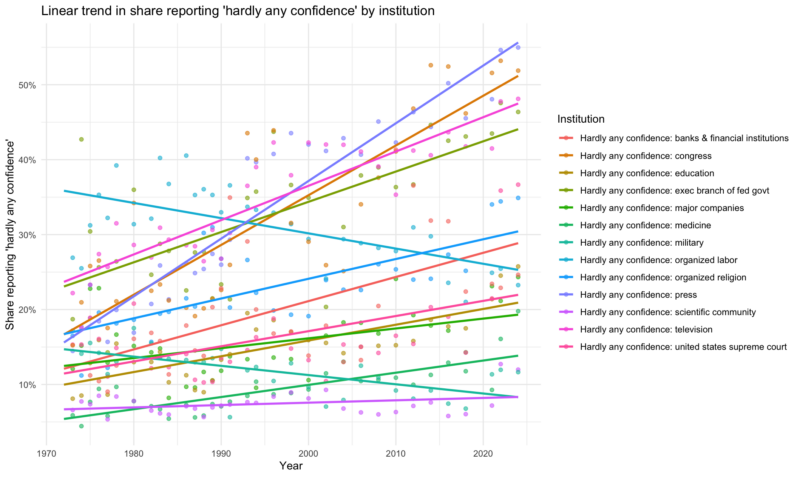
I’m increasingly appreciating that one of the side-benefits of being a TS permablogger is that it provides a nice place to park my graphs and insights that don’t make it through the editors with my other work. On that note, my draft of a recent Deseret News article of mine was built around this graph. I have no idea why they decided to cut it.
But seriously, I knew they’d have to pare it down, but I thought the graphics guys would make the choice about which lines to keep or throw, but they ended up just throwing out the whole thing–it was probably way too cluttered to be salvageable. The topline reported in the article is:
At that time, only about 15% of Americans had hardly any confidence in the press, with only 22% having that same low amount of confidence in television (about the same as religion, it is worth noting).
Now? Their tumble has been much faster and harder than religion. While about one-third of Americans now have hardly any confidence in religion, about half of Americans have hardly any confidence in the press (55%) or television (48%).
If you squint hard enough at the graph you’ll see that.
- The main exception to cratering confidence is organized labor, which is so small and powerless in 2025 I suspect that had more to do with their perceived glory years of yesteryear more than any current interactions with them.
- Concerns about COVID breaking our confidence in medicine notwithstanding, it looks like medicine and science both enjoy high confidence without a significant trendline in the opposite direction.
- But the vast majority of other institutions: academia, the government, business, media, and, yes, religion, all have cratering confidence levels. We are generically much more cynical than we were. Anecdotally, it seems like when people point out that religion doesn’t enjoy the confidence it used to, it’s taken as some sort of a gotcha that by definition shows how problematic religion has been or acted. However, some of those same people turn around and assume that declining confidence in, say, academia or the media as our arbiters of truth is a sign of intellectual stagnation or decadence when you could just as rightfully diagnose declining confidence in those institutions as stemming from their own shortcomings and scandals.
Comments
8 responses to “Declining Confidence in Religion and Other Institutions”
Medicine and science haven’t bowed to Trump. Generally speaking, all those other institutions (academia, the government, business, media, and, yes, religion) have.
Maybe, but the fact is that these trends long pre-date Trump, who only shows up in the last sixth or so of the graph.
It mostly looks like a graph of institutions that people are incentivized to criticize versus those that aren’t, as opposed to any horrible institutional missteps. The solution in most cases would be for people to trust most institutions more and have less respect for knee-jerk cynicism.
My color perception must not be very good because I cannot identify which lines represent major companies, medicine, and military. The greens all look the same.
Your eyes are probably fine, you just need top percentile visual acuity to make any sense of the chart.
You’re not alone, Hoosier. Given the sensitivity of linear fits to outliers near the ends, Tim *could* be right that the slopes are being driven by Trump (I very much doubt it). The individual points are there so we can check, but I’m not willing to squint that hard. :)
On the other hand, 50+ years of data means this graph goes back to when union membership was at its peak. So the decline in the number of people with hardly any confidence in organized labor corresponds with a decline in the number of people with direct experience of organized labor. It’s a conundrum for me as a somewhat left-leaning economist (if I can still claim that title): I think one of the biggest problems with today’s economy is that workers have less power in the workplace than in the past, which should make me a fan of organized labor, but my personal experience with it has been pretty negative.
The head of the serpent is consuming its own tail. The university has taught its students to be suspicious of institutions–and now the students are becoming suspicious of the university itself.
For the Des News to delete the whole graph and focus the text on religion and labor, I think shows a low opinion of their readers. To mention the general trend of decreasing confidence across nearly all fields gives a better summary of attitudes.
The commenters’ inability to distinguish colors tells you why the graph was not printed..TMI.
I think your comment diminishes the influence of the trump years. Even a “best fit” graph to display linear results has outsized influences on the endpoints. Especially following the spiking cynical decade of the 90s.