
 This week, peace has become something more than personal for me.
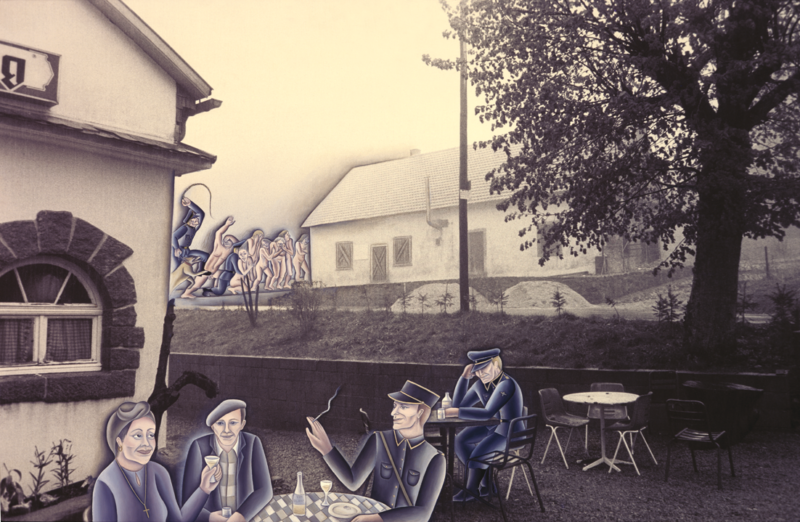
For many of us in the United States today, and in most western countries for that matter, peace is thought of as part of the background of our lives. We don’t see violence in person, and its often not close enough. We’re privileged to not have to live in poverty and in locations where violence seems endemic. I think this is part of what Arendt was talking about when she coined the term the “banality of evil” — the ways that we participate and encourage social systems that act badly simply because we are used to them and its too inconvenient to say no. Indeed, the social structures around us make it impossible not to participate to some degree—and if you need a job and aren’t so skilled that you can choose which job you take, you may be participating even more.
On Thursday, about 4pm in the afternoon, a man driving not far from my home was shot in the neck in his car. His five year old son was in the car with him. The streets were busy and a lot of people were in the area. Many children in the area were walking home from school. I walk through that area myself fairly frequently, usually after visiting my friend at the Bronx VA.
The shooters showed an extreme lack of concern for the general public. While they may not have known that a child was also in the car, they had to know about all the people around them. They didn’t seem to care. In case you haven’t figured it out, the shooters were from ICE.
I don’t know about you, but I don’t often hear about police opening fire in crowded public places. It is my understanding that they avoid that — its too easy to hit bystanders. They don’t open fire at protests for the same reason (and many other reasons as well). When they are looking for a particular suspect, they take the time to figure out how to secure them when its safest for both the public and themselves. One of the shocking things about how ICE has operated under the current administration is that this care for the public has been reduced. The problem is the stunning lack of care for others.
Another shocking thing is the amount of lies told to protect their bad behavior. I read the other day that a judge severely sanctioned ICE and federal prosecutors because they had arrested two hispanic men who they soon knew were NOT subject to arrest (one was a US citizen), and then repeatedly lied to keep them in custody and cover up their mistake. This has already happened in the case this week. While the man who was shot was someone ICE was seeking, his record doesn’t support the claim that he was a “dangerous criminal.” He did have a conviction for robbery, but the court decided his actions didn’t justify jail time—not what you would expect in cases involving someone who was “dangerous.”
So my peace of mind about my neighborhood is diminished. Can I walk around without thinking that I might catch a bullet? Am I ok with how my fellow human beings are being treated? Should I just put it out of my mind because I’m not the target of ICE’s actions? Am I, a native born citizen, even safe when the administration is actively trying to find problems with naturalized citizens and when ICE has repeatedly killed US citizens when they were protesting, simply in the way, or when they simply looked like possible targets?
The situation is too similar to Niemöller’s famous poem for comfort:
And I did not speak out—
Because I was not a Communist.
And I did not speak out—
Because I was not a Socialist.
And I did not speak out—
Because I was not a trade unionist.
And I did not speak out—
Because I was not a Jew.
And there was no one left
To speak out for me.
I would like to stop before the Communist stanza (or should we think of it as the Immigrant stanza?) How secure should I be? When do I stop looking at all this as some impersonal, far-away thing that doesn’t involve me? When do I stop participating in the banality of evil?
Or, perhaps more importantly, HOW do I stop participating? How do I speak up? How do I convince people? How do I say NO, NOT IN MY NAME!
For more than a decade I have participated in a local interfaith group, trying to build bridges between the diverse wealth of religious expression in our neighborhood. When the shooting happened on Thursday afternoon, several of the ministers went there in person, leading prayers and trying to calm everything down. [I am and have been out-of-town, so I couldn’t participate.] As often happens with these events, neighbors and the curious were there witnessing what happened. Many neighbors were soon protesting, and shortly after more extreme and violent protestors showed up—one account I heard said that they wanted to attack the vehicles ICE used, to disable them. The police also arrived after the incident, and the police (not ICE) took the man who had been shot to the hospital (which was less than 500 feet away). Eventually everything calmed down, despite the portion of the protestors who were seeking violence.
The next day the interfaith group met on zoom and later several of the ministers went down to join the public protests at Foley Square, where the courts are located. And the group was writing an official statement to release complaining about how the event was handled.
How should I act? How should any group act?
Of course, I do NOT want to support those who seek violence (although it seems like the press, the politicians and the public only pay attention when there is violence). The violence almost always makes things worse. [I wish ICE understood this.] In addition, I’m skeptical of the ability of protest to help—it makes the protestors feel like they’ve done something, but without massive crowds its dismissed. And even with massive crowds, in our partisan environment the protests are ignored as “partisan.” [IMO the “No Kings” protests last year are an example of this. — For the record, I did participate.]
But if protests and letters and phone calls don’t really lead to change in a reasonable timeframe, what does? With polls showing that at least 2/3rds of Americans aren’t ok with ICE’s tactics, what does it take to get the kind of change to keep people safe?
I wish I knew.
But there is one thing that I do know. I am NOT willing to participate in the banality of evil. I’m NOT ok with what is happening, and I WANT to do something to foster peaceful change.
Yes I was opposed before. But now, the difference this week is that now its personal. How long will it take for it to become personal for you?
Leave a Reply