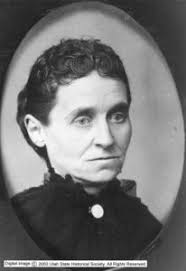
 One of the most frequently published and regarded most highly LDS poets of the 19th century was Emily Hill Woodmansee, who is best remembered for the poem “As Sisters in Zion,” currently #309 in the hymnal. For us today, like almost all 19th century poetry, her work might seem rather conventional—it’s almost all written in conventional meter and rhyme, often with a message that you would expect from a hymn.
This past week I reviewed and remembered a poem she wrote in 1883, “A Blessing Instead of a Ban.” Here it is in full:
A Blessing Instead Of A Ban
- “We learn by the things we suffer”
- Such is our Maker’s plan;
- Oft what we deem such trouble
- Is a blessing instead of a ban.
- What if a favor’d number
- Can verily do as they please?
- What if the aimless slumber.
- Or say – “soul take thine ease?”
- Better our strength to measure
- ‘Gainst a host of “the ills that be,”
- Than to sink in the sands call’d pleasure,
- That circle prosperity’s sea.
- Better the constant tension
- The straits that the poorest know
- Than be void of the comprehension
- That senses a sufferer’s woe.
- Better to learn compassion
- By much that we keenly feel,
- Than to follow the tyrant. Fashion!
- A slave to her whims and will.
- Better to need assistance
- And lean on our Father’s love.
- Than to widen the space – the distance
- ‘Twixt the earth and the Heavens above.
- The test of our soul’s convictions
- The gauge of our trust and truth
- Such are our light afflictions
- Count them, a crown, forsooth.
- “We learn by the things we suffer”
- Such is our Maker’s plan;
- Oft what we deem such trouble
- Is a blessing instead of a ban.
Her message is one we think about a lot as LDS Church members, and it addresses one of the most basic questions of philosophy and theology: why do bad things happen to good people, or why must we suffer. And Woodmansee’s answer is very Mormon — we’re here on earth to learn. And while the poem communicates this message well, But I’m not sure how well the poem was remembered for communicating an important element of LDS belief — it has been forgotten in our heritage (like the vast majority of LDS poetry), and I haven’t found it anthologized anywhere.
Perhaps it will help if we know more about Emily Hill Woodmansee. Sometimes how well the poet knew the subject changes how we see the poem. And in Emily’s case, this is true. Born in England, Emily Hill was already an accomplished poet, whose work had appeared in the Church’s British periodical, the Millennial Star, when she immigrated to Utah in 1856. She wasn’t wealthy, and ended up pulling a handcart with her sister across the plains.
They were in the Willie handcart company.
Do I need to say more? She suffered. The whole company suffered in a way that few or none of us know. So, when Emily Hill Woodmansee argues that “We learn by the things we suffer,” I think she knew what she was talking about.
Leave a Reply