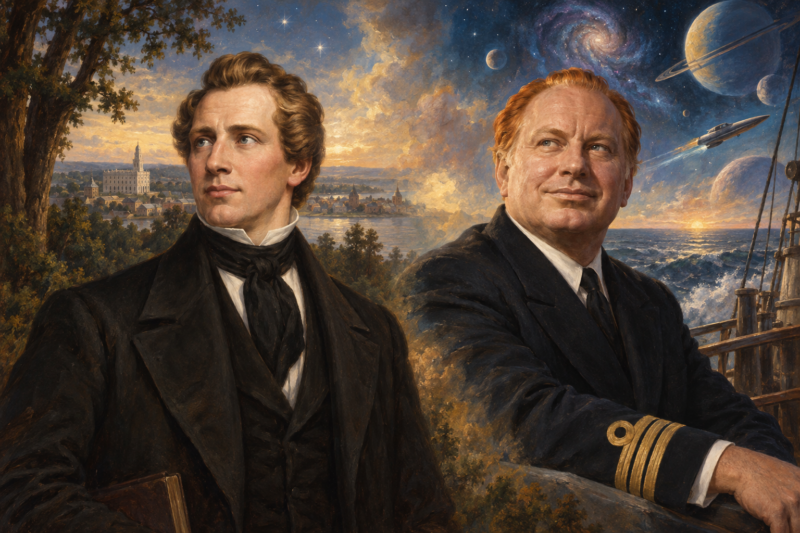
Internet discourse often compares Joseph Smith to L. Ron Hubbard, and there are some superficial similarities: they both engaged in magic practices, they were both charismatic, they both enjoyed military uniforms and titles, and for non-believers in either they both (depending on your view) came up with fantastical new worlds. L. Ron Hubbard’s teachings are even inscribed on metal plates and buried in a repository (although they probably got that idea from us).*
I just finished reading the definitive biography of L. Ron Hubbard, Bare-Faced Messiah and, superficial similarities notwithstanding, there are some pretty fundamental differences, even if you were to take a naturalist perspective on Joseph Smith. (If you don’t want to read the book, one of the best anti-religious movies of all time IMHO, Paul Thomas Anderson’s The Master, clearly heavily drew on the book,** and gives you a sense of the man Hubbard, although it doesn’t quite capture his self-centeredness and temper, Philip Seymour Hoffman’s brilliant performance notwithstanding).
Family
It’s a major point to Joseph Smith’s credit that his entire immediate family were true believers; by all appearances his love for his family was sincere. When his family was hurt he was hurt, and he was deeply concerned for their welfare. From a naturalistic or non-naturalist perspective, it isn’t surprising that eternal family theology became a pillar of restorationist thought given Smith’s proclivities.
L. Ron Hubbard, on the other hand, was married three times, with his first two wives and intermittent mistresses all saying very similar, negative things about him (that he was a pugilistic, emotionally abusive, paranoid, narcissist). By all accounts he didn’t show any sadness at his son’s death by suicide (he was mostly angry at what it would do to him). He claimed his ex-wife was a Nazi sent to spy on him, denied that a daughter was his, and cut off his son after said son decided to get a job outside of Scientology. Hubbard was estranged from his father until the very end of his life, while Joseph Smith had an intense loyal all throughout his.
Again, the fact that those that knew Smith best, his immediate family, were all believers and were generally on good terms with him (with the occasional exception of William Smith and Emma) doesn’t prove anything religious truth-claim wise, but it does show that he was simply a much better human being to those around him than Hubbard was.
Narcissism and Fabulism
The Book of Mormon has a few verses referring to Smith. Fair enough, but in terms of importance Smith was always the side character, whereas with Hubbard he was always the central actor. (Honestly, he kind of reminds me of an L. Ron Hubbard-looking individual in the White House.)
There are a few specific points in Smith’s early history that are disputed, and somebody could read negative things into it like the money digging, the Kirtland Safety Society, or the lost plates episode. Also, Joseph Smith liked to brag about his wrestling prowess,
Hubbard passed this up before breakfast most days. He claimed to be past-life general, spy, top commander in the Pacific theater, groundbreaking chemist, nuclear physicist, pioneering horticulturalist…and on and on, nearly every character witness had some unique claim of his to report. Not to get into cultural warfare, but he was a Jason Arday-level fabulist, living out every spy novel, science fiction, and political drama narrative. Additionally, it was all about Hubbard. Hubbard was the genius that discovered Scientological principles that was going to solve war, cure cancer, and resolve racism.
Joseph Smith, on the other hand, keeps getting harshly rebuked for his weaknesses by the Lord in canonized scripture again and again (e.g. D&C 3, D&C 93, D&C 5, D&C 64). This isn’t exactly the hallmark of a narcissist who thinks he’s the chosen messiah.
Joseph Smith involves others in the revelatory experience (e.g. Oliver Cowdery in D&C 110 and Sidney Ridgdon in D&C 76), given his personality there’s no way Hubbard would ever share his revelatory (he would call it research) process with others. It was all about his genius. While Smith respected his prophetic office and saw it as important, there isn’t a lot of self-laudatory material outlining all of his virtues that led to him being chosen.
Again, doesn’t necessarily mean that he was what he claimed to be, but if he was a fraud it does mean that he was much more subtle and nuanced about it than Hubbard.
New Worlds
With Joseph Smith we have the Book of Mormon world, and then some derivatives from that like Zelph and Adam’s Adam-Ondhi-Ahman altar. Then there is Lucy Mack Smith’s (very long-after-the-fact) account about him as a child telling them stories about the ancient American continent that arguably sounds Hubbard-esque. If Joseph Smith did make it all up he wasn’t nearly as creative as Hubbard. He would have had one developed Tolkien-esque world his whole life, but again Hubbard passed all that up before breakfast.
Plus, in the restored gospel’s new cosmology there was a subtlety that is missing in Hubbard’s grand cosmic operas. There are little hints at a greater universe beyond that you easily miss if you nod off in the temple ceremony or while reading D&C (“That which had been done on other worlds.” Wait stop, what other worlds!), but for which details are withheld. Hubbard would not have been able to resist filling in those details with all sorts of stories, plots, and characters. Again, not proof of anything, but if it was a con Joseph showed much more self-control and subtlety in his theological constructions.
This is similar to how the fact that the gospels are almost completely, reverently silent about Christ’s early life is a point in favor of their authenticity (I think Talmage made that point?), when there would be a huge temptation for a writer to fill in the details with fantastical accounts (like, in the case of Jesus, bringing clay birds to life). The lack of details and reverent silence makes both Jesus’ life and the speculative Latter-day Saint temple theology feel more authentic than Hubbard’s worlds that have just a little too much detail.
Closing Notes
Scientology is one of those organizations that it’s become so easy to criticize that it’s not brave and almost not even interesting to do so, so to be contrarian I’ll end on a few positive notes about Hubbard and Scientology.
One, I wouldn’t be surprised if Hubbard was sincere in his beliefs. He would take his vessels on treasure hunts around the Caribbean to try to find treasures he had buried in past lives, and by all accounts he thought he was going to find something. When he wrote to NASA telling them that they could not make it to the moon without the conditioning provided by Scientological principles, he had prepped Scientology centers for the influx of astronauts he thought was going to come. When he sent out letters out to invite prestigious scientists to form a global organization under the auspices of Scientology that would help prevent nuclear war (or something, I forget the details), for the next several months he made arrangements as if he was going to actually be managing the organization. He requested that the Navy send him copies of medals that he never earned but which he thought was in their records. At some point I wonder if fabulists go so far off the deep end that they start to convince themselves.
Second, in a sense both us and the Scientologists experienced early unwarranted persecution (although the later persecution of Scientology was very warranted). In the early stages of Scientology the FBI and international law enforcement organizations clearly overreacted. At that point in terms of actual illegal behavior Scientology was essentially guilty of making unfounded medical claims (which, thanks to Orrin Hatch, is now no longer a crime as long as you put a disclaimer on it!), although it’s true that their response to that persecution (Wikipedia Operation Snow White) didn’t help them.
********************************************************
* Very snootily, my opinion on Mitt Romney took a huge hit for me when I found out that, even though he was an English major, his favorite book was Battlefield Earth.
**To keep things at an even-keel with his friend Tom Cruise, Anderson denied that it was based on Scientology, but the similarities are way too patent for that to be true. Besides the obvious points (the sea organization, the quasi-psychological angle, the past-lives going back trillions of years, etc)., there are other points presumably drawn from the book that you could miss if you’re not paying attention: the book talks about a game called point-to-point that Hubbard would play that is also played in the movie, and the episode where the Joacquien Phoenix character gets the random call from the Hubbard character that he misses him and wants him to come back is also in the book almost word for word.
Also, standard disclaimer that there are parts that Latter-day Saints might want to “VidAngel.”
Leave a Reply