From guest blogger Kendall Buchanan
One of the most popular bloggers on Substack, Scott Alexander, hosts an annual book review competition and posts submissions from finalists he selects. Alexander’s blog targets “rationalists”—a community predominantly made up of atheists, of which he is indisputably king. Last week’s anonymous finalist reviewed , of all things, the Book of Abraham. Alexander is wildly popular with techies in the Bay Area, so a review of Mormon scripture on his blog is… remarkable.
Let me say up front: the reviewer’s assessment of Joseph Smith and his efforts as “translator” are not flattering; he (or she?) is, nevertheless, admiring and complimentary of the movement Smith launched.
As it happens, the article is less about the Book of Abraham than it is his conduit for studying faith as a “potential superpower”, which Mormonism represents well. He argues that while Mormonism’s claims are fantastical, they are uniquely testable:
The result [of being a young religion] is that we today have large quantities of very reliable records detailing exact quotes and events pertaining to early Mormon history… You can even read all the original source texts yourself exactly as Joseph intended them because they’re originally written in English!
The earliest records testifying of Moses’ existence, for example, are fragmentary papyri dating 1,000 years after his sojourn. Jesus’ resurrection is obscured by centuries of Patristic debate. For lack of abundant first-hand evidence, the reviewer argues that your typical Christian’s faith claims simply can’t be critiqued as easily as a Mormon’s.
So, we can freely ask questions like: Did Joseph Smith actually exist? What did he teach? While scholars can’t answer these questions with as much certainty for, say, Jesus, the Mormon historical record (the “receipts”) offers satisfying answers to these kinds of questions.
As most Times & Seasons readers know, however, the receipts in Mormon history have left pesky—indeed, existentially pesky!—details that have nipped at the heals of believers for 200 years, including… well, the entire conceptualization of the Book of Abraham.
In the end, our reviewer concludes that the Book of Abraham, “written by his own hand, upon papyrus,” is not in fact what Smith claimed. Speaking somewhat tongue-in-cheek, he says:
I guess this is the part where we could wrap up with a neat, triumphant moral: Joseph Smith was a fraud, the papyri proved it, and the entire edifice of Mormonism is a monument to human gullibility.
Indeed, the failures evident in the Book of Abraham, he argues, extend to all of Smith’s translation efforts. But as I mentioned, he is startlingly generous to the Church:
On average, [Latter-day Saints are] kinder, more hard working, more moral and more educated, than the average non-Mormon… It has been hard for me to not feel inspired by the light in their eyes, which I rarely see otherwise in my largely atheistic circles.
He quotes South Park, in which Stan, the new kid in town, says:
All I know is that because of my religion, I have a family that loves me, a family that gets together every Monday night to play games… A religion that teaches us to be kind, and welcoming, and to help others. If my religion is a bunch of crap, then fine. But I still got a great life, and a bunch of people who love me. So you can kiss my a—, Kyle.
Three times he posts the same graph, as if to say, “Have atheists ever accomplished anything like this?”
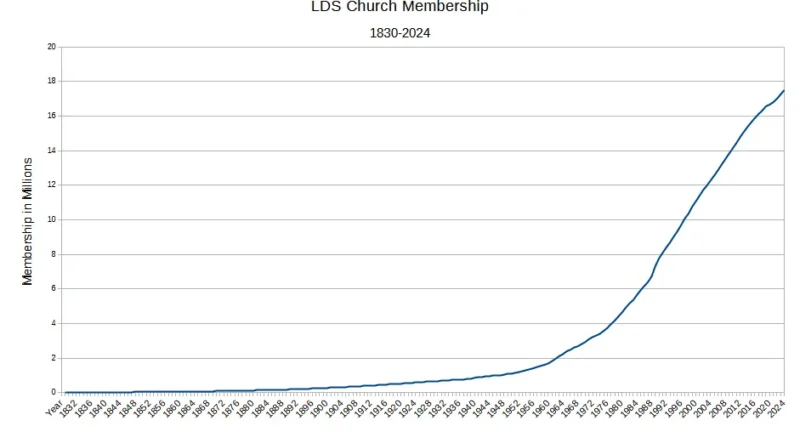
The reviewer believes that groups like Mormons who share the same religious delusions solve important problems like the Prisoner’s dilemma , because people who practice costly rituals together are more likely to cooperate than save themselves. Mormonism is also…
… almost surgically optimized for psychological and prosocial output. Death anxiety: you’re eternal. Sense of purpose: you were chosen by name. The problem of suffering: you consented to this in advance. Tribal bonding: the people in the pew next to you are your pre-mortal siblings, also chosen, also noble, also great. Long-term motivation: infinite, the trajectory only goes up.
I think many Latter-day Saints are prone to reject this line of reasoning from outsiders, because rewards are not so much the point of Mormonism as the byproduct of living according to Truth. In fact, the Latter-day Saints I saw responding to the article seemed to have missed the reviewers positive assessment of the faith entirely, distracted by the wrong-headed conclusions he made about Smith, claiming he read the wrong sources and used the wrong vocabulary.
I think the complaint deserves a closer look. Believing Christians broadly argue that tallying historical ”receipts” is a necessary but insufficient approach to knowledge. As Paul says:
But the natural man does not receive the things of the Spirit of God, for they are foolishness to him; nor can he know them, because they are spiritually discerned. — 1 Corinthians 2:14
Indeed, in 1993, Elder Dallin Oaks echoed this alternative epistemology in defense of Book of Mormon historicity at an annual FARMS event:
Persons who practice that kind of “reasoning” deny themselves the choice experience someone has described as our heart telling us things that our mind does not know.
This spiritual superpower allows the ”heart” to fill the spaces between gaps of knowledge, where even the reviewer would admit is incomplete. Elder Oaks goes on to say, the “authenticity [of the Book of Mormon] depends, as it says, on a witness of the Holy Spirit,” placing the Book of Mormon and other evidences of the Restoration beyond critical analysis.
This is logical Judo, unfortunately, and it means that when the “foolishness” of the heart comes in direct combat with “reasoning” of the “natural man,” the believer must bear a burden of dissonance. What surprised me is the reviewer has first-hand experience with this:
If you pay attention to the way Mormons deal with religious doubt, you’ll often hear the word “personal testimony,” which is when you withdraw inwards in prayer and let the Holy Ghost come to you… Mormon religious leaders will say stuff like “if worldly wisdom confuses you, trust instead in what you can directly witness.”
Yeah, for dissident Mormons, this is a maddening dynamic. Something they desperately plead with their Mormon friends and family to appreciate.
Ironically, our reviewer and Elder Oaks (at least in 1993) both approach Mormonism from a rationalistic paradigm. Early Church fathers of the 2nd century, such as Irenaeus and Tertullian, battled mystics who preached ideas like docetism , which argued that Jesus appeared to be human but was actually a spiritual illusion—an illusion carrying truth that could not be comprehended in the physical realm.
I think this is why I liked the book review—I myself am attracted to mystical things and ideas , in spite of the fact that nine times out of ten I am swayed by reason. New Testament scholar Elaine Pagels said:
Even though Bishop Irenaeus ridicules “heretics” for telling mythical stories, this is myth as Plato understood it: a poetic story meant to reveal the deeper truth of human experience.[1]
So while our reviewer rejects the literal founding of the Church, he pokes at something he recognizes is true about human existence, something Mormonism has captured extremely well. I think that’s something all Latter-day Saints can be proud of.
-
1. Pagels, Miracles and Wonders, 158.
Comments
13 responses to “A Preposterously Complimentary Review of the Book of Abraham”
Thanks, Kendall. Though I did not read the review in it’s entirety, it addresses a lot of themes I’ve been interested in and have posted about. https://www.timesandseasons.org/index.php/2024/03/a-secular-case-for-the-church/
I’ve long thought that concluding line from the South Park episode the reviewer cites was important, but I do get the challenges of believers engaging in claims like these.
Thanks, Kendall
I’m a big Scott Alexander fan, so I read this Substack when I saw it in my Inbox. One thing I’ll add is that, while he’s not going to be joining the Church anytime soon, Alexander’s take on the apologetics arguments is actually more generous and sophisticated than most online rationalist’s responses to the BoA (which is usually just some version of “Lol, John Gee is dumb and Robert Ritner is cool.”) So it’s a little more generous than the South Park angle of “this is patently dumb but Mormons are nice and that’s what matters.”
My sense is that the reviewer is engaging in a more sophisticated grappling with a similar question that the South Park episode seemed to ask in a more crass way. Is there something about Mormonism that produces the outcome of it’s very nice people? I think that’s an interesting question too and am glad the reviewer is interested in the topic.
Stephen C, Stephen F,
Yeah, I think he was being more generous than the South Park quote suggests.
In a follow-up post I’d like to touch on another theme the reviewer implicitly grapples with: when Mormonism is so “obviously incorrect”, how does it stay so resilient and continue to thrive?
Would not be surprised if the author is a former member or has family that are members.
Thanks for this post, Kendall. I’ve occasionally seen references to Scott Alexander but I wasn’t aware of the book review. For what it’s worth, I continue to think that the Book of Abraham is one our more interesting and important books of scripture, and that questioning the accuracy of the Egyptian translation gets everything backwards – not that anyone here is doing that. I’m looking forward to your next post.
Jonathan,
Do you mind explaining more? I’m curious to hear what you mean about BoA.
“Latter-day Saints are prone to reject this line of reasoning from outsiders, because rewards are not so much the point of Mormonism as the byproduct of living according to Truth.”
So I think his synthesis of why our faith works is pretty good. The problem is a similar construct can be built around every other faith. Maybe not exactly the same, but you could build a framework that justifies why all the other faiths work too.
And he might reply, that’s right, which is why they have some utility.
Which brings me to a couple points. None of us are thinking about F=mA when we avoid getting too close to a cliff. But that truth informs our reasoning at a very fundamental level we aren’t even aware of.
That’s how I imagine his argument can be framed to apply to the success of Mormonism.
But another thought, which is worth considering, is that if our faith has brought us to the lived sociological equivalent of F=mA, then is that not truth? Must one possess the specific God equation in order to be on the path to become like God?
What if that equation literally consisted of covenants to do and not do things he would do and not do?
What if when we are on that path, our lives, and the lives of those around us are improved? Isn’t that what God himself does? Make things better for his children?
This is no spaghetti monster argument because that belief system isn’t yielding results, as the author says.
Kendell, I don’t know what Jonathan had in mind about the BofA, but I agree about it being interesting and important.
The Book of Mormon is important because it exists. It’s actual message is mostly fairly standard Christian.
Our unique doctrinal beliefs mostly come from the books of Abraham and Moses.
Kendall, I wrote up my thoughts a few years ago. Part 9 sums things up pretty well.
Totally beside the point here, but I just wanted to say that I absolutely think about F=ma when I get close the edge of a cliff. Also, f=µN and v[f]=v[i]+at, and J=F?t and mgh=1/2mv^2. A physics degree and a mild discomfort with heights will do that to you.
Personally, as I continue to watch, learn (and live) as the years roll along – I’ve come to perceive that the Book of Abraham is simply just silly “Fan Fiction”; and that there’s no historical or revelatory value to it. And, I believe that many LDS folks are coming to the same conclusion.
I absolutely agree (that a great many) LDS Folks are tremendous people and I want to continue my association with them.