It’s not a fair fight.
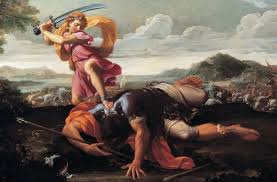
Thinking about the fight between David and Goliath, author Malcolm Gladwell famously came to the conclusion that it was not a fair fight — because Goliath was the underdog. Goliath only had an advantage, Gladwell claimed, in close fighting. In addition, Goliath may have had a genetic condition that left him unusually tall and big, but also with poor eyesight. So all David had to do was to stay far enough away from Goliath and sling stones at the giant until he mortally wounded him. If Gladwell is right, then yes, it wasn’t a fair fight.
But I don’t think that’s the lesson the scripture wants us to take away from the story, and certainly not from the statement that “The Battle is the Lord’s.” The problem, I think, is the word “battle”, which is usually interpreted to mean an armed struggle, or at least the use of force to reach one’s goals. But when we’re talking about the Lord, that doesn’t make sense to me. The Lord’s work is always about the souls of His children. And the struggle never involves force. It is about the strongest weapon in the world: Love.
Since the conversion of the soul involves agency, that is, the idea that each soul chooses what it wants, in the eternities love is the ONLY weapon that will work. Coercion and force can never convert the soul, and they often backfire. So, in a sense I agree with Gladwell: it is not a fair fight. The Lord has the only weapon that can actually work in the “battle” for the souls of human beings. And the only way it doesn’t work is when that soul chooses another path.
With the help of the Lord, I can overcome any challenge.
Since the only weapon in the fight is Love, we arm ourselves by drawing on His help. Therefore, that help will give us what we need to overcome any challenge. I suspect that when we don’t understand this, it’s because we don’t understand the nature of the struggle. When we think that oppositional force is needed against a foe, we simply misunderstand. It’s always about love.
Missionary work is a good example of this. We often believe that missionary success comes from hard work. But that’s not exactly the case. The hard work must be motivated by love. Here, Frank Kooyman, one of the more prolific mid-20th century LDS poets, discusses missionary struggles in tracting—long the most common missionary tool for finding those interested.
To Tract
by Frank I. Kooyman
- Dear Lord, another friend of mine
- Has gone to far-off mission field.
- Grant him, I pray, Thy power divine,
- To be his armor and his shield.
- And one thing, Lord, oh! may he learn,
- Above all other things, in fact,
- Which in the field are his concern:
- With patience, zeal and love to tract.
- He may lose courage, now and then,
- When meeting ridicule and sneers,
- But if he’ll try, and try again,
- In faith, he’ll overcome all fears,
- And soon will see the masses’ plight,
- With pity view each wayward act,
- Because they lack the Gospel light —
- With patience, zeal and love he’ll tract.
- And oh! what joy will swell his heart,
- When he shall find truth-hungry souls,
- Who’ll mend their ways, with error part,
- And reach, in faith, for Gospel goals.
- Be with him, Lord! He will succeed’
- When by Thy power inspired and backed;
- Bless him, that he may learn indeed
- With patience, zeal and love to tract.
1946
One person with faith in Christ can make a difference
Knowing that we can arm ourselves with love through trusting the Lord gives us the faith to accomplish miracles. By exercising that love for others, we can change hearts and accomplish much. In the following poem, Mary Page gives us a list of examples of those whose faith allowed them to bless the lives of others and expand the Kingdom of God.
On Faith
by Mary Page
- We read that faith the assurance is
- Of things the Lord is pleased to give,
- If saints will ask in Jesus’ name,
- The blessings ask’d they may obtain.
- By faith Jehovah fram’d the world,
- And many wonders yet untold,
- In ancient days, by faith were wrought,
- By men who sought the law of God.
- By faith an Enoch sought the Lord;
- By faith obtain’d a just reward;
- By faith beheld his maker’s face,
- And triumph’d o’er the powers of death.
- By faith Elijah raised the dead:
- And for three years the prophet said,
- It should not rain in all the land;
- ‘Twas done by Jesus’ great command.
- By faith a Joshua could say,
- Stand still thou glorious king of day,
- Thou splendid orb of night be still
- Till I Jehovah’s word fulfill.
- By faith the walls of Jericho
- Met with a dreadful overthrow;
- For Israel trusted in the Lord,
- Believed he would fulfill his word.
- But time would fail, the scripture saith,
- To mention all who liv’d by faith.
- Some quench’d the violence of fire,
- And others waxed strong in war.
- While some were mock’d, and scourg’d, and ston’d,
- Some for the gospel lost their homes;
- Others were in the prison shut;
- They kept the faith, denied it not.
- And many wandered too and fro
- As pilgrims on the earth below,
- Knowing that they their Lord would see
- On Zion’s mount from bondage free.
- By faith proud Jordan’s wave was stay’d;
- In years to come the Lord hath said,
- He will roll back the mighty flood,
- Israel pass through the sea dry shod.
- Remember saints, the scripture saith,
- The Lord doth work only by faith
- Among the sons of men below,
- By faith he doth his wonders show.
- O then ye saints of latter days,
- Come, let us study wisdom’s ways,
- Shake off the power of carnal sloth,
- Obtain this glorious living faith.
- Help us, O Lord, to fear thy name,
- Help us this mighty faith to gain,
- That we with ancient saints may stand,
- When Christ shall reign on Zion’s land.
- Then let our faith and works agree,
- Until from all our sins we’re free;
- O, may we practice peace and truth,
- That we may dwell with Christ on earth,
1841
“Jonathan loved [David] as his own soul.”
As a weapon in the battle for souls, love works in many different ways. For example, it can be a way of wearing down opposition—a kind of direct “attack” (if something love does can ever be called an “attack”). It can also be a way of linking up those who are participating in the effort. This latter method includes friendship, such as that between David and Jonathan. Their love for each other fended off many attempts to use force against them.
Written to commemorate the installation on Temple Square of a statue of Joseph and Hyrum Smith, this poem compares the two martyred brothers to David and Jonathan.
The Martyrs
by James A. Leishman
- With reverend hands we raise these graven forms
- Of men who in the forefront of our age
- Strove in the van of truth, amid the storms
- Of hate, and persecution’s bitter rage.
- The one of Joseph Smith who, called of heaven,
- Than whom no man in greater grandeur towers,
- Rare favors had, and unto him was given
- By gift of God, the priesthood’s matchless powers.
- Who else than he has in the presence stood,
- Of God the Father and his only Son,
- And converse held in words of gravest mood,
- That thrilled the heavens with joy, like vict’ry won?
- The realm of ethics opened to his view;
- He heralded the word of God to earth;
- The lustre of the gospel born anew
- Gave weight to all he claimed of special worth.
- The other, Hyrum, Patriarch of the Church,
- Stood hand in hand, with steadfast purpose fixed,
- A colleague worthy of the name; few such
- Have graced the earth with love and friendship mixed.
- As Jonathan and David set the pace
- Of mutual affection’s ardent spell,
- The fame of which has warmed and blest the race—
- In brothers these we find a parallel.
- These molten statues show artistic skill,
- Modest in contour, point a tragic tale,
- Serve as mementos, scarce a preface fill
- To that which yet shall come as years avail.
- The spectacle of Zion and her stakes
- Is monumental—growing year by year—
- Of their great deeds, while justice overtakes
- The rancor that cut short their life’s career.
- As men are wont to venerate the past,
- So we’ll for them erect an edifice
- Grander than “Liberty,” in splendor vast,
- And sing their praise with joyous benefice.
- These martyrs, troth, shall come into their own
- And hallowed be, with honors richly laid;
- Though while in life they bore an unjust scorn,
- ‘Twill swell their glory that shall never fade.
1911
Forgiveness is the sure path to peace and healing.
You might claim that forgiveness is also a weapon in the Lord’s struggle for the souls of men. But then, is forgiveness significantly different from love? Isn’t it really an expression of love? Is true forgiveness possible without love?
While 19th century conceptions of these ideas were likely different, even there the underlying sense of the the idea is that it’s rooted in love. In this poem, John Lyon suggests that we should all be seeking this love we call forgiveness.
Forgiveness
by John Lyon
- When I against the Lord transgress;
- And none but he can know my secret sin,
- Then I’ll repent, and strive his love to win;
- By doing all that I’ve forgot to do,
- And more devoutly, righteousness pursue;
- Then shall I have forgiveness.
- And should my folly cause distress,
- To father, mother, sister, brother, friend;
- I’ll run with speed, confess to each, and mend
- The sinful breach, by new obedience I
- All loss restoring, through the vile offence;
- Then shall I have forgiveness.
- Should love demand that I confess,
- For open sin a public sense of grief;
- I’ll humbly yield, if this should bring relief,
- No matter what may be the penance; still,
- I’ll strive the law of trespass to fulfil,
- To gain from all, forgiveness.
- Then shall my brethren love, and bless,
- The penitent with heartfelt joy again,
- While the recording angels sound the strain
- Through brighter spheres: the sinner is forgiven,
- And mercy, radiant with the smile of heaven,
- Exults in God’s forgiveness.
1847
The Lord can give me direction.
Direction, or instruction or guidance, is another tool inextricably connected to an expression of love. We give direction to others because we love them and want them to avoid suffering. God gives us direction for the same reason—because He loves us.
In another missionary poem, turn-of-the-century poet David Frame also sees this love in missionary service, in this case as direction for a missionary (perhaps a family member) who is headed to Scotland. Clearly embedded in his direction is a love for the Scottish people and for the missionary as well.
A Missionary’s Farewell
by David Frame
- Go and bear the blessed message,
- To thy father’s native land,
- To our kindred still in darkness,
- Give to all a friendly band.
- On the hills of bonnie Scotland,
- In each heather covered dell;
- ‘Mong the blue-bells and the thistles,
- There the joyful tidings tell.
- Tell them how the fore-told angel,
- Flying through the midat of heaven;
- Brought the everlasting Gospel,
- And to all mankind has given
- Plans to gain a life eternal,
- Truths that Christ, our brother, gave;
- Joys celestial, exaltation,
- Sure redemption from the grave.
- Tell them of the fertile valley,
- Watered by the mountain streams;
- Tell them of the glorious temples,
- Reared to catch the sun’s first gleams,
- Where the humble and the faithful
- Followed where the truth hathled;
- Work and offer true salvation,
- To our kindred long since dead.
- Teach the people true repentance,
- Bring them to the water slow;
- Tell them that to follow Jesus,
- All beneath the waves must go.
- Scoff not at them if they see not,
- Show them that your way is best;
- Humble to an ever prayerful,
- Trusting Father for the rest.
- When you’ve told them all things heavenly.
- Tell them of our earthly fare;
- Of our home with peace and plenty,
- Blessed by heaven’s own special care;
- Of our husbands, wives and children,
- Given by our Friend above;
- In each cottage e’en the humblest,
- Rules suprome the God of love.
- Take to them a friendly greeting,
- Sent by us to Scotia’s shore;
- Lay it down as love’s bright offer,
- Close at every kind man’s door;
- And our faith and prayers shall follow,
- In your path across the foam,
- Asking God to bless and keep you,
- Guide, and bring you safely home.
1900
What is the “house” the Lord promised to David?
The promised house is, of course, the Temple, another symbol of God’s love. The Temple was a future, promised building, and it wasn’t until the reign of David’s son, Solomon, that the Temple was actually constructed. Today Temples are both places of instruction and worship, and are quite different from our regular Sunday worship services. And even today they remain places that we, as a people, look forward to, both as already constructed places that we visit, and as promised, not-yet-constructed locations that we look forward to.
I recently wrote about the history of LDS Temple poetry, which has a long tradition of poetry celebrating and looking forward to promised temples. This poem is a good example. Written to commemorate the dedication of the first Hawaii Temple in 1915, it speaks of the “long-sought day” that has arrived, and the wait for a promised temple like many before and since.
A Temple in Hawaii
by Ruth M. Fox
- Sound forth your strains of gladness, ye islands of the sea,
- And lift your hearts in praises, O Saints of Hawaii:
- The Lord hath heard your pleadings, your long-sought day is here
- When to the great Jehovah a temple you shall rear.
-
-
- A temple, a temple, in Hawaii!
- Foreshadowing the splendors and glories yet to be.
-
- The spirit of Elijah shall rest upon its walls;
- A choice, beloved Remnant, within its sacred halls,
- Receive the promised blessings their father Lehi saw
- The Lord would surely give them when they obeyed his law.
- Samuel, the Lamanite, forecast this blessed day;
- Nephi and Moroni, and the faithful passed away,
- Who lived, believed, and perished on this your glorious land,
- Unite with you in praises for God’s all-guiding hand.
-
-
- A temple, a temple, in Hawaii!
- Foreshadowing the splendors and glories yet to be.
-
1915