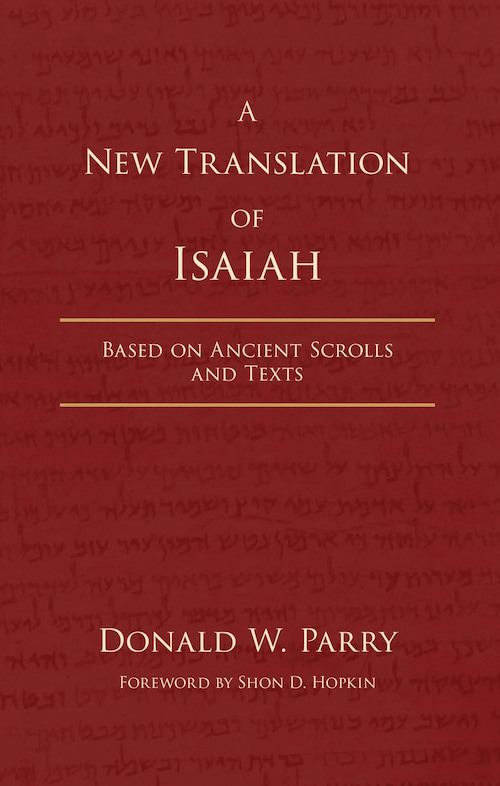
The writings of the prophet Isaiah have historically served as a central yet difficult pillar within the Latter-day Saint tradition, often obscured by the linguistic limitations of seventeenth-century English of the King James Version. In his latest volume, A New Translation of Isaiah: Based on Ancient Scrolls and Texts, Donald W. Parry, a professor of ancient scripture at Brigham Young University, offers a specialized translation that synthesizes Dead Sea Scrolls scholarship with Joseph Smith’s translation projects. This work represents the culmination of a trilogy, providing a readable, structurally oriented text designed for a modern audience while maintaining a foundation in rigorous manuscript analysis. From an academic perspective, the volume is a significant exercise in translation for a specific faith community, creating a unified toolkit that bridges the gap between ancient Near Eastern texts and nineteenth-century revelation.
Textual Basis and Translation Philosophy
The primary scholarly contribution of this volume is Parry’s use of the Great Isaiah Scroll from the Dead Sea Scrolls, alongside the medieval Masoretic Text (MT). As a member of the International Team of Translators of the Dead Sea Scrolls, Parry utilizes his access to the oldest surviving biblical manuscripts to correct passages that appear corrupted or unexpected in traditional versions. A couple of examples include changing the word “seer” in Isaiah 21:8—where the MT and KJV read “lion”—and “witnesses” in Isaiah 33:8—where the MT and KJV read “cities.”
Parry’s translation philosophy follows the language of the King James Version to a significant degree, preserving its familiar cadence. Yet, he modernizes and corrects it where the seventeenth-century English has become obsolete or inaccurate. He chooses to modernize archaic pronouns such as thou, ye, and saith, arguing that these forms often hinder the comprehension of many readers. At the same time, he stays true to Hebraic wording, such as the construct form “House of the Lord” and the characteristic, “and it came to pass,” which serve to anchor the text in its original ancient Near Eastern literary context. His commentary in the footnotes isn’t strongly interpretive and focuses primarily on translation notes and variants.
Methodological Integration of Restoration Scripture
What distinguishes this volume from a strictly critical or secular edition is its explicit integration of the Restoration’s textual corpus. Parry incorporates dozens of variants from the Joseph Smith Translation (JST) and the Book of Mormon, demarcating these additions and corrections with brackets. This results in a “composite” translation that treats nineteenth-century revelations as valid textual witnesses alongside 175 BC Qumran scrolls. This approach provides a cohesive narrative for the Latter-day Saint reader. Parry further utilizes his expertise in Hebrew poetics to organize the text into many parallelistic and chiastic structures. By formatting these “rhymes of thought,” he aims to clarify the methodical logic underlying Isaiah’s message in modern formatting that makes the structure of the text clearer.
A particularly innovative methodological choice is the identification of approximately sixty distinct speakers throughout the text. Because Isaiah’s artistic delivery frequently shifts perspectives without explicit markers, discerning between the Lord, Isaiah, or entities like “Lady Zion” can be difficult. Parry provides provisional assignments for these speakers in the left-hand column of the translation, based on textual clues and interpretation.
As might be expected for a translation produced before the change to the handbook allowing for more translations to be used in the Church, Parry is transparent about the volume’s status. He states explicitly that it does not replace the King James Version and is neither “authoritative” nor “official.” It is presented as a study resource, yet its scholarly and professional background ensures that it rises above mere devotional summary.
As a side note, this publication feels like an indication of a good direction in FAIR becoming a publishing house in Mormon Studies. I find it encouraging to have another press, alongside the BYU RSC, Greg Kofford Books, and Oxford University Press, that is positioned to print these types of high-quality scripture editions and translations for Latter-day Saints.
Conclusion
Donald W. Parry’s A New Translation of Isaiah represents a specialized contribution to the expanding corpus of Restoration-centered biblical scholarship. It functions effectively as a structural and textual bridge, offering a readable edition that accounts for both the antiquity of the Dead Sea Scrolls and the theological developments of the Restoration. While the bracketed inclusion of Book of Mormon and JST variants creates a categorical hybrid that diverges from strictly secular critical methodology, Parry is consistent in his approach. For the student of Mormon history and philosophy seeking a resource that synthesizes manuscript evidence with modern revelation, this volume provides a rigorous linguistic framework. It serves as a testament to Parry’s specialized expertise and is a valuable resource for Latter-day Saint readers.
For info on more books being published in 2026, see Mormon Studies Books in 2026.
Comments
2 responses to “A Review: A New Translation of Isaiah: Based on Ancient Scrolls and Texts”
How can I get a copy
Click on the picture or either hyperlink. Or search on Amazon. Any of those will get you there!