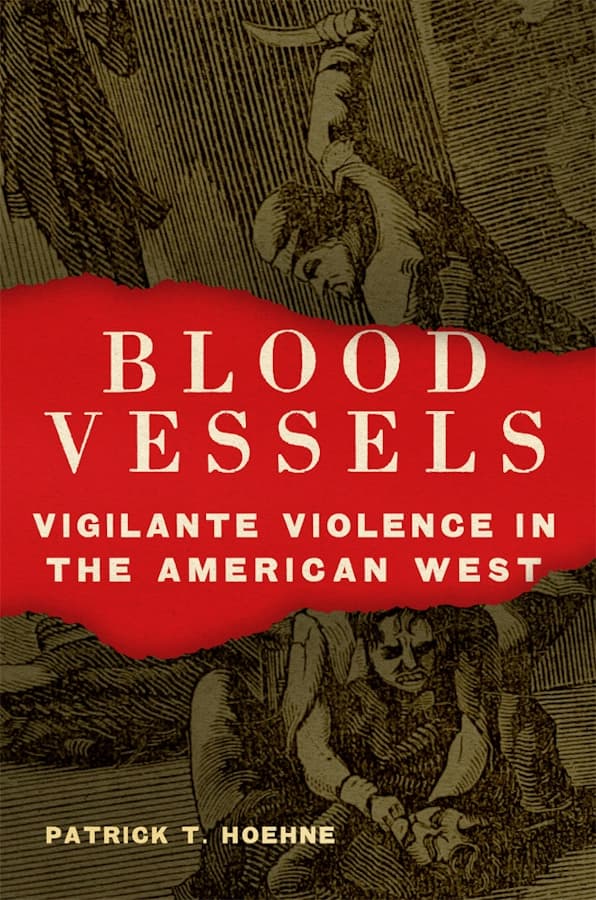
In Blood Vessels: Vigilante Violence in the American West (University of Oklahoma Press, 2026), Patrick T. Hoehne provides a compelling and sophisticated analysis of extralegal justice that challenges the traditional view of Western violence as a series of isolated, frontier outbursts. Instead, Hoehne maps a trans-regional network of “blood vessels”—interconnected events and actors that carried the logic and tactics of lethal vigilantism from the Mississippi Valley to the Rockies and beyond.
A Network of Extralegal Justice
The strength of Hoehne’s work lies in his ability to trace the movement of specific individuals and families across the American landscape, showing how lessons learned in one theater of conflict were applied in the next. The narrative begins with the 1840 Bellevue War in Iowa, where a posse-turned-mob’s attempt to arrest an innkeeper accused of counterfeiting and horse thieving devolved into a lethal shootout. (As a side note, I served part of my mission in the tri-state area, so it was kind of funny to see sleepy communities like Savannah, Bellevue, and Dubuque that I spent time in as the center of a violent confrontation that had ramifications across a larger area.)
Hoehne demonstrates that this was not merely a local skirmish but a foundational moment that radicalized participants. He follows the survivors and their associates as they moved into Ogle County, Illinois, where they attempted to oppose a club of regulators who used violence to enforce land claims. This escalating conflict—characterized by cold-blooded executions and retribution—established a blueprint for extralegal action that would soon intersect with the history of the Latter-day Saint movement.
Re-evaluating Thomas Ford and the Carthage Assassination
For scholars of Mormon Studies, the most significant contribution of Blood Vessels is Hoehne’s re-evaluation of Illinois Governor Thomas Ford. For generations, historians have puzzled over Ford’s erratic behavior in the twenty-four hours leading up to the June 1844 assassination of Joseph and Hyrum Smith. By contextualizing Ford through his earlier experience as a judge during the Ogle County vigilante crisis, Hoehne offers a convincing perspective on what he may have been doing.
Hoehne argues that Ford had reached a cynical conclusion: extralegal mob violence was an inevitable force of nature that could not be stopped, only channeled. In this view, Ford’s decision to dismiss the majority of the militia while leaving the hostile Carthage Greys in charge was a calculated attempt at containment. By concentrating the violence in Carthage while he personally visited Nauvoo, Ford sought to ensure that any Latter-day Saint retribution would be focused on a single community rather than igniting a regional civil war. This maneuver provided Ford with plausible deniability while effectively removing a political thorn in his side, in the person of Joseph Smith. While the plan did not unfold perfectly, Hoehne’s analysis moves the discussion of Ford away from simple incompetence toward a more sinister brand of pragmatic maneuvering.
The Western Migration of Violence
The book further explores how the unraveling of counterfeiting and horse thieving rings in western Illinois—which operated as part of the criminal underworld of Nauvoo—catalyzed subsequent violence. Hoehne skillfully tracks these players as they participated in the early settlement of Omaha, Nebraska. There, the “claim clubs” utilized the same vigilante mechanisms to enforce land claims, introducing a new generation of settlers to their lethal extralegal methods.
This lineage of violence eventually merged with the experiences of actors from San Francisco’s Committees of Vigilance and the partisans of “Bleeding Kansas.” When these disparate groups converged in the mining camps of Denver and western Montana, they produced some of the most concentrated and violent lynching sprees in United States history.
Conclusion
Blood Vessels is a meticulously researched and fluidly written volume that situates vigilante violence (and some Latter-day Saint history) within the broader, gristly reality of nineteenth-century American experience. Since I am writing this for a Latter-day Saint blog, I will note that for Mormon Studies, Hoehne moves beyond a parochial focus on religious persecution. Instead, Hoehne reveals how the violence directed at the Saints was part of a larger, systemic phenomenon of extralegal “justice” that defined the era.
This book provides essential context for the Martyrdom of the Smith brothers and the subsequent exodus from Illinois. It is an important volume to read for scholars seeking to understand the mechanics of mob power and the fragile nature of the rule of law on the American frontier.
For info on more books being published in 2026, see Mormon Studies Books in 2026.
Comments
9 responses to “A Review: Blood Vessels: Vigilante Violence in the American West”
Thanks for the review. It’s always interesting to learn more historical context.
Yeah. I’m loving that we’re starting to get more books that aren’t specifically about Mormon history that include Mormon history as part of their story, since that offers a different look at the context in which our history took place.
Thanks, Chad.
Sounds interesting! Can I borrow it?
Thanks very much for the review.
Any connection of his thesis to Mountain Meadows?
Mountain Meadows Massacre isn’t addressed in the book, but the thesis of one act of violence leading to another based on the previous experience could easily be applied.
John Brown gets a mention? And do they explore racial dynamics in general?
Looks interesting, particularly the bit on governor Ford. here’s hoping my library gets a copy.
From what I’ve read on California’s vigilance committees they involved a substantial portion of the population, so I wonder how that fits with tracing individual actors.
RL, I don’t think it went into John Brown, at least not the famous one. There is some discussion of race dynamics in one or two situations, but the focus was primarily on white-on-white violence.