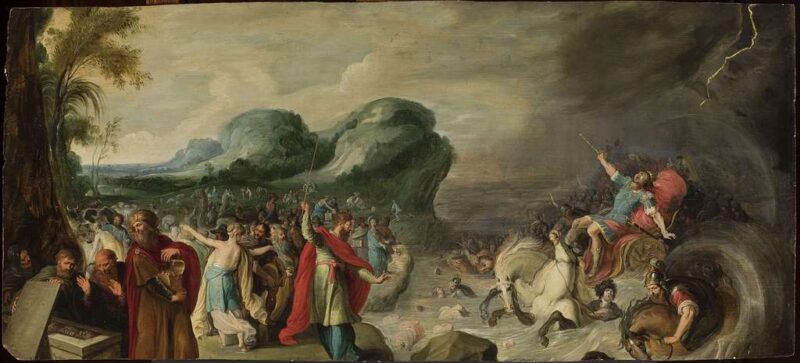
The story of the exodus of the Israelite from Egypt is often used as a metaphor for the downtrodden and despised. Our own tradition has frequently used the story for its similarities to the pioneer trek from Nauvoo to Utah, and, for different reasons, the story was an important element in the discourse of the civil rights movement in the United States. In contrast, no one puts themelves in the role of pharaoh in the story — no matter how cruel, how much the rights of minority groups are ignored, no matter how much minorities are subjugated, enslaved and killed for the “safety” and even convenience of those in power, no one thinks they are the Egyptians in the story. Perhaps we should think about that.
In contrast, the lesson takes a spiritual approach to the story, seeing the bandage in Egypt as similar to the bondage of sin, with Christ’s atonement as the saving act, that compels Sin to “let my people go.” If so, then who is Pharaoh in the story? I suspect most people will claim that Satan fills that role. While certainly true, that is also a very convenient answer, because it resolves each of us of our own participation and promulgation of Sin. Perhaps we should think about that also.
I can choose to soften my heart.
Was Pharaoh responsible for “hardening his heart?” The wording in Genesis can be read to imply that God did that, the equivalent of “the devil made me do it.” I don’t like that reading—I believe that Pharaoh, like all of us, should take responsibility for his own actions. But, I do hope that God has some influence over us — that His persuasion can help us “soften” our hearts to become more charitable. I’m not sure how that works, exactly, but I do hope that we can learn how to “soften” our hearts.
In the following poem, Lucy Minerva Woodward Hewlings asks ‘Charity’ to “Soften hour hearts”. Indeed, there is little difference between what ‘softening’ involves and having ‘charity’ for others.
Invocation to Charity
by L. M. Hewlings
- Dear messenger of Charity,
- Descend from heaven we pray,
- And on our earth-born hearts the gift,
- Of thy sweet influence lay.
- Quicken our dormant souls,
- And on our slumbering eyes,
- Impart the power to behold,
- Where the path of duty lies.
- Soften our hearts that they ne’er close,
- To thy holy pleading voice;
- For every impulse born of thee,
- Makes some sadden’d heart rejoice.
- Dear sacred messenger of peace;
- Oh, come quickly to our aid!
- Pour from thy bounties large increase,
- ‘Till all deadly strife is staid.
- On waiting hearts throughout our land,
- Let thy presence cheer and warm,
- ‘Till all go forth at thy command,
- In love’s spirit newly born.
1891
Jesus Christ can save me because of His Atonement.
Like salvation from slavery in Egypt, salvation from Sin required a savior. But again this idea raises the issue of responsibility. We have agency to make choices, but we don’t seem to be able to be successful without the assistance of the Atonement. Where is the line between personal responsibility and relying on the Savior?
This is the question behind the following poem, perhaps the best known of Orson F. Whitney’s poems. It is a reply to William Ernest Henly’s well-known poem, “Invictus”, which places the responsibility for our souls firmly on us, proclaiming “I am the Captain of my Soul.” Whitney objects, pointing out that Christ has saved us, and in the process has become “The Captain of thy soul.”
The Soul’s Captain
(A Reply to William Ernest Henley’s Poem “Invictus,” ending with the line, “I am the Captain of my Soul.”)
By Orson F. Whitney
- Art thou in truth? Then what of Him
- Who bought thee with His blood?
- Who plunged into devouring seas
- And snatched thee from the flood?
- Who bore for all our fallen race
- What none but Him could bear, —
- The God who died that man might live.
- And endless glory share?
- Of what avail thy vaunted strength
- Apart from Him who gave?
- Pray that His light may pierce thy gloom,
- Who else thy soul can save?
- Men are as bubbles on the wave.
- As leaves upon the tree.
- Thou, captain of thy soul, forsooth!
- Who gave that place to thee?
- Free will is thine — free agency,
- To wield for right or wrong;
- But thou must answer unto Him
- To whom all souls belong.
- Bend to the dust that head “unbowed,”
- Small part of Life’s great whole!
- And see in Him, and Him alone,
- The Captain of thy soul.
1930
The sacrament helps me remember my deliverance through Jesus Christ.
Regardless of what you think about responsibility and Christ’s role in our lives, it’s clear that the efficacy of the atonement depends on our remembering Christ’s sacrifice and trying to apply it in our lives. Like the Passover, the ceremony the Israelites instituted to remember the exodus from Egypt, we take the sacrament each week to remember Christ’s sacrifice and its importance in our lives.
In the following poem, Theodore Curtis tries to put all of this together, showing the need for Christ’s sacrifice as well as the need to remember it.
The Sacrament
by Theodore E. Curtis
- With Adam and the first great sin,
- Eternal Death was ushered in;
- And fell its stern and fatal ban
- O’er all the race of fallen man.
- There was no power in man to save
- The groping nations from the grave,
- Till a redeeming arm of love
- Was given from the courts above.
- He came, the mighty Prince of Peace,
- To cope with Death for our release;
- He died, and in the grave alone,
- He conquered Death upon his throne.
- So, when we meet to take afresh
- The emblems of his broken flesh,
- Remember, by his sacrifice,
- Of all that live Death only dies.
1910
Comments
2 responses to “CFM 4/6-4/12: Poetry for “Remember This Day, in Which Ye Came Out from Egypt””
“But, I do hope that God has some influence over us — that His persuasion can help us “soften” our hearts to become more charitable.”
I have the same hope–and I think the book of Mormon gives us a good example of how the Lord’s influence can soften our hearts. 1 Nephi 2:
16 And it came to pass that I, Nephi, being exceedingly young, nevertheless being large in stature, and also having great desires to know of the mysteries of God, wherefore, I did cry unto the Lord; and behold he did visit me, and did soften my heart that I did believe all the words which had been spoken by my father; wherefore, I did not rebel against him like unto my brothers.
This is a sharp and intellectually stimulating analysis that brilliantly deconstructs the **’liturgical architecture’** of collective memory and the critical importance of poetic structure in the evolution of modern devotional strategy. I particularly appreciate the way the feature highlights how the shift from historical recitation to high-impact, mission-aligned rhythmic reflection serves as a vital bridge between the abstract mechanics of the seeker’s journey and a profound, lived experience of narrative agency—it’s a powerful reminder that the most resonant creative environments are those that prioritize procedural integrity, ethical complexity, and the strategic interrogation of the stories that shape our shared progress. The insight into how these verse-based frameworks function as both a practical toolkit for the contemporary student and a sophisticated roadmap for the future of the *Times and Seasons* community is a fantastic and deeply moving observation. Thank you for sharing such a clear and focused perspective on the intersection of Exodus theology, craft, and the seeker’s heart!