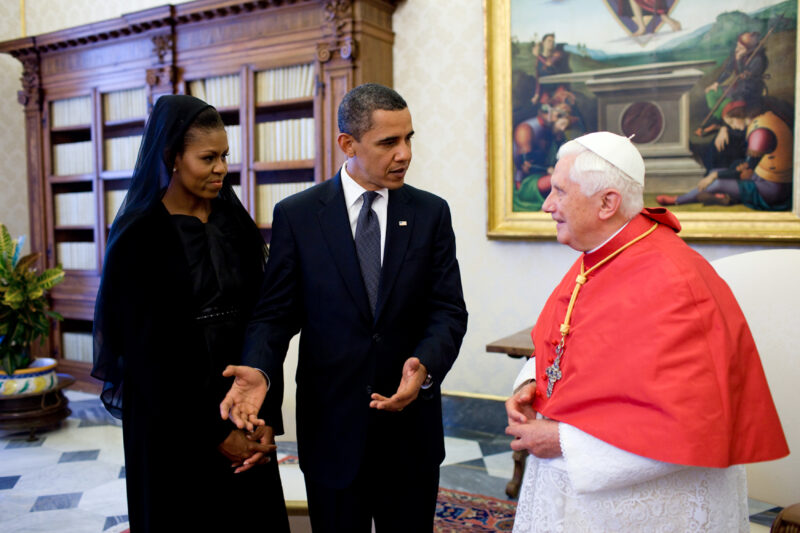
Funeral and temple veiling for women is one of those practices that would sound familiar to other religious traditions (and yes, I’m aware things have changed). For example, during my Traditional Latin Mass research you quickly come into contact with the Catholic version of this–the wearing of the Mantilla that traditional Catholics will often (but not always) wear to the TLM. And then there’s the older tradition that women meeting the pope wear a black veil. This practice has generally fallen out of favor, but it’s sometimes revived, as was the case when Michelle Obama visited the Vatican.
And then in Eastern Orthodox Churches women are supposed to wear a head covering in church, and then of course there are the different variations on the Islamic dress code.
But I wasn’t aware of the actual LDS-specific history and thought behind the practice, and how it might be genealogically related to the common religious practice more generally. Nor could I find any one-stop-shop Dialogue, BYU Studies, or JMH article that explains it, so I did a dive into the practice and how it related to other faiths’ similar practice.
- The first record we have of female veiling appears to be from some of the later ex-member accounts of the temple ceremonies during the Utah era (Stenhouse, Young, Green). So I suppose the most parsimonious explanation is that the female veiling was part of the original Nauvoo endowment.
- There’s an online folder in the Prince Collection (“Temples: Bergera – Garments.”) that has several quotes on the rationale for the practice.
- Abraham H. Cannon Journal; BYU Special Collections; Vol XII, pp. 43-4; 31 January 1890.
At the Gardo House the question arose this morning as to whether the face of a woman who has had her endowments should be veiled or not when her coffin is closed on her dead body. Pres. Woodruff did not decide in absence of any written law on the subject, but Bro. Joseph F. thought the face should be covered as this was the course pursued in the early days of the Church, and it was doubtless done in accordance with some instuctions of the Prophet.
- Journal of Abraham H. Cannon; Thursday, January 7, 1892.
Thursday, January 7, 1892 . . . It was agreed that when the coffin is closed containing the body of a sister who has been through the temple, her veil should be placed so as to hide her face, so that when her husband meets her on the other side he may lift the same from her countenance. This is in accordance with the instructions which President Young gave during his life.
- Journal of Samuel W. Richards; September 12, 1894.
Sept 12, 1894: Prest Snow informed me he had not been able to obtain information why women were required to vail [sic] their faces when at prayer in the Temple.
So it looks like the earliest takes weren’t clear on the rationale behind the practice, but it was probably part of the original ceremony.
Where did the idea come from? Standard throat clearing, there’s nothing contradictory about recognizing the role of both environment and inspiration in revelations. I have no problem with the idea that Joseph Smith could have received a revelation about veiling “whole cloth,” but this is one of those things that I suspect was a part of the background environment.
The Catholic practice traces its roots to 1 Corinthians 11:2-16, so given other LDS practices that found inspiration in 1 Corinthian like baptisms for the dead, it’s possible that there’s a direct connection between Corinthians and the Nauvoo practice.
And then there’s the Jewish practice of bridal veiling, which has its inspiration in a different biblical event (obviously): the veiling of Rebekah as Isaac approached before their marriage (and then of course, we have one case in the bible where a man–Mose–veils himself). I assume that there’s probably some connection between this and the European practice of marital veiling, but whatever the case in 1840 Queen Victoria had her famous wedding that invented the traditional-white-wedding-gown-with-the-veil fashion motif, even if the practice of marital veiling predated the famous wedding. As noted above, Brigham Young saw this as the motivation for the funeral veiling, but the temple veiling still remains unexplained.
As far as I know it doesn’t appear that there’s a clear historical or theological explanation from Smith himself or even from a second-hand source explaining the symbolism or provenance of the practice. However, it is likely that some influence of the marital ritual, 1 Corinthians, and possibly other religious practices may have provided the catalyst.
Leave a Reply