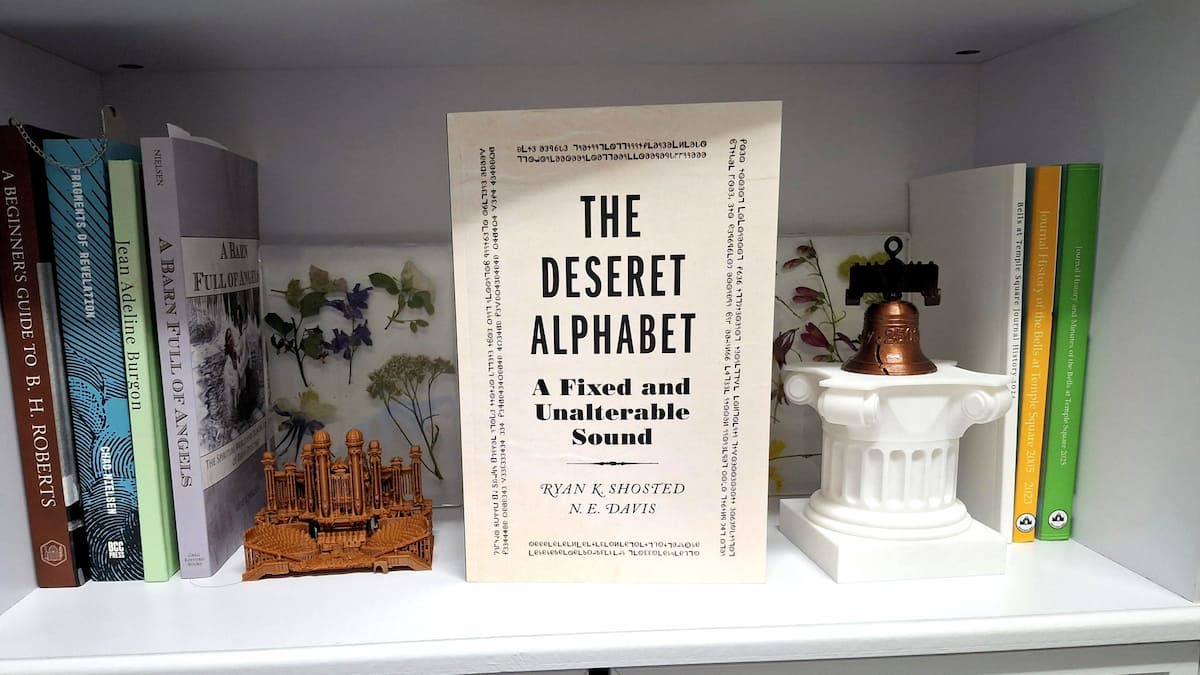
Ryan K. Shosted and N. E. Davis. The Deseret Alphabet: A Fixed and Unalterable Sound. Urbana: University of Illinois Press, 2026. 315 pp. Paperback: $25.00. ISBN: 978-0-252-08942-8.
Reviewed by Chad L. Nielsen
My own interest in the Deseret Alphabet is admittedly sentimental. While serving a mission in Iowa, I regularly corresponded with the young woman who would later become my wife. To playfully test her patience, I frequently appended untranslated postscripts written entirely in the Deseret Alphabet. She spent over a year attempting to decode the script, correctly identifying that it was a phonetic system but failing to pinpoint which one. It was only during a Christmas date at Salt Lake City’s This Is the Place Heritage Park—while dancing inside the historic schoolhouse and pointing to an alphabet chart on the wall—that I finally revealed what it was. Consequently, I am predisposed to welcome any scholarly work that brings this eccentric piece of Great Basin orthography into the light.
Fortunately, Ryan K. Shosted (a professor of linguistics) and N. E. Davis (a computer language designer) have produced a volume that can belong on the shelf of any serious student of the Mormon past. In The Deseret Alphabet: A Fixed and Unalterable Sound, the authors approach this audacious nineteenth-century linguistic experiment from multiple, intersecting angles, detailing its visionary origins, its contested social functions, and its eventual decline.
From Adamic Purity to Orthographic Reform
One of the most valuable contributions of the book is how clearly it connects the Deseret Alphabet to the broader, early Restoration impulse to recover a “pure” or “Adamic” language. Historically, because Brigham Young was the primary executive force behind the alphabet’s mid-century push, I understood it as a purely pragmatic, frontier endeavor designed to simplify English spelling and consolidate a culturally distinct territory. Shosted and Davis correct this by tracing its intellectual lineage directly back to Joseph Smith’s esoteric translation and pure language projects, including the Grammar and Alphabet of the Egyptian Language (GAEL).
While Brigham Young did not directly participate in the Kirtland language projects, he was deeply familiar with Joseph Smith’s views on the sacred nature of words. Indeed, it was Young who introduced speaking in tongues into early Latter-day Saint worship, and he openly expressed his desire to eventually return to a pure, uncorrupted tongue. Though the Deseret script was not directly derived from the characters of the GAEL, Shosted and Davis demonstrate that it was the direct intellectual descendant of that earlier, visionary pursuit of a celestial language.
Pioneers, Pronunciation, and Dialectology
For historical linguists, the book’s analysis of mid-nineteenth-century Utah dialects is very interesting. Because the Deseret Alphabet was strictly phonetic, the spelling of printed materials and personal journals provides an incredibly precise, phonetic “fossil record” of how early pioneers actually pronounced words.
This phonetic fossil record yields some fascinating discoveries regarding the pronunciation of unique Latter-day Saint terminology. For example, the authors show that Liahona was originally pronounced with a long i and o sound—modeled as Lai-eh-hohna rather than the modern Lee-ä-hohna (my spelling, since this edition of WordPress doesn’t handle a lot of specialty characters). Similarly, Cumorah was phonetically rendered as Kioomorä, while Deseret was dezeeret instead of dezuhret. These transcriptions offer an invaluable window into the regional dialects of the early Great Basin, revealing how the linguistic background of New England, the Midwest, and British converts played into the regional accents of Utah.
A Lexical Hurdle
Despite the book’s impressive research and insightful framing, readers are likely to encounter one significant stylistic hurdle: the authors’ choice of vocabulary. Throughout the text, Shosted and Davis write with an exceptionally dense, academic vocabulary that occasionally borders on the ostentatious. As someone who prides myself on maintaining a relatively robust vocabulary, I found myself forced to halt and consult a dictionary several times per chapter simply to understand what the words they were using meant. While high-level academic prose is to be expected from a university press, the density of the vocabulary here occasionally interrupts the reading experience and risks alienating the broader, semi-professional or amateur Mormon Studies audience that would otherwise benefit most from the book’s insights.
Conclusion
The Deseret Alphabet is an indispensable addition to the fields of nineteenth-century American history and Mormon Studies. Shosted and Davis successfully illuminate the Deseret Alphabet despite its reputation as a curious, failed frontier novelty. Instead, they successfully reframe it as a living monument to a people’s visionary struggle with the divine potential of the written word. For those interested in the material, cultural, and linguistic history of the Intermountain West, this book is highly recommended.
For info on more books being published in 2026, see Mormon Studies Books in 2026.
Comments
5 responses to “A Review: The Deseret Alphabet: A Fixed and Unalterable Sound”
You missed the best one. It is not the Book of Mormon. It is the Book of Mahrman according to the Deseret Alphabet edition.
At least in the introduction, I didn’t find the vocabulary too far outside the norm for the academic humanities, but introductions are often more approachable. The choice to occasionally refer to the Deseret Alphabet as just “the Deseret” seems utterly bizarre to me, and I wonder how well the authors understood the source or informant from which they borrow this usage. After reading the introduction, my impression is that the authors do not respect the people they are writing about.
There were just a lot of bizarre choices, and El Call has a more thorough look at those (https://www.associationmormonletters.org/reviews/current-reviews/shosted-and-davis-the-deseret-alphabet-a-fixed-and-unalterable-sound-reviewed-by-el-call/). I.e., lots of highly technical language about language, but a refusal to use International Phonetic Alphabet because they didn’t want to burden a non-specialist audience.
As a biologist, I was annoyed that they skipped right to referring to honey bees as A. mellifera without ever actually introducing the genus in full before abbreviating, which is a technical failure on their part, and another odd choice, but also nitpicky on my part.
I agree that this is a terrific book, scholarly yet approachable. I was astonished to learn how complex the story is and how rooted in Mormon utopianism. Great review!
Hey, Shosted was my home teaching companion in Urbana, lo these several decades ago!