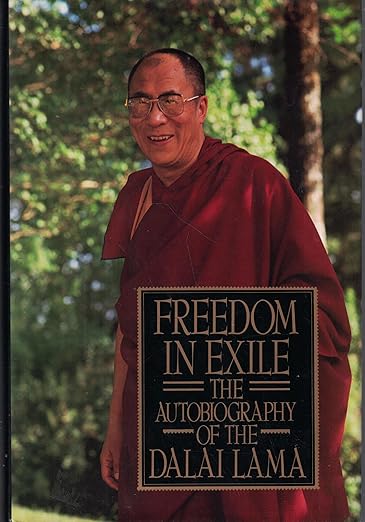
Latter-day Saint Book Review: Freedom in Exile, The Autobiography of the Dalai Lama
The Dalai Lama is the coolest of the cool for a certain progressive type that pines for an authentically spiritual alternative to what they see as the problems of western organized religion. E.g. Peggy Fletcher-Stack’s public Facebook profile picture is of her meeting him (I’m not questioning her Mormonism or saying she’s a crypto-Buddhist, just that he appeals to her sociocultural/ideological demographic), Richard Gere converted to Tibetan Buddhism, and even Sam Harris was his bodyguard for a short stint and still maintains significant respect for him. And after reading his autobiography I can see why. It’s hard to not like the man. (Which makes the Chinese efforts to make him out to be some sort of wannabee Caesar all the more laughable). While he was born into a role that was handed to him on a platter, his power authentically stems from his Durkheimian religious charisma more than his legalistic position as Dalai Lama (although the latter helps).
He shows a sort of assume-the-best-in-people approach that you rarely see in cynical, modern heads-of-state. Even when he is speaking about the Chinese officials who took over Tibet in the early days, he takes time to point out which ones he thought were sincere and that he thought highly of. He takes the anti-China propaganda against him in stride and good humor, jocularly referring to one case when the Chinese “suggested that I performed certain quite surprising sexual services for Mrs. Gandhi!” [Indira Gandhi, the then-Prime Minister of India]. Still, he doesn’t make the mistake of being both harmless and wise as doves; he’s an adept politician at playing his very limited hand vis-a-vis his homeland and the Chinese.
A few other points.
- There’s a CCP pattern towards religious groups–be it Tibetan Buddhism or the Vatican–that does not bode well for us Latter-day Saints. The CCP doesn’t compromise on having absolute and total control over the leadership of the religions they allow in, whether it’s them insisting on having a veto over Catholic bishop appointments or them kidnapping the Panchi Lama (the spiritual second-in-command of Tibetan Buddhism) as a child and appointing their own (to this day nobody outside of the CCP knows where the true Lama is). I wasn’t exactly optimistic Eddy on the Church in China before this, but after reading this I despaired on the Church ever reaching a sort of live-and-let-live arrangement in China in the medium term; the CCP doesn’t do live-and-let-live.
- He is clearly a True Believing Buddhist(™). He consulted the Tibetan oracles, like we would consult our patriarchal blessings, before deciding to flee to India and takes very seriously various facets of Tibetan Buddhist cosmology and ritual. (Also, Ross Douthat has pointed out that the Dalai Lama’s sex and gender positions are conveniently ignored by his progressive sympathizers. I didn’t see any of that in the autobiography but I assume there’s something there). So the Dalai Lama shouldn’t be seen as a placeholder for some super vanguard religion of the future where dogma and truth claims don’t matter, only love. The man prays for hours every day, you simply don’t have that kind of behavioral commitment without some underlying religious beliefs. He shows you can have both concrete religious beliefs and love.
- Most of my knowledge about the Tibetan situation before I read this book is, like many of you, from Seven Years in Tibet. The scene where the Chinese official stomps on the sand art and snorts that “religion is poison” is somewhat based in truth–except it was Mao himself who said that to the Dalai Lama, but the actual situation was more complicated. The Chinese were respectful of Tibetan religious practices–in the capital–outside they were burning monasteries, forcing monks and nuns to rape each other, and tearing out the tongues of prisoners with meathooks so that they couldn’t yell “long live the Dalai Lama” before they were hanged.
- Like the King of Bhutan or King Juan Carlos of Spain, he is one of the few rulers with total control who voluntarily democratized without being at the point of a gun, although he makes fun of himself when he points out that he “somewhat autocratically” insisted, against the wishes of the democratically elected representatives, on a clause in the Tibetan government-in-exile constitution that the Dalai Lama could be deposed with a two-thirds vote in parliament.
- Word on the street is that the Dalai Lama is seriously considering not reincarnating– ending the line of Dalai Lamas. I know it’s none of my business whether His Holiness decides to continue the office, but I hope he does. However, I get the hesitancy. Like the Community of Christ and Wallace B. Smith, there’s a certain gamble that you take when you somebody is born into a role that they may or may not want or buy into. Plus the Chinese government will no doubt be up to some mischief in regards to his successor. The Tibetans are not guaranteed another good Dalai Lama.
Comments
5 responses to “The Chinese Communist Party, The Dalai Lama, The Church, and Live-and-Let-Live”
Kundun is an amazing movie on the Dalai Lama I watched at international Conema at BYU and have since rewatched. Great director, great score, and a beautiful treatment of religious tradition.
A writer a decade or more back described the Dalia Lama meeting with a gathering of Tibetans in the West. The writer said that in that setting their leader acts like one in authority and sterner than he is with Westerners. Latter-day Saints will remember when Gordon Hickley would be affable and witty on TV with Mike Wallace or Larry King and in General Priesthood Meeting would admonish men to straighten up and do their duty.
Another reason for his popularity in certain circles is his association with mindfulness meditation, including the scientific study of it. I don’t know how much of a role he played in, say, making monks available to be research subjects, but he has come to visit the local research center that works on it.
I imagine one reason he’s considering not reincarnating is that the CCP will presumably identify a new Dalai Lama who will claim leadership of the movement while being under the CCP’s thumb. Meanwhile, the exile community will identify someone else, and there will be a schism. I can see why he might think no Dalai Lama is preferable to that.
I used to be optimistic that it was just a matter of time before the Church was able to operate normally in China. After all, China was on course to become a normal member of the international community, just like Russia! Maybe that was always naive, but certainly under Xi Jinping China is going in the opposite direction…just like Russia…and other countries. (Maybe this paragraph could have stopped at “I used to be optimistic.”)
The Dalai Lama is cool for conservatives as well.
The last time the Dalai Lama was in SLC, Church leaders P3 decided not to meet with him. About the same time, they welcomed Trump (who was accompanied by Hatch).
The irony here is that while refusing to meet with a global proponent of Freedom of Religion, the P3 agreed to meet with a pol whose personal words and actions are disgusting. Not a pretty picture. How about freedom of religion for the Tibetans and Uyghurs?