Many stories of miracles are reasonably attributable to wishful thinking, bad record keeping, friend-of-a-friend rumors, or some kind of neurosis or hallucination. However, there are a number of historical episodes that meet the standard criterion for historical plausibility. Multiple witnesses, contemporaneous accounts, disinterested observers.
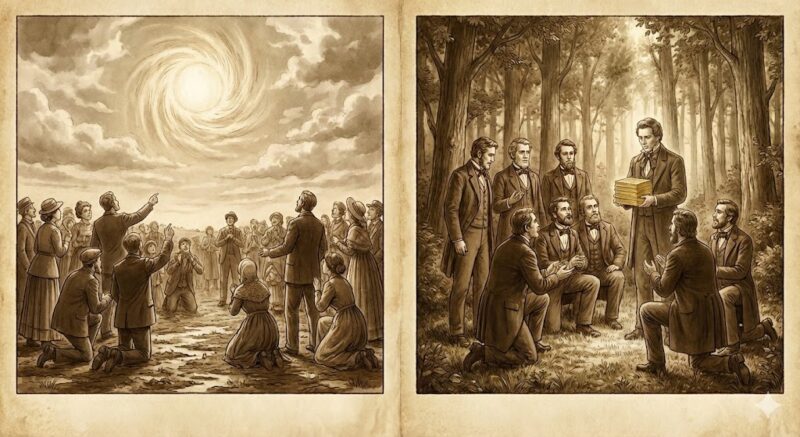
Popular secular Substacker Astral Codex Ten referred to the Fatima Miracle of the Sun, when hundreds of people supposedly witnessed the sun dancing in the sky in fulfillment of a prediction of some peasant children that were later sainted, as the “the final boss of paranormal experiences… The witnesses included journalists, atheists, prominent scientists, and people who freely admitted that they had only attended in order to laugh at everyone else when nothing happened. There are far too many of them to dismiss, and their reports are surprisingly close to unanimous. People in nearby towns who knew nothing about the miracle claimed to have seen the same thing, seemingly ruling out mass hallucination. There are photographs – too low-tech to clearly visualize the sun, but clear enough to show a crowd pointing at the sky in astonishment.” Recently there was a flurry around Substack as skeptics and religionists on the Fatima question, including NYTimes columnist Ross Douthat, back-and-forthed about whether the standard skeptical responses held water there.
I also just finished reading (okay, skimming really) They Flew: The History of the Impossible by Yale Historian Carlos Eire. He basically covers accounts of saintly levitation and bilocation (being two places at once) as if they were actual historical events, treating eyewitness accounts as he would treat them for any other account. One advantage of the Catholic Church being very legalistic is that they gathered reams of meticulously collected evidence for sainthood investigations. It is true that some of these accounts are more plausible than others. Some of them are documented years after the fact. Some of them were shown to be fraudulent and the supposed miracle workers were using magician-type tricks that would later be employed during the spiritualism craze, but there are a handful of cases that would be assumed to be valid if we treated them like any other historical event, with multiple contemporaneous witnesses that didn’t necessarily have a dog in the fight.
In the Latter-day Saint world I think the Witnesses fit in this category. There are multiple accounts (11, 12 including Joseph, and even more if we include informal Witnesses). Many of the basic accounts are close to contemporaneous with the time they were shown the plates (e.g. the signed witness statement), and many of them left the Church later, thus fulfilling the criterion of embarrassment. (So no, contra Mark Twain on this, the fact that many of the witnesses were related–when the entire Church basically consisted of four families total, isn’t a huge mark against their validity). Again, if it was a non-supernatural historical event its reality would be taken as a given.
So how do we address this? Are we forced to accept one if we accept the other?
For me the Witnesses–and the Miracle of the Sun for that matter–have enough evidence to give one pause, but not enough to single handedly epistemologically force religious belief. The likelihood that their respective faith tradition’s truth claims are valid is higher than they would be without these well-documented miracles but they don’t, by themselves, take us all the way. If I wasn’t a believer I would agree that the Witnesses are weird and I couldn’t quite explain it, but by the same token if God is going to try to convince me through empirical evidence He could easily provide more. In Hume’s words on this, “No testimony is sufficient to establish a miracle unless it is of such a kind that its falsehood would be more miraculous than the fact that it tries to establish.”
Taking a step back, however, there’s the meta-question of why God would allow these occasional miracles. For the Book of Mormon it was relevant to a very particular truth claim that the restoration hinged on, so that, contrary to South Park and any other pop culture depiction of Joseph Smith, it wasn’t just one guy who refused to ever show them to anybody and we all had to take his word.
However, it’s less clear why God would have a Buddhist monk levitate just to levitate. What’s God’s point in endowing very particular people with magician-type powers that sit at the edge of historical plausibility? (It’s also worth noting that the critique people have of UFOs is valid here. If UFOs were occasionally visiting earth we would expect to see more sightings and photographic evidence now that everybody is carrying a camera around in their pocket, but so far there hasn’t been an increase in photographic evidence. In much the same way, while technically there may be eyewitness accounts that meet certain historical standards, the fact is that the miracle spigots seem to have turned off once we have reliable scientific recording and measurement processes).
Maybe it serves the same function in providing a little more space for faith, but specifically what teachings, practices, or dogmas are confirmed by so-and-so levitating? While I won’t hand wave away the miracles of other faiths, indeed I’m not entirely against the idea that our faith doesn’t allow other faiths their miracles in certain contexts, I recognize that mass psychology, bad record keeping, and sometimes outright fraud probably goes pretty far in explaining a lot of supposedly supernatural events. But regardless, once we’re okay with a miracle happening, the bigger issue is why, and in my opinion the Witness statements are the perfect example of a miraculous event that not only is historically reliable, but also has a clear role to play in a religious narrative. It makes sense why God would do what He did with the Witnesses.
Leave a Reply