
OpenAI just came out with their latest stepwise improvement, so I went ahead and cancelled my Gemini subscription and got a ChatGPT one (that’s not saying I’ll stay loyal, I’ll probably switch back at some point when Google pulls ahead).
To give you a sense of where we’re at right now, a few days ago and a kid with no mathematics training literally ChatGPTed the answer in one prompt to an unsolved mathematics problem that resisted efforts of professional mathematicians for decades . The New ChatGPT has much better visual and coding capabilities, especially when combined with Codex, their Desktop app that allows the AI to iterate over its own commands and respond to its own output.
So, with a few prompts I created.
- A 50-page graphic novel of the Book of Moroni. It had a harder time with the speech bubbles than Gemini so the dialogue is near the bottom of the frame, but it can create much more content with much more consistency than before. See it here. (And yes, ChatGPT has decided that Moroni had a man-bun).
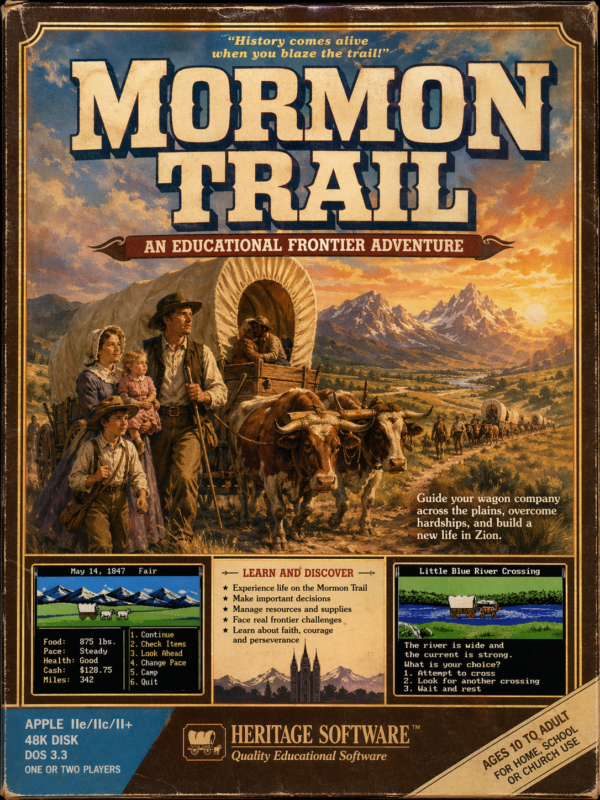
- A game “like Oregon Trail,” but Mormon Trail. Play it here. I tried to get it to match the retro, 1990s video game look, but it’s a touch off.
- ChatGPT now really excels at handling massive amounts of text, so I created an image of Nephi writing 3rd Nephi (and yes, I know Nephi didn’t write in English).

Once again, none of these are perfect (the dialogue for the Mormon/Moroni graphic novel is schmalzy), but still, not bad for a few minutes of work on my end.
Comments
2 responses to “Latest AI Updates: “Mormon Trail,” a Graphic Novel of Mormon/Moroni, and 3 Nephi on Gold Plates.”
A grad student recently came close to embodying one of my fears about AI: after describing a not-hard-but-not-trivial data wrangling problem, she ended not with “How can I do that?” but with “I don’t know Stata, so I got AI to write this code for me. Can you tell me if it’s right?”
It wasn’t. To be fair, she may not have described the problem clearly in her prompt. Learning to code also teaches you to describe things precisely.
The good news is she knew she needed to ask, and had someone she could ask. I’m more worried about all the grad students who don’t. We’re seeing a drop in registrations for the workshops we teach, and I suspect that’s because many grad students are thinking, like this one, “Now that we have AI, I don’t need to learn R/Stata/Python/whatever.” This leaves them incapable of even reading the code AI generates for them.
I don’t know how these errors are going to get caught. With something like your Mormon Trail game, you can test it and see if it works, but that’s hard to do with social science research code–especially if your solution is getting AI to write testing code you also can’t read. In her case, the errors were egregious enough that someone who is familiar with the subject could probably look at her “Table 1” and say, “That doesn’t seem right,” but it’s easy to imagine errors that give plausible-looking results but the wrong answer to your research question. Peer review is not code review; a reviewer may tell you you used the wrong statistical technique, but isn’t going to catch that you tried to use the right technique but didn’t get the code right. I fear it’s going to take some high-profile, embarrassing replication failures along the lines of Reinhart and Rogoff’s “Growth in a Time of Debt” paper, which could be career-ending for a young scholar, before the message sinks in that AI can help you spend less time coding, but can’t get you out of learning how to do so.
Yes, I’m banging this drum with the faculty responsible for training these grad students.
You’ve hit on why I’m much less nervous about AI taking my job than I would be if I was a game designer. For video games the proof is in the pudding. If I can vibe code a game that is indistinguishable from something hand-written then any errors will get caught in the testing stage, whereas with data science you can have very subtle errors that creep in that can remain uncaught if they’re not reviewed by somebody who knows what they’re doing. So I suspect computer game coders will need to look for new work in 5 or so years once you can vibe code an advanced first-person shooter like you can vibe code pretty much any Atari game at this point, but I have a really hard time ever seeing an investment bank rely on figures that were completely vibe-coded without having their quants at least check the math and coding.