Google recently released Nano Banana 2, the most advanced image generator for small detail kind of stuff. (Still not the more advanced for artistic purposes, that’s still Midjourney–when people still say that all AI image generation is slop I point them to online fora of Midjourney artists).
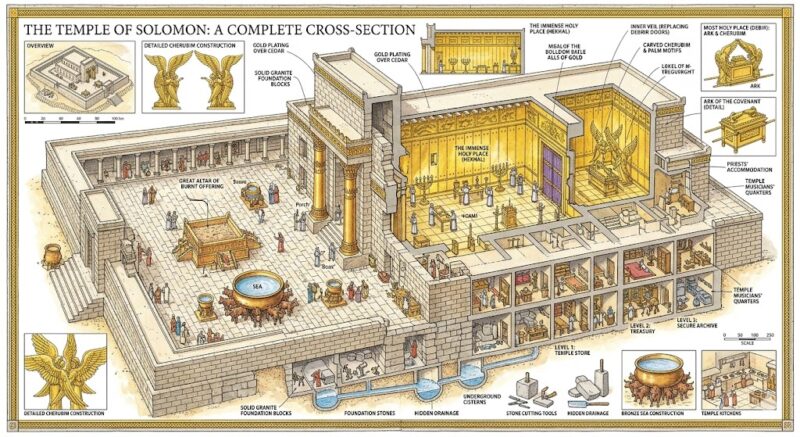
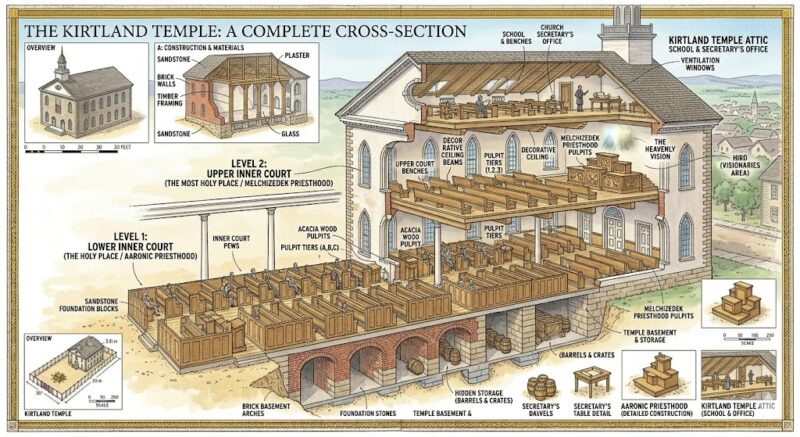
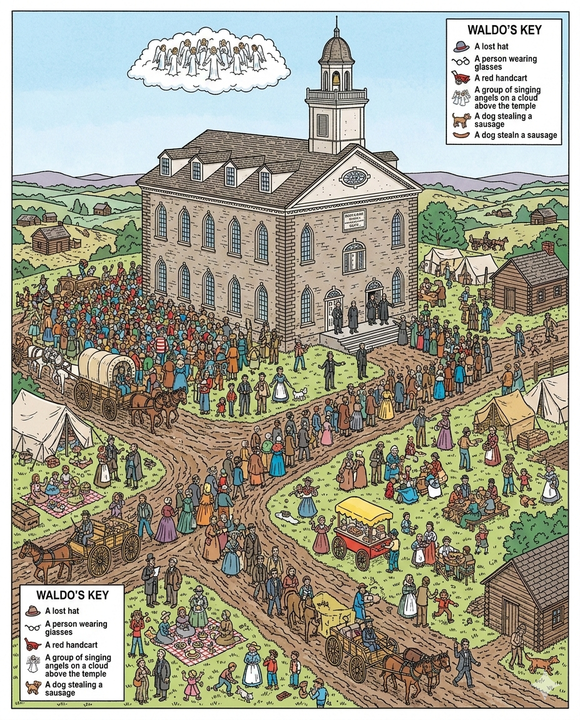
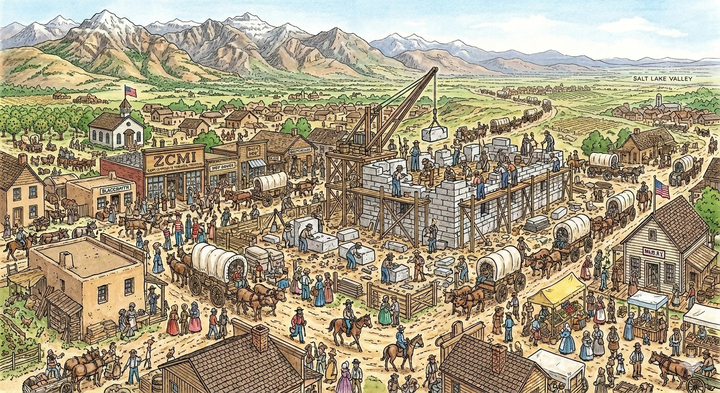
When I was a kid I loved those Stephen Biesty cross-section books, the kind where you folded out the image of the Titanic, castle, or whatever and you were able to see the insides. I also liked Where’s Waldo, so I used the new Nano Banana 2 model to do Latter-day Saint versions. (Noting that Pat Bagley at the Salt Lake Tribune already produced a Nephite “Where’s Waldo”).
Of course there are inaccuracies, and if I wasn’t preparing for an international business trip I’d clean it up, develop it more and add more funny aside scenes like the real Where’s Waldo (these are all one-prompt, simple requests), but the basics are there.
Comments
5 responses to “Latter-day Saint Where’s Waldo and Stephen Biesty Cross-Sections”
On the one hand, this is AI slop. Yes, there is art (“artifice”) and skill involved in crafting the AI prompts to get what you want, and there can be value in using AI tools as part of a larger creative process. But this is still slop.
On the other hand, I am highly amused by all the hallucinations, confabulations, and conflations in the Kirtland Temple cross-section. Clearly, this AI tool does not have enough domain-specific knowledge either in the Kirtland Temple or in cross-section illustrations to come up with a remotely convincing model of the building’s interior and grounds.
As someone who has spent the past couple years deeply understanding downtown Salt Lake City in the period 1882 – 1915, that ZCMI marquee intrinsically annoys me!
Only tangentially related: in the 90s, a third party publisher put out a Where’s Waldo copycat called “I Spy a Nephite”. (I just looked and noticed the publisher is “White Horse Books” which is just so on the nose for the time period.)
May be worth your time!
I loved “I Spy a Nephite!”
The historian/illustrator David McCaulay published some amazing books that illuminate historical activities and explain how things work: gothic cathedrals, Medieval castles, ancient Rome, etc. They are very enlightening. They demonstrate the power of illustration.
Years ago, in college, I was interested in social history. At the time the field was in its infancy. Since that time, a wide variety of fields have expanded our knowledge of how people lived, including archeology, nutrition, engineering, etc.
AI will help bring these diverse studies into a coherent whole. And AI illustrations will certainly be an important ingredient in this activity. What did ancient Rome look like What did Medieval London look like.
We need to remember that AI is in its infancy. What is possible in the future is pretty unimaginable. We will move past slop.