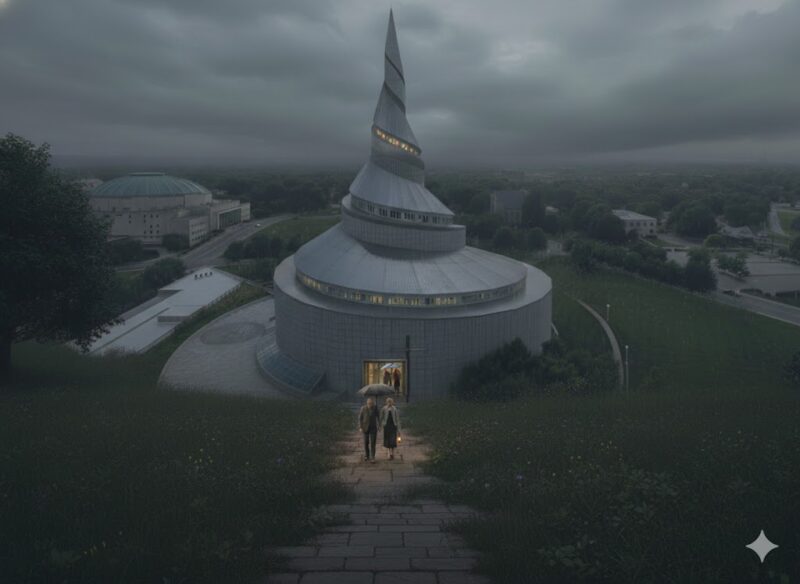
Yes, I know there’s no big hill on the back-side of the Community of Christ Temple, but Gemini has decided that there is and I can’t convince it otherwise.
It is no secret that the Community of Christ is not doing so well growth-wise. Of course, no religious groups except for Assemblies of God, Amish, Haredi Jews, and Mennonites are doing great growth-wise right now (let that be a lesson, if you’re not wearing floor-to-head clothing, you’re not conservative enough to grow ;), but there are some groups for which the decline is particularly pointed and the CoC is one of them.
To get the throat clearing out of the way, I’m not doing the Brighamite spiking-the-football thing. Relations are exponentially warmer than they were when Joseph Smith III had a super awkward dinner with cousin Joseph F. Smith and his wives in Salt Lake City. While there may have been some subtle tension for some people as they held the Kirtland Temple and other sites and artifacts, now that the vast majority of their historical crown jewels have been transferred there’s virtually no zero-sum dynamic going on from any angle, and I wish them the best with their mission and future.
But yes, they are in fact in decline, with a very top-heavy, aging membership base. I’m not interested in making a particular prediction for the magnitude of their decline or for when the lights will turn off (although here are some interesting thoughts on that), I just want to game out some possibilities for what it might like if the faith dies off. The flipside of exponential growth is exponential decay, where losses become smaller the smaller you become. If your population halves every 10 years then eventually everything but the absolute core remains, even if it takes a while, and then the question is what will happen to that institutional/cultural/social core.
Possibility #1: Disbandment
There is precedent in the restoration tradition for different splinter groups just simply closing up shop and everybody going back to their farms. However, this typically happens with really small groups that never achieved any kind of critical mass or takeoff, so the institutional inertia keeping them together never really developed. This might happen with the Community of Christ, but I doubt it, I suspect there won’t ever be a CoC meeting where the leadership meets, says they had a good run, and tells everybody to turn in their keys. Or at least by the time they get to that point the institution won’t look anything like the Community of Christ does now.
Possibility #2: Limp Along
There are still Strangite churches, the Temple Lot Church is still going. Heck, there are still followers of Sabbatai Zevi, the 17th century Jewish Messiah pretender who converted to Islam when his life was threatened. And Shakers recently exhibited the fastest religious growth in the world when they went from 2 to 3 members. A church rooted in a clear truth claim can limp along for quite some time, but it’s not clear that the CoC has that kind of stake in the ground like, say, their more conservative splinter group cousins (the Restorationist branches) do.
Possibility #3: Absorption or Transformation
In the Nation of Islam Elijah Mohammad’s son and successor kind of pulled a Wallace Smith, discarding their more eccentric doctrines that largely defined them and moved towards mainstream Sunni Islam. Eventually they lost even this smidgen of distinctiveness, and eventually just told adherents to join their local mosque and closed up shop. (The “Nation of Islam” today led by Louis Farrakhan is actually technically a splinter group.)
In much the same way I wouldn’t be surprised if the Restorationist branches, essentially the RLDS splinter groups, actually outlive the CoC and continue the reorganized tradition. However, Elijah Mohammad’s son was able to use his authority as the duly-appointed successor to officially close up shop. If the CoC President just wanted to do the same there would probably be subordinates that would probably splinter off to keep it going in some form or another as long as there were institutional incentives to do so.
Of course, “some form or another” does a lot of work. For example, the world’s largest no-kill animal shelter in Kanab, Utah is the institutional successor to the New Religious Movement of The Process Church of the Final Judgment, a sort of Scientology-type group that was founded in the 1960s. After a series of internal divisions and splinters, they gradually divested themselves of their religious aspect by degrees and became an animal shelter. (Fun fact, I actually interviewed a couple former Process members when I was at Baylor, and got some of the old members in contact with each other for the first time in decades). Likewise, at some point in the process, after many more congregations have shut down and there is simply no demographic future for the CoC as a religion qua religion, I could see the CoC becoming a non-religious NGO with a mission or promoting peace (a big part of their contemporary mission), or an independent generic liberal Protestant Church, and then it might eventually close doors, but it wouldn’t be because of a grand “we are officially dissolving the institution Joseph Smith III reorganized” moment, more of a “this church is closing and hey, didn’t it have its roots in the Community of Christ?” It will sort of end in a whimper because the institution will be so different by then.
Possibility #4: De-Centralization
Some movements can continue as a more diffuse theology and ideology even if particular institutions die off and evolve. However, this has already sort of happened with the restorationist branches splitting off from the then-RLDS. I might be wrong here, but at this point if the Community of Christ stopped existing it wouldn’t have any leftover attendant theology particular to them that couldn’t just be picked up by either an already existing restorationist branch or mainstream protestant church. The CoC is, above all else, an institution at this point (not saying that’s a bad thing!) more than a cultivator of a particular, distinct theology or ideology that could outlive it.
Possibility #5: Stasis and Equilibrium
One function in the religion market that the CoC serves is as a more liberal counterpart of the Latter-day Saint tradition for progressively-disposed ex-members of the Church of Jesus Christ of Latter-day Saints (indeed, I get the vibe that’s one of their selling points). With inflows and outflows you can have a dynamic where you can lose a significant percentage of your membership every year, but once you get small enough a sort of equilibrium takes hold, where your outflows are numerically small because you are small, but the inflows, even though they are very small as a percentage of the whole, replace the outflows. For example, is .000005% of Latter-day Saint liberals convert to the CoC every year, then the CoC can maintain stasis even if, say, they lose half their membership every ten years once they get small enough.
However, there is a history of liberal splinter groups from the Church of Jesus Christ of Latter-day Saints that haven’t panned out, I just don’t think the market for liberal but still institutional competitors for the Church of Jesus Christ of Latter-day Saints is that big. People might like the idea in theory, I just don’t see enough people doing the hard work of paying the tithing and showing up to a New Liberal Church of Jesus Christ of Latter-day Saints. Plus, the CoC is evolutionarily distinct enough from the COJCLDS that it’s not a simple equivalency of CoC= liberal COJCLDS. They’re their own unique thing.
Possibility #6: Become a Quasi-Ethnic Group
There are still Samaritans. There are still ancient Gnostics, there are still Zoroastrians (the faith of the king of Daniel-in-the-Lion’s Den fame). Some religious groups start to blur the line between ethnicity and religion, so you don’t have to sign on to theological particulars to belong. The CoC has a small aspect of this, with some multi-generational families traditionally belonging in the CoC category, but it never achieved the level of demographic distinctiveness to reach ethnicity level.
Conclusion
If the Community of Christ doesn’t reach some sort of inflow-outflow stasis with the Church of Jesus Christ of Latter-day Saints, I suspect at some point it will rebrand again as a more generic NGO, or essentially become an independent mainstream Protestant church that will eventually close its doors. We’ll see.
Comments
14 responses to “Will the Community of Christ Die Off?”
I am not sure if there is anything left for the church to buy from the CoC, but with the $250mil they recently got from us, I think they will just keep rolling along until they need to sell something else. I read their financials before the deal and it was pretty dismal.
You could ask the same question about our church as people keep leaving it. Our church has always touted the membership #s but we all know that at least half those #s are just members on record. We also know that typically if there is 300k new converts in a year, maybe 30% ? will be in the pews the following year.
IMO if the CoC had the missionary force, they would do well with converts as most of the “hard stuff” we ask converts to do, they do not, but they still have the “restoration and living prophets” story to tell.
On another note….can we stop spelling out the long form of the church’s name all the time? I am tired of reading it and hearing it for that matter. (within our church) We only have had one president who had an issue with it so can we bury it with him? All those in favor?
The Kirtland and other heritage places sale was interesting to me in that the real purpose was survival and through the transaction the Church with a debatable 200 billion endowment helped another Church set up a 200 million endowment. Corporations have lives beyond a human lifespan.
The LDS Church is continually set on expansion and probably needs 50-100% more to no longer have donations be essential to sustained current aggressive expansion.
For the COC a 2-3.5% draw helps them keep the lights on. They are very open with their finances and their donation base is limited-Aging and growth would be most likely through the poor with a structure not incentivized for donating. They will survive but their structure doesn’t set them up to grow. I’d argue the 200 million infusion saved their group from extinction and don’t see them wasting their last chance.
Come what may in the LDS Church we’ve set up an institution that will survive fiscally. We have hope in international growth but at the same time in the US are graying and not reproducing enough. We build all our temples and have pathways available for all and will keep expanding Annual giving. We’re not as threatened by fragmentation as our COC siblings, but we have gone through a dose of WASP type disaffection. We’re changing too, with a drawback in time commitment required in our Church community, We are moving to be more mainstream Christian in name and adding more of the liturgical calendar. Are we on a decentralization and transformation pathway already/next?
While I understand this is meant as a demographic ‘thought experiment,’ I find the tone of both the post and comments deeply unsettling. There is a clinical detachment here that feels less like a conversation between ‘cousins’ and more like an autopsy performed on a living patient. It’s hard not to feel like we are acting as vultures circling a community that is very much alive, filled with people who can hear these remarks. When did our interest in religious studies start to look so much like schoolyard bullying—making disparaging predictions loud enough for the subject to hear? I would hope for more grace and less speculation on the ‘death’ of those we claim to wish the best. If we truly value ‘warm relations,’ perhaps we should consider how this conversation would sound if our Community of Christ friends were sitting at the table with us.
I don’t know, as long as it’s done in good taste and not with any kind of glee I don’t think any social science of religion speculation should be off the table for discussion. As noted, I feel no sense of triumphalism, there’s absolutely nothing the COJCOLDS would gain by the COC closing up shop, and in nearly all cases the death of a religion leads to less light and truth in the world, but it’s precisely because it’s a weighty matter that it’s worth discussing.
In a different direction, but similar in concerning nature, I’ve been prone to occasionally wonder what will happen to our temples in areas where the church declines over generations.
Would it be better for the building to be shuttered and closed, or to stand as a memorial of faith once held, where visitors will walk through the gardens and throw the halls and say, “this is where they once sat an ate 50-cent mash potatoes and gravy on their lunch break.” Oh wait, the Provo Temple already was torn down….
But will the day come when a temple gets refurbished and dedicated essentially as a visitors center because we can no longer staff it?
Wouldn’t having it be a house of peace and sanctuary open to the public be preferable to sitting empty? I hope the day never comes, but imagine several hundred years from now, how a historical preservation society should want to handle such a building. Not so unlike many of the cathedrals across Europe.
I wonder about the LA Temple. It’s pretty, but generally empty. Great location.
Living in Europe it’s amazing to see all the money during 1870-1910 that got into beautiful cathedrals everywhere just to have war and other things in the West evaporate it’s established purpose.
Love being able to pop in and enjoy the beauty, would be cool if we had an equivalent shared space for the community.
Two Sundays ago, a multi-month investigator was asked in Elders quorum about what sparked his interest in church. He said that he felt the need to go to a church, so he started attending local congregations. Either they were warehouse/stadium style churches that he didn’t feel a connection to, or the congregation was full of old people ready to die off. Then he came to our ward and saw a church with all generations. He’s been coming for months. He has no problem with church standards and lifestyle, his hangup is if God does have a prophet on the earth today.
I have so many thoughts about this… Overall I agree with Chad, musing on the theoretical demise of our closest cousins in the Restoration is strange and off-putting. I’ve attended a few CoC congregations in the South and Midwest, and have thoroughly enjoyed myself each time. The congregations do skew older, but I’ve met some wonderful and faithful youth as well who will undoubtedly continue the faith of their fathers. Frankly, I don’t see a world in which the CoC would ever consider closing it’s doors. Denominations like the Temple Lot or Strangites have a much, much smaller membership base, and they aren’t in any danger of shutting down soon.
The idea of their membership being very top heavy is focusing on the US, which is less than half of the total membership. If you watch their World Conference (which I would recommend doing, it’s all available on YouTube), the institution is very focused on including the international membership and does everything in English, Spanish, and French. Several of their apostles are non-American (including one of the members of their First Presidency), and like us, their growth is concentrated outside the US in places like Africa. Anecdotally, I recall hearing in an interview with their new president that growth in Europe for the CoC is concentrated amongst young people with graduate degrees.
We can revisit this topic in 200-300 years and see how things are going. The CoC has experienced a turbulent past 50 years, including losing several of its most distinct theological positions, and is still around. I expect it will continue to reinvent itself to a degree as their leadership feels inspired.
As an aside, the sale of Kirtland and the Nauvoo properties only bought the institutional church a few more years of solvency, they are expected to run through that money by the early to mid 2030’s if memory serves. There’s a great interview on Gospel Tangents with their new President where she discusses the fiscal issues. Individuals can choose where to donate their tithes, to their local congregation or the “head church,” and more and more people are choosing to just donate locally.
As for whether Stephen’s post is appropriate, we can ask if a similar post about our own church would be acceptable. And in fact it is: We have seen both unblinking considerations of church growth (including several from Stephen) and less firmly grounded contributions from the doomsday demographers brigade for decades. If for no other reason, the Community of Christ’s growth is worth discussing seriously because some popular proposals for improving the long-term growth of our own church amount to taking paths already taken by the Community of Christ, which have had no discernible positive effect. Those paths might be correct for other reasons, but there’s no argument for them based on growth.
JTB noted:
“There’s a great interview on Gospel Tangents with their new President where she discusses the fiscal issues. Individuals can choose where to donate their tithes, to their local congregation or the “head church,” and more and more people are choosing to just donate locally.”
I suspect this is simply the same suspicion of large corporations that is prevalent in the west today. If you are suspicious of corporations you tend to focus locally.
The LDS Church’s structure avoids this—tithing and expenditures are all centralized, which means that if you are suspicious of the corporation you don’t donate at all. The CofC’s structure makes it more vulnerable to the current situation, but lets it capture the donations locally.
I don’t know, but I think it’s possible, and perhaps even likely, that this attitude will change. But I have no idea how or when.
It might be a good idea for the CofC to change its structure. Or that could be the worst response. That is true for the LDS Church as well. We may be structured exactly wrong for whatever comes next.
Making projections based on the current situation often doesn’t work. The one thing I am sure of is that the situation and the motivations for that situation will be different — so the op’s assumption that the CofC will continue to loose members is just that, an assumption. Trends change over time.
Since the underlying causes have to do with the attitudes and perceptions of people, I doubt we can know for sure. Predicting the future is impossible.
The CoC Temple is now only open on Thursdays from 9am-4pm. They used to be open 6-7 days a week. The grounds have deteriorated considerably- the parking lot is a mess and the landscape has been severely neglected. It’s tragic. Independence itself is in shocking midwest rust-belt decay. Most of the surrounding CoC buildings are rarely staffed/open for the public and are in disrepair. Each time I’ve visited, I have observed unhoused persons and persons experiencing substance addition in the downtown.
Unpopular opinion:
Maybe we (LDS) shouldn’t be building hundreds of such high-maintenance temples across the world- each susceptible to a myriad of unforeseen and uncontrollable circumstances, including our own economic solvency in generations to come. Maybe a better way would be to create Shinto or Buddhist like Gardens as our temples. They would be 100% integrated in nature and relevant when curated and visited, but ultimately- just nature. These gardens would be appreciated and tended in the moment as an act of devotion and sacredness. We could spend the left-over money on the poor and the sick. Side note, we’re building a new temple in Maui, where such an outdoor temple would be absolutely perfect. But our new temple will be a cold-climate granite implant on a tropical clime and an environmental catastrophe. But we must cling to our French rococo velveted tufts, air conditioning, nursing home conveniences, and giant parking lots dotted with suburban shrubbery a la the malls and shopping centers.
It’s a major burden to maintain. And, I would rather keep the integrity of my family, my descendants, my people, than rely on and encourage the lifestyles and ethics of the mega-rich. That wealth does not materialize out of thin air. I’m aware that the church frequently says that money, success and power aren’t necessarily evil and can be righteously obtained and used. But, the ultra rich (which we idolize) are part of a disturbing global economic system that is directly connected to real human consequences.
So, one of the wealthiest and most famous Saints from the ‘Mormon Moment’ famously enriched himself using his private equity firm. He walked away with massive profits while workers, families and communities absorbed the damage. Another famous political Saint has been so pressured into obtaining political power and legacy, that he traded constitutional originalism for political opportunism. He enables horrid leaders in to climb the ladder. Together they execute extremely concerning and repetitive constitutional breeches. And, let’s not even get started with the lifestyles of the LDS Desperate Housewives of SL and the McMansion ilk throughout the valley and across the world.
It’s not worth asking our fellow saints and family members to aspire to succeed in those environments, to idolize and praise those who do (and in doing so, lose integrity.) Swimming in those waters is revolting and dangerous.
Maintenance comes at a high cost. I find no shame in Emma’s people and their humble financial losses and dwindling numbers. There are worse ways to die.
Scholars have written about the membership decline and its reasons for years (see Walton, Launius, Jorgensen) but CofC leadership seem to not take scholary work into account, they know better. Nepotism is also a big issue in CofC (the Presiding Bishop’s son, daughter and son-in-law work for the CofC and its seminary).
When I was in college I could go up to Orem and visit Sunday School with the Reorganized folks to see what they believed. Back then, they did believe in things. Now, the building isn’t even there. To the extent it believes anything, the CoC believes in being nice. That’s not enough to sustain it.
Thank you for this thought-provoking article, and I appreciate all the commenters as well. I live in the greater Washington DC area, and here is my recent (i.e. late 2025) CoC experience. I wanted to visit a CoC congregation, so I found the website of the nearest one (Springfield, VA). The website noted that they have in-person service two Sundays a month, and a strictly Zoom service the rest of the month, so I decided to show up for the in-person service.
Well, I showed up, and there were no cars in the parking lot. The inside of the building looked abandoned. I left a voicemail for the contact phone number and sent an email to the contact email address from the website, and got no response.
I then looked in to the next closest congregation (Washington, DC). I didn’t want to have another wasted trip to an abandoned church, so I emailed the contact given on the website. I waited a while and go no response.
At this point I found the website of the nearest CoC Mission Center (Chesapeake Bay) and emailed them. They emailed me back that the DC congregation is, in fact, still functional, and apologized for the lack of response. The DC pastor also emailed me.
The overall sense I got from this experience is that the CoC is really struggling as an institution in my area. And this, to me, is sad, because I admire so much about the CoC, its history, and the values for which it stands. I am indeed grateful to the CoC leaders who did finally reach out to me, and I do hope to attend a service soon. I send all love and good wishes to everyone who is fighting to keep the CoC alive.