
As we were growing our family, each parity level fundamentally represented something different to the world about who you were. It went something like this, but experiences may vary:
0 kids) Very atypical for married Latter-day Saint, the operating assumption if you’re old enough is that you have fertility problems. For gentiles there’s the possibility that you’re just a power couple or really into traveling and have decided to not have kids. (I’ve never understood people who choose this demographic; if you’re going to live the free-living, unattached life, then why be married in the first place? But I digress).
1 kid) Within the past couple of decades this has entered into the confidence intervals of “normal” for gentiles. Again, for Latter-day Saints it’s assumed the one-kid family is from infertility/health issues, and it’s still somewhat atypical. I suspect that if you were to look at the parity distribution of completed fertility for members there’d be a hill at 0 and 2, with a valley at 1.
2 kids) The golden mean all-American family. You’re a picture perfect “family man” (I’d say “or family woman,” but that’s not really a term in common use, for a variety of interesting reasons). There’s actually some evidence in demography if you have one boy and one girl you’re much more likely to stop, presumably because you’ve hit the perfect American family. For members in the past this level was indicative of infertility or health problems but I’m surprised at how many Church members I personally know are opting for this, even in the absence of any health, psychological, or financial issues. I get the sense that this being the lowest tier needed to fulfill the “replenish” mandate has some heft with members.
3 kids) Similarly, three is the lowest tier needed to “multiply,” of the “multiply and replenish,” command, and I think that means something for members. For gentiles 3 kids puts you squarely in the super duper family, life-in-the-suburbs category.
4 kids) This is where things start to get weird for gentiles. (Large family comedian Jim Gaffigan noted that after three kids people stop congratulating you). I think the operating assumption here is that either 1) you’re a mixed family with multiple marriages, or 2) you’re religious. Not extremely so necessarily, but you’re probably a weekly church attender. I remember when we got to four officially thinking of ourselves as a “big family” (with some reason, as seen below). For super orthodox Latter-day Saints this has become the “one boy, one girl” version of the all-American family. This is where you start to get the “you have your hands full” comment that we big families outside of Utah hear every other minute.
5 kids) You’re clearly weird, and this is where they start to suspect that you’re a Trad Catholic, Evangelical Protestant, or Latter-day Saint. However, in some sectors of Latter-day Saint culture this number is considered honorable and even praiseworthy even if slightly atypical. We haven’t gotten to “weird even for Latter-day Saints” territory yet.
6 kids) For your gentile friends you have the largest family they know. For Latter-day Saints it’s still considered noble, but it’s getting theoretical in 2026 with its rarity. You start to come up with canned responses to little slights (my favorite: “don’t you know what makes children?” “Yeah, and we’re getting really good at it!”)
7 kids) Everybody assumes you homeschool your kids so they don’t learn about evolution or something.
8 kids) People stop asking you if you’re done, because they kind of know the answer, and even Latter-day Saints think that you’re weird and stop congratulating you. I assume this is rare outside of hard core Trad Catholics, Quiverfull Protestants, Latter-day Saint seminary teacher types (besides myself, every member family I know this large under the age of 50 works for either the Church or BYU-Idaho), or Haredi Jews.
Outside of my own anecdotal observations, I was curious about exactly how “weird” different levels of big families were, so I looked at the total, national rates for 18-50 year olds in 2024. I already did a post on religion and big families using the CES. However, the CES, while large (60,000 some years), is still not quite large enough for super big families, since we’re such a small portion of the population, so I used the Census IPUMS data, using a simple crosstab and subsetting for 2024.
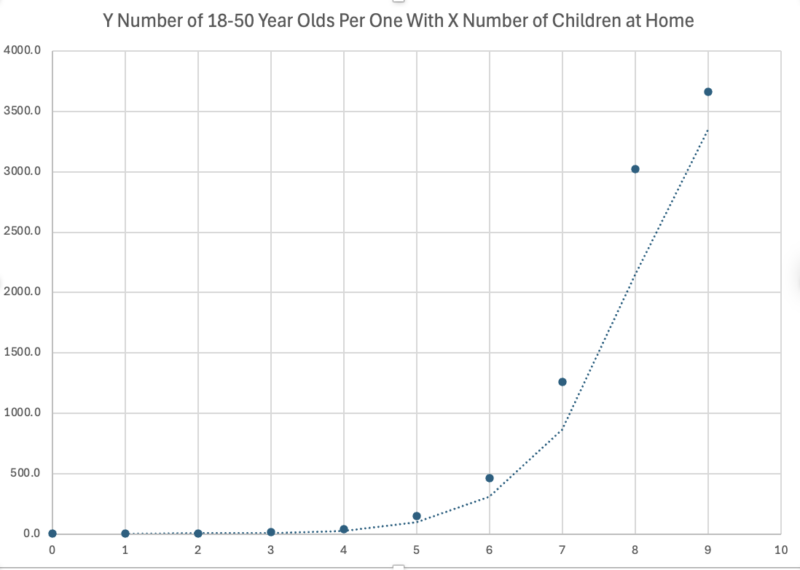
The left column shows the ratio of 18–50 year olds to every one person at that parity. So there are 1.7 18-50 year olds in the country for every 1 that is not living with any of their own children, 6.8 for every 1 that is living with exactly one of their own children, etc.
| 0 | 1.7 |
| 1 | 6.8 |
| 2 | 6.1 |
| 3 | 14.0 |
| 4 | 42.8 |
| 5 | 151.1 |
| 6 | 462.7 |
| 7 | 1262.9 |
| 8 | 3025.7 |
| 9 | 3662.3 |
So I am one out of 3,025 (maybe 3,662 depending on labor timing). When we graph it we see that it starts to get really “weird” and exponentially rarer at around four. (Of course these numbers shift around if we set our age limits differently, but I doubt it changes the overall curve.) Which makes sense to me, given my observations above. Four is still in the realm of “that’s a huge family but you’re still kind of normal and that’s a nice even number” whereas with 5+ you’re clearly not somebody who goes with the flow, and then there’s another big drop-off going from 7 to 8.
I also wanted to see where large families were.
Even though Utah is below replacement childbearing and is the ninth highest for fertility (falling from 3rd highest in 2019), Utah is still far and away number one for number of people who live with 5+ of their own children (yes, it’s an oddly specific variable, but it’s the only proxy for number of own children the Census Bureau collects information on).
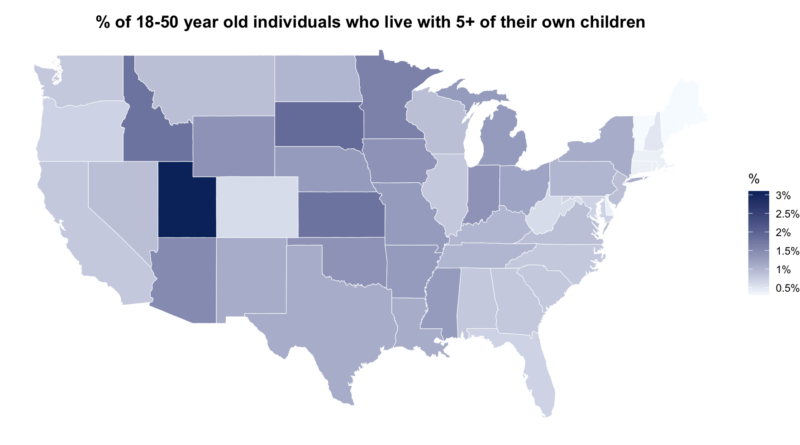
What I think this means is that Utah has enough childless or small families to offset the 3% of 18-50 year olds who are having huge families and bringing it down a few notches on the average rankings. However, the unique particularity of “big families,” not one when the expectation is none, or 2 when the default would have been one, but stereotypically, historically “big,” is still something that is very Utahn and, for this particular variable by extension, Latter-day Saint, even if our averages hide that fact.
So big families are quite rare, but in the right places and networks you can still know a handful, but in others, say, secular white people in Maine, they have largely become the stuff of legend.
Comments
12 responses to “How Many Big Families Are in the US? Where Are They?”
0) There are actually some very compelling reasons people choose this over the single life. As this is a family blog, I will leave the reasons up to your imagination.
3) Enough kids to generate comments from neighbors you barely know in the coastal South: “Y’all are done now, right?”
4) If you go abroad, you have not twice as many kids as normal, but three times. You’re suddenly one full column or more to the right on the exponential curve. You get panicked e-mails from the person who worries they might have to find an apartment for you. Every other family you know with 4 or more kids are either ward members (a handful of families), or attend a similarly weird church (just one case). Getting your family to church by bus is a minor public spectacle.
5) A strangely common number of children in large families in our corner of the upper Midwest. Common enough to take the edge off of weird.
6) Even in the 1980s, this was weird enough among church members in California to be the basis for a gag about your family at a ward talent show, at least if you also didn’t make the cut for invitations to certain informal intellectual and cultural events.
8) Congratulations! I like birth announcements with tables and graphs.
“If you’re going to live the free-living, unattached life, then why be married in the first place?”
For me, this is such a weird question. I really do not understand it at all. Choosing to be married is a fairly separate decision from choosing to have children. I not only love my husband, I like him. I like spending time with him. He genuinely is my best friend. I also sincerely both love and like our children. But in all honesty, the empty nest years both before and after the years spent raising them in our house have been rewarding and happy. It’s very clear to me why someone would choose that life.
I know that’s not central to your topic. But that question is so strange, it kind of derailed your actual topic for me.
My two cents: For the kids, I think the ideal family has at least three sons and three daughters. Then every single child in the family has sisters (plural) and (brothers). That makes for lots of good experience in a variety of relationships, getting along, working together, and lots of love and support all around.
Retry: For the kids, I think the ideal family has at least three sons and three daughters. Then every single child in the family has sisters (plural) and brothers (plural). That makes for lots of good experience in a variety of relationships, getting along, working together, and lots of love and support all around.
Stephen, don’t you know where kids . . . ? On a more bizarre note, in the 1970s I met an LDS family in Germany, yes Germany, that had 13 kids. This was at a time when more than 2 kids was considered huge. They probably got all sorts of odd comments in public, but they did make the ward bigger.
Interesting stuff, but I mostly came to the comments to say that the use of the term “gentile” here makes me deeply uncomfortable.
Is Colorado the second lightest state on your chart, or is that an optical illusion being next to Utah?
I myself am living with my four children.
For this sort of question one source to look at is, most recently, National Vital Statistics Reports, “Births: Final Data for 2023,” vol. 74, no. 1, March 18,2025. Table 3 on page 16 gives the number of births by birth-order.
The number of first-borns, second-borns, etc. was:
1st: 1,406,183; 2nd: 1,126,450; 3rd: 589,447; 4th: 262,793; 5th; 108,652; 6th: 47,180; 7th: 21,661; 8th and over: 23,870; not stated: 9,781; total: 3,596,017.
That makes for the following ratios:
1st/2nd: 1.25; 2nd/3rd: 1.91; 3rd/4th: 2.24; 4th/5th: 2.42; 5th/6th: 2.30; 6th/7th: 2.18.
A decade ago I looked at the numbers then, and the ratios are all about the same now as they were then. Taking the ratios as approximately static, we can invert them and say:
80% of mothers of one child also had a second, 52% of mothers of two children also had a third, 45% of mothers of three children also had a fourth, 41% of mothers of four children also had a fifth, 43% of mothers of five children also had a sixth, and 46% of mothers of six children also had a seventh. (80%, 52%, 45%, 41%, 43%, 46%)
This narrow range (41-46%) seems to indicate that past three children the choice or ability to have another is not changed by existing family size, and not much less than the choice or ability to go from two to three.
I will put links in a subsequent comment, in case URLs trip some embargo on comments.
Links:
https://www.cdc.gov/nchs/data/nvsr/nvsr74/nvsr74-1.pdf
https://www.jrganymede.com/?s=birth+order
My mother was one of her parents’ fourteen children, the fifth of ten sisters. I formed from that an exaggerated sense that any couple that was willing could have a dozen children, but it is not really so. To be physically capable of that, even if willing, is very exceptional. For example, of apostles ordained in the 20th Century, Packer and Nelson each had ten children, and to find another with at least that many we have to reach back to Joseph Fielding Smith, who had two children with his first wife and nine with the second following the death of the first. Numerous 20th Century apostles had seven or eight children, though.
Infertility is more than a yes/no matter. Many couples were able to have one or three, followed by miscarriages. Some women are blessed with healthy childbearing into their 40s, but not all. Elder Holland remarked on his and his wife’s experience with that. In the March 1987 Ensign, Flora Amussen Benson (wife of Ezra) was quoted, “I wanted twelve children, but had to settle for a choice half dozen. If we just would have had twins every time, we would have made it.”
Of particular “going against the grain” note, consider Kyung Yeol Park, his wife Myeongsuk, and their seven children. Elder Park was 48 when called to the 4th Quorum of the Seventy in April 2024. At the time of his call he was a counselor in the presidency of the Seoul Korea South Stake.
Called as an Area Seventy last year there was, “Motoshige Karino, 52, Togane, Japan; Representative Director, Modere Japan GK; currently serving as president of the Chiba Japan Stake; former bishop, mission presidency counselor and stake presidency counselor; wife: Mirei; seven children.”
This tracks with my experience as the oldest of, eventually, eight children, maybe subtracting one since “normal” family size was bigger in the 70s and 80s. One possible shift: there were actually two families with eight children in our ward, and it wasn’t a particularly ideological project for either of us. (My parents planned to have two, but the Lord prompted them to have one more. Repeatedly.) I now know two families of comparable size, one LDS and one not, but both were planned that way for explicitly religious reasons. Having a large family seems to have become an intentionally counter-cultural thing.
On being married with zero kids…I think our society generally agrees that being in a healthy committed relationship contributes to happiness, and marriage strengthens those relationships. I don’t hear a lot even on the left these days about marriage being obsolete or being an oppressive patriarchal institution. Whether to have kids or not is almost a separate decision from getting married. We’re not quite empty nesters yet, but our 19-year-old doesn’t need us to organize our lives around her anymore, and it’s been striking to me how our marriage has become even more important and fulfilling.
But most importantly, congratulations!