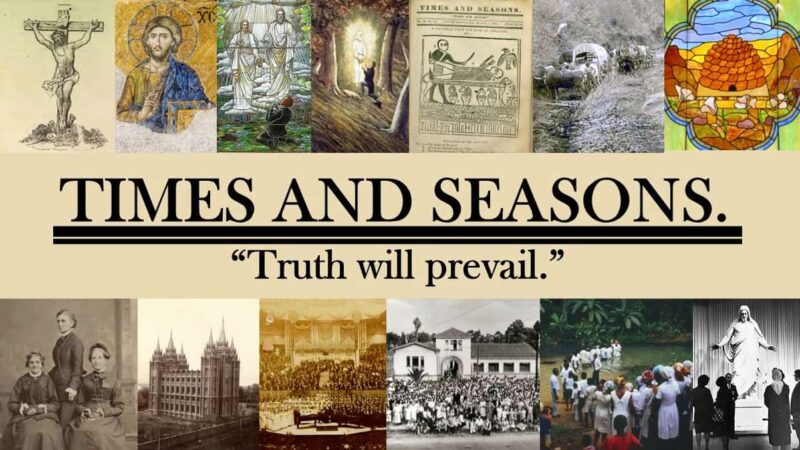

The phrase “Let God Prevail” suggests a certain view of life—the idea that we might be a kind of impediment to what God wants to do, and that we need to get out of the way. And the idea makes sense theologically, since we believe that God respects our agency, and will not force us, we must be what hinder’s God’s work in our lives. So, we should cooperate, and let God prevail in our lives.
However, this idea can also sound like we just need to be passive, letting God do all the work. But that doesn’t seem right either. Is there a way that “letting God prevail” requires active, positive effort on our parts? I believe it does. Choosing God often requires choosing between options that all seem attractive, and many times choosing God is actually choosing the option that seems most unattractive to our world-influenced minds.
For the most part, the choices covered in this lesson involve covenants, agreements and actions we take to learn how to become more like our Heavenly Parents.
Covenant marriage is essential to God’s eternal plan.
Marriage may be the covenant that makes the most urgent requirements of individuals—because those involved have to actually get along with each other, and inevitably have to make changes and compromise as a result. The following poem, by one of the early LDS English converts who had such a large impact on our culture, describes both the benefits and requirements of marriage.
Marriage
by M. Morton
- Most sacred bond, celestial tie, cement of kindred minds!
- Sweet union, patronized on high, where no harsh bondage binds!
- Blest intercourse to heaven-born souls! ’tis their’s alone to prove:
- Their names, by heaven’s high lows enrolled, are register’d above.
- Sent here to meet by heaven’s blest will, their spirits sweetly blend;
- Confiding truth their bosoms fill; their deeds to glory tend.
- Thought meeting thought, no jars ensue : each will prevents the sane;
- Each motive pure—affection true—no longer arc they twain:
- “While He, who rules by heaven’s design, the sceptre mildly sways,
- She loves, reveres, with thought sublime, and cheerfully obeys.
- Each other’s weal or woe they shore, nor know a selfish aim;
- They learn to bear, and to forbear, nor e’er unkindly blame.
- ‘Tis true, a union so divine transcends a mortal’s ken,
- Till the pure gospel light refine: faith can discern it then.
- This is the power alone can bind on earth, that binds above;
- Its precepts pure; its laws refined; its ultimatum, Love!
1851
I can value eternal things over temporal things.
It’s possible to see a covenant as a way to get us to focus on the eternal instead of the earthly, although I think that most eternal things also have very real benefits in the here and now. In the following poem, poet and hymnwriter Joseph L. Townsend, finds the eternal in nature, specifically in rural Virginia (I can’t help thinking of the Shenandoah Valley when I read this), and sees it inspiring us to overcome “the sordid thoughts of temporal affairs.”
A Scene in Virginia
by Joseph L. Townsend
- Here mountain ridges side by side extend,
- Far as the eye in distance can discern,
- While lost in hazy blue, the outlines blend,
- And fade from sight where skies to earth return.
- Dark robed in sombre growth of forests green,
- The mountain sides, with ever changing hue,
- Throw deep their shadows o’er the vales between,
- And rise in grandeur far in heavens’ blue.
- With knobby ridges where the river swells
- From streamlets ever purling as they run,
- The broken valleys, mingling hills and dells,
- Lie dark in shade or brightened in the sun.
- With pastures velvet green and woodland hills
- Rock-ribbed and craggy reaching o’er the vales,
- The farms adjoin, and all the valley fills
- With checkered bounds marked by the zigzag rails.
- The golden grain fields of oats and wheat
- Is ready for the reapers busy throng,
- The meadows, full of grasses blooming sweet,
- Await the mower and his cheerful song.
- What homes could be within a scene like this,
- Were truth upheld and culture free to all!
- Alas! the selfish hearts to love remiss
- Uphold the laws that must their minds enthrall.
- Where nature, kind to all, her wealth bestows
- In forests, field, and ever flowing springs,
- The customs of society impose
- The poverty of thought tradition brings.
- When landscapes fill with beauty all the scene
- In depths of leafy shade and sunlit fields,
- Uncultured man sees only country green,
- And beauty only where it money yields.
- The grasping rich forever grasp for more,
- The poor are filled with sullen discontent,
- And class distinction keeps both rich and poor
- Away from culture by their own consent.
- All works united interesting require,
- All joys refinements of the soul create,
- All pleasures art and nature may inspire,
- Are lost within the minds uncultured state.
- The sordid thoughts of temporal affairs,
- The jar and wrangle of a daily strife,
- Enslave the mind beneath the many cares
- Of selfish labors, and a foolish life.
- And vales where labor skilled in landscape art
- Could make an Eden of the prosy farms,
- Show everywhere the minds unskillful part,
- Destroying even natures’ lavished charms.
- O! land of mountains, forests, fields and streams,
- When will thy people from their errors turn?
- When will thy customs yield to light that beams
- In knowledge free to all that will to learn?
- Can mind from darkness of traditions’ lore
- Evolving truth from error turn its range
- In thought and action that may laws restore
- Of universal and progressive change?
- Alas! to-morrow as to-day must be,
- Except the powers of heaven wield their might,
- In revolutions that externally
- Establish higher thoughts of life and right.
- Till man, inspired with higher, nobler thought,
- The selfish passions of inherent sin
- Has conquered in the aspirations taught
- By revelation to the soul within.
- While mind, expanding in the laws of God,
- To something higher than the common state
- And pathways which for ages it has trod,
- Aspires to be the noble, truly great.
- Inviting all to join a higher cause
- And in progressive thought have liberty,
- By heaven sent, we teach the higher laws,
- And daily labor all the land to free.
- And slowly, surely, truth the land inspires
- To turn from customs ever seeking pelf,
- To nobler aspirations and desires
- In Gods’ refinement of immortal self.
1883
The covenants of the Lord’s house bring God’s power into my life.
We frequently think of covenants in terms of the obligations they give us, but covenants always include blessings and even power to help us in our lives. Here, in one of her lesser-known palms, Eliza R. Snow focuses on the blessings that come from covenants.
For the Album of Mrs. R
by Eliza R. Snow
- How blessed are the Saints of the Most High, who keep their covenants sacred, and walk in the light of His spirit.
- Blessed are the daughters of Zion, who dwell in her midst in the valleys of Ephraim; where the spirit of peace reigns—surrounded by the halo of Omnipotent protection.
- Blessed are all those who seek diligently the things that pertain to eternal life—whose affections are elevated above perishable objects, and whose hearts feast on the sweet foretastes of that felicity which will hereafter fill the cups of the righteous to overflowing.
- Blessed, yea thrice blessed is she who possesses a meek and quiet spirit—who seeks not to exalt herself—but by virtuous merit—whose ambition is to do the will of God, and who clothes herself with humility as with a garment.
- Yea, I say unto thee thou art blessed, and blessings shall be multiplied unto thee—thou shalt be a blessing to thy father’s house—thou shalt be a blessing unto many, and many shall rise up and call thee blessed.
- The spirit of God is the spirit of consolation: this is thy present portion; and thro’ thy faithfulness, to this shall be added every good thing that heart can wish, and mind anticipate both of the heavens above and of the earth beneath.
1857
The Lord remembers me in my trials.
Most of the time our lives pull us into “the sordid thoughts of temporal affairs” as Townsend calls them above. The trials of our lives do this, as the saying goes, “When you’re up to your neck in alligators, it’s hard to remember that your objective is to drain the swamp.” In the following poem, G. C. Ferguson sees the trials in his life, and realizes that the Lord is there to support him.
The Saint’s Trials
by G. C. Ferguson
- In the dark scenes of life, when the grip of disease
- Hath bound up the limbs of the active and strong,
- When the wife of his bosom, the child on his knees
- Are testy and tiresome and everything’s wrong,—
- When the hour of retiring brings with it the dread
- Of darkness and weariness, anguish and pain,
- And the dawn of the morn sees him lifted from bed
- To encounter new woes and meet old ones again,—
- ‘Tis sweet for the Saint, under trials like this,
- When even life’s joys are changed into woes,
- To find that his God and his Father doth bless
- And opens the hearts both of friends and of foes.
- His life is sustained—yea, his children are gay;
- His creditors even go pleased from his door;
- And his spirit, immured in its prison of clay,
- Hath conquered a trial unconquered before .
1859
The Savior can heal my family.
Seeing the role of the Savior in such trials often requires us to look carefully. Our environment often trains us to see the world without the Lord in it—because the explanation of the Lord’s participation isn’t required for their way of looking. The following poem tells the story of a the author’s mother, Martha Alice Parker, and finding the Lord’s blessings in crossing the plains with a handcart at 9 years of age.
Child of the Handcart Train
by Camilla Woodbury Judd
- I see her trudging down the dusty trail,
- Struggling to keep within the handcart’s sight,
- A girl-child, knowing anguish and travail,
- Clasping the hand of baby brother tight—
- Or on her back the loving burden bore,
- Her faithful little feet so tired and sore.
- I hear her singing down the silent wind,
- Singing to the creaking of handcart wheels;
- Cheering the lagging feet that fall behind,
- A song of faith and courage as she kneels
- To smile into a little tear-stained face
- And heal its heartache with her childish grace.
- I hear her sighing in her bed at night,
- Sighing and praying when all is still;
- Beseeching God in his mercy and might,
- To heal her father now stricken ill;
- Dear little body o’erburdened with care,
- Tomorrow the weight of the load must share.
- I see her lending her childish might,
- Pushing the cart on its torturous way;
- For her gentle mother, broken and white,
- Alone in the traces must toil today—
- Dear God, give me just one note of that song,
- Of the spirit that led her feet along.
- I see her sobbing by the campfire’s glare,
- Piling it higher with trembling hand;
- For baby, left to the children’s care,
- Is lost in the treacherous timberland;
- And her father, weak from fever and pain,
- Is searching and praying and calling in vain.
- I can see him standing so gaunt and tall,
- While her mother pins around him a bright wool shawl—
- “If you find him dead—wrap him tenderly,
- If alive, a signal wave to me”,
- And breathing a prayer, “Thy will be done”,
- Alone he faces the rising sun
- I see her keep watch by the dimming trail,
- Three days have passed and her tired eyes fill;
- But the faith within her will never fail,
- When lo—from the top of a distant hill,
- Glimmering faint in the sunset’s glow,
- A bright wool shawl waves to and fro.
- I see her kneeling—words cannot tell
- The sweet soul-gratitude given birth;
- Someone is singing, “All is Well”,
- And she falls asleep on her bed of earth.
- Blind God, I thank thee that her I can claim
- As my mother—child of the handcart train.
1936