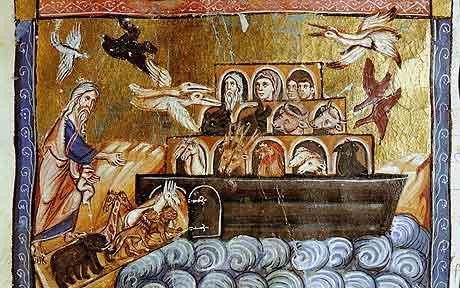
The story of Noah and the flood has often led to difficulties, especially between those who take the story literally and those who see it more metaphorically. For those who are trying to decide between a literal interpretation and a metaphorical interpretation (as if this were a binary question that has to be decided one way or another), my introduction of poetry here then doesn’t make the question any clearer, since poetry tends to make even the most concrete ideas into metaphor.
I think both interpretations are ok — especially since many metaphors have more impact when we treat them literally—is the idea that the World is being baptized in the flood more powerful if the whole world is inundated at the same time? Or if it only occurred in a relatively small location? Even if you don‘t believe the whole world was immersed in water, some metaphorical value comes from setting physical truth aside and treating it as if it were so.
That idea might also apply to some of the concepts taught in the lesson, or at least to some of the ideas presented in the poetry below:
There is spiritual safety in following the Lord’s prophet.
Following the prophet is like this—simple on its face, but more difficult when we dive into it. Are we supposed to follow unthinkingly, abandoning our personal responsibility, or are we supposed to evaluate what we are told, making active decisions about what to do? I don’t think true spiritual safety comes from blind obedience. Instead, we adapt the righteous counsel we are given to match our circumstances and to follow the revelation we are given. And yes, sometimes we will make mistakes.
The following poem is best known as hymn #21 in the current hymnal, but this version doesn’t include the 4th verse in the hymnal (written by Bruce R. McConkie, not Murdock), and includes what would be 2 additional verses not in the hymnal.
Come listen to a prophet’s voice
by Joseph S. Murdock
- Come listen to a prophet’s voice
- And hear the word of God;
- And in the ways of truth rejoice,
- And sing for joy aloud.
- CHORUS.
- We’ve found the way the prophets went,
- Who liv’d in days before;
- Another prophet now is sent
- This knowledge to restore,
- The gloom of sullen darkness, spread
- Through earth’s extended space.
- Is banished by our living head,
- And God has shown his face.
- Through erring schemes in days that past,
- The world has gone astray,
- Yet saints of God have found at last
- The straight and narrow way.
- ‘Tis not in man they put their trust,
- Or on his arm rely;
- Full well assured, all are accurs’d
- Whom Jesus Christ deny.
- The Saviour to his people said,
- “Let All my words obey,
- And signs shall follow you on earth,
- Down to the latest day.”
- The sick, on whom the oil is pour’d,
- And hands in meekness laid,
- Are, by the power of God, restor’d,
- Thro’ faith, as Jesus said.
- No more in slavish fear we mourn;
- No yoke of bondage wear;
- No more beneath delusion groan;
- Nor superstitious fear.
- Of every dispensation past;
- Of every promise made;
- The first be last, the last be first—
- The living and the dead.
- Saviours shall to Mount Zion come—
- Their thousands bring to rest
- Throughout the great Millennium—
- Eternally be blest.
1843
The Flood was an act of God’s mercy.
There are many ways to look at the Flood, and the idea that it was an act of mercy to save people from themselves is one, but it isn’t an idea that appears in any of the LDS poetry I’ve found. Instead, I see the Flood used as an example of the necessity of separating out the evil from the good. One of the ideas current at the time that the Church was founded was Universalism (ancestor of the Unitarian-Universalist churches today), which teaches that everyone will eventually be saved and restored to a right relationship with God. To me, this idea has some attraction, since eternity is so long, I suspect that there is plenty of time to persuade and bring every (or almost every) person to God. But, I’m not comfortable with the accompanying implication that has no lasting consequence. I don’t like the idea that anyone could think that they can do whatever they want because they will eventually be “restored to a right relationship with God.” That seems irresponsible.
Regardless of my thoughts about this issue, it was an issue for many Church members in the early Church, including poet Joel H. Johnson, who used the flood in the following attack on Universalism. Johnson objects here to the idea that the sinners who perished in the Flood would have gone up to heaven. Unfortunately, he doesn’t address the idea of eternity—whether somehow, in the endless time after this life, sinners might change and restore their relationships with God.
Anti-Universalism. A Poem.
by Joel H. Johnson
- O! that I had an art in rhyme;
- Although I am a feeble youth,
- I’d spend one moment of my time,
- To vindicate the cause of truth.
- O! that I had a poet’s fire;
- My pen with pleasure I would move;
- With melody I’d touch the lyre,
- And try the cause of truth to prove.
- I’d bring to view God’s holy word,
- The only hist’ry that is found,
- Where we can find it on record,
- What happen’d ere the world was drown’d.
- For in this sacred book we’re told
- Of things before the ancient flood;
- How men did multiply of old,
- And how they sin’d against their God.
- How God did send a righteous man,
- To teach the people righteousness,
- And how they’d be cut off for sin,
- If they went on in wickedness.
- This man, his name was called Noah,
- But they believed not what he said;
- The Lord then bade him to prepare
- An ark to save himself and seed.
- The world around did look at him,
- As though a poor deluded man;
- But still he warned them of their sin,
- And of the judgements then at hand.
- One hundred twenty years it took
- To build this ark so big and strong,
- Yet for the judgements he did look,
- Although they were delay’d so long.
- He preached and warned them night & day,
- While God’s long sufferings thus did wait,
- And pointed out to them the way,
- How they might shun their dreadful fate.
- But they did not believe his word;
- The Lord then unto Noah spoke,
- And said all flesh shall be destroy’d,
- Enter thou now into the ark.
- Then Noah with his little band,
- Enter’d the ark with joy and peace;
- No doubt the world did laughing stand,
- For they were Universalists.
- Then the great fountains of the deep,
- Were broken up from west to east,
- And o’er the earth a flood did sweep,
- And drowned all both man and beast.
- But in the Universal plan,
- Those men were wafted all to heaven,
- Although they were cut off for sin,
- No punishment to them was given.
- And righteous Noah with his band,
- Because the Lord they did obey,
- Was closely in the ark confin’d
- With reptiles, birds and beasts of prey.
- Thus they were doomed to stay a space,
- Here in this world for punishment,
- Shut out from Heaven, that happy place,
- Where those unrighteous rebels went.
- Had they been wicked like the rest,
- They might have gone to heaven too,
- They might like them have all been blest,
- Instead of staying here below.
- But three hundred and fifty years
- Poor Noah he was doom’d to stay,
- In this world of sorrow and tears,
- Because the Lord he did obey.
- O now give ear unto the truth;
- ’Tis written on God’s holy word,
- How Sodom and Gomorrah both,
- For sin were awfully destroyed.
- No righteous man but righteous Lot,
- Was to be found in all the place,
- Although he righteousness had taught,
- The rest were Universalists.
- God unto Lot an angel sent,
- For to reveal their dreadful fate,
- He quickly told them to repent,
- Or soon with them ‘twould be too late.
- But if his councils they made light,
- For they did not believe his word;
- Lot then was bade to take his flight,
- And leave them all to be destroyed.
- God rained on them then we do read,
- A shower of fire and brimstone too,
- Then up to heaven those wretches fled,
- If Universalists are true,
- In chariots of brimstone made,
- All burning blue with flaming fire,
- And a hot time no doubt they had,
- Before they ever entered there.
- Had Lot been found in wickedness,
- Amongst the Universal crew,
- He with these Universalists,
- Might then have gone to Heaven too.
- But he on earth was doomed to stay,
- Where pains and troubles daily rise,
- While those unrighteous rebels they,
- Enjoy’d the courts of Paradise.
- Now had I time I’d bring to view,
- How Pharaoh and his wicked host,
- While they did Israel pursue,
- Were drown’d and in the Red Sea lost.
- How God these wretches did destroy,
- Who were too bad to live below,
- The promis’d land for to enjoy,
- So up to Heaven they all did go.
- O reader, stop and look at this,
- One moment stop and think it o’er,
- If you’re a Universalist,
- Perhaps you may not be secure.
- Can such injustice be believed,
- The word of God thus thrown aside,
- Can wicked wretches be received
- In glory, and the saints denied.
- If half an eye to you is given,
- I think you will discern the truth,
- That sinners cannot go to heaven,
- And leave the righteous here on earth.
1838
Tokens or symbols help me remember my covenants with the Lord.
The account in Genesis teaches that the rainbow is a symbol, sign or token of the covenant that God would never again flood the entire earth. Such symbols are a kind of metaphor, a way of representing and calling to mind generally intangible things that are important to us. The Bible teaching about the rainbow expects that we will remember the covenant with God whenever we see a rainbow. These tokens are always around us — the sacrament, garments, prayer, etc. all remind us of who we are in relation to God.
Words themselves are symbols, aural or written representations that we use to communicate. And they can also be tokens that remind us of our covenants and of our relationship with God, as the following poem demonstrates:
Definition of a Word
by Jessie J. Dalton
- A word is a sound
- By which silence is broken;
- A symbol said, causing
- A thought to be spoken;
- A message of danger
- Or faith ever healing;
- A vow and a promise
- Eternally sealing.
1941
Following Jesus Christ is the only way to Heavenly Father.
While following the Prophet might seem less important than following Christ, they are theoretically the same, provided that the Prophet is a true prophet. Of course this means that when we perceive a conflict, we need to first look at ourselves to make sure we are interpreting things correctly and pray for clarification. I don’t know about you, but I mistrust my own perceptions. I know I could be wrong, so I rely on revelation to help me.
Teaching that we follow Christ, and His gospel is therefore a core part of our doctrine. And when we teach others, it is a core part of our message. In the following poem, poet David Frame advises his missionary son to teach that in on his mission in Scotland:
A Missionary’s Farewell
by David Frame
- Go and bear the blessed message,
- To thy father’s native land,
- To our kindred still in darkness,
- Give to all a friendly band.
- On the hills of bonnie Scotland,
- In each heather covered dell;
- ‘Mong the blue-bells and the thistles,
- There the joyful tidings tell.
- Tell them how the fore-told angel,
- Flying through the midat of heaven;
- Brought the everlasting Gospel,
- And to all mankind has given
- Plans to gain a life eternal,
- Truths that Christ, our brother, gave;
- Joys celestial, exaltation,
- Sure redemption from the grave.
- Tell them of the fertile valley,
- Watered by the mountain streams;
- Tell them of the glorious temples,
- Reared to catch the sun’s first gleams,
- Where the humble and the faithful
- Followed where the truth hathled;
- Work and offer true salvation,
- To our kindred long since dead.
- Teach the people true repentance,
- Bring them to the water slow;
- Tell them that to follow Jesus,
- All beneath the waves must go.
- Scoff not at them if they see not,
- Show them that your way is best;
- Humble to an ever prayerful,
- Trusting Father for the rest.
- When you’ve told them all things heavenly.
- Tell them of our earthly fare;
- Of our home with peace and plenty,
- Blessed by heaven’s own special care;
- Of our husbands, wives and children,
- Given by our Friend above;
- In each cottage e’en the humblest,
- Rules suprome the God of love.
- Take to them a friendly greeting,
- Sent by us to Scotia’s shore;
- Lay it down as love’s bright offer,
- Close at every kind man’s door;
- And our faith and prayers shall follow,
- In your path across the foam,
- Asking God to bless and keep you,
- Guide, and bring you safely home.
1900