Latter-day Saint history has no shortage of narratives concerning the Willie and Martin handcart companies. For many, the 1856 emigration is the ultimate “morality play” of the Restoration—a story of faith under fire and the high cost of the gathering. Yet, while the spiritual lessons of the trek have been well-plowed, the gritty logistical mechanics of why the tragedy occurred have often been obscured by hagiography or simplified blame.
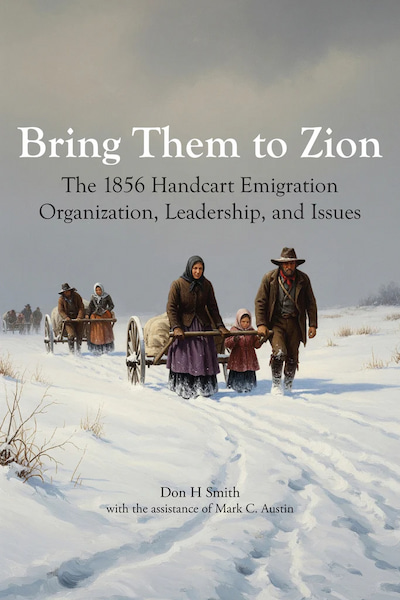
In Bring Them to Zion: The 1856 Handcart Emigration Organization, Leadership, and Issues (Greg Kofford Books, 2025), Don H. Smith, with the assistance of Mark C. Austin, provides a meticulously researched corrective. If Fred E. Woods provided the essential panoramic view of the gathering in his book Ports to Posts: Latter-day Saint Gathering in the Nineteenth Century, Smith offers the zoomed-in counterpart. By focusing specifically on the Willie company, Smith and Austin provide a case study in cascading logistical failure and the agonizing weight of leadership.
A Stark but Effective Dichotomy
The most striking feature of Bring Them to Zion is its dual structure. The book is essentially split between rigorous historical analysis and a composite trail journal. The journal chapters offer a day-by-day account of the journey from Liverpool to the Salt Lake Valley, woven together from the primary records of those who walked the miles. Interspersed within these entries are the authors’ commentary and supporting evidence from outside sources, creating a sense of “live” history.
Admittedly, I was initially taken aback by the stark dichotomy in chapter styles—shifting from high-level organizational analysis to the granular intimacy of a trail diary. However, as the narrative progresses, the choice proves effective. The analysis provides the “why,” and the journal provides the “how it felt.” By the time the company reaches the plains, the reader is grounded in both the organizational errors and the human stakes.
The Mechanics of Delay
Smith and Austin are at their best when dismantling the complex web of issues that doomed the 1856 season. Rather than pointing to a single villain, they illustrate a systemic breakdown. They summarize the situation poignantly:
“In a nutshell, the short time frame, uncertain money supply, new plan, new place of outfitting, lack of facilities, distant supply sources, poor train services, absence of modern communication systems, adverse weather conditions, misunderstandings, and inadequate numbers of qualified outfitters account for the majority of the delays experienced by the first two companies” (p. 52).
This perspective moves the conversation away from simple negligence and toward a sophisticated understanding of how “new plans” and “uncertain money” can lead to catastrophic ends.
Reevaluating the “Decision at Florence”
The standout moment of the volume is the chapter addressing the decision made at Florence, Nebraska to continue moving forward. Historically, this meeting—where leaders and the company debated whether to push forward so late in the season despite Levi Savage’s famous warning—has been the site of much historical finger-pointing.
Through a rigorous analysis of the regional data and the specific resources available to the company at the time, Smith and Austin persuasively argue that the leaders were faced with a choice between several bad options. They demonstrate that staying at Florence presented its own set of lethal risks, including starvation and lack of shelter during one of the coldest winters on record in the region. The authors’ conclusion—that moving forward was, in fact, a defensible choice made under impossible circumstances—is one of the most compelling reframings of this event in recent years. It replaces a narrative of reckless hubris with one of tragic, calculated risk.
Conclusion
Bring Them to Zion is a fantastic resource that manages to be both an academic reference and a gripping narrative. For anyone interested in the handcart story or the broader mechanics of the 19th-century gathering, this book is essential reading. Smith and Austin have done the hard work of archival synthesis, providing a volume that honors the pioneers not just by celebrating their faith, but by seriously examining the world they were forced to navigate.
For info on more books being published in 2026, see Mormon Studies Books in 2026.
Comments
4 responses to “A Review: Bring Them to Zion: The 1856 Handcart Emigration Organization, Leadership, and Issues”
Good review. Thanks. At the risk of lapsing into hagiography, to me, the following two quotations sum up the “Tragedy on the Trail.” I’ve always loved what Brother Francis Webster had to say in response to criticism of leaders for what happened to the two ill-fated companies:
“I ask you to stop this criticism. You are discussing a matter you know nothing about. Cold historic facts mean nothing here for they give no proper interpretation of the questions involved. Mistake to send the Hand Cart Company out so late in the season? Yes. But I was in that Company and my wife was in it. … [ellipses sic] I have looked back many times to see who was pushing my cart but my eyes saw no one. I knew then that the Angels of God were there.
“Was I sorry that I chose to come by hand cart? No. Neither then nor any minute of my life since. The price we paid to become acquainted with God was a privilege to pay and I am thankful that I was privileged to come in the Martin Hand Cart Company.”
That, and what Brother Levi Savage said after warning the Saints not to depart so late in the season:
“Brethren and sisters, what I have said I know to be true, but seeing you are to go forward, I will go with you, will help you all I can, will work with you, will rest with you, will suffer with you, and if necessary, I will die with you. May God in his mercy bless and preserve us.”
Ken, I’m seen the Francis Webster quote many, many times, but everytime time I do, I find myself wanting to ask all the other pioneers in those two companies whether they agree that it was worth the price they paid. I suspect several of them might have disagreed with Brother Webster’s evaluation of the bargain.
Therefore, what?
I’m reminded of Chad Orton’s statements about this: