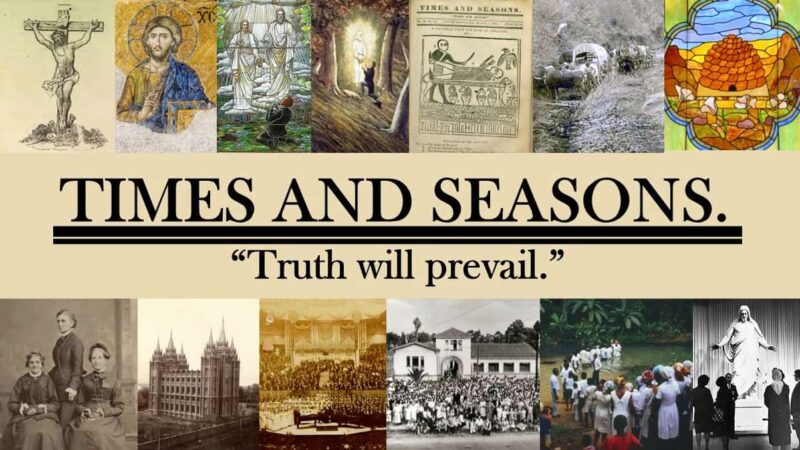
I’ve left off any image to represent Gods “work and glory”; since we teach that His work is “to bring to pass the Immortality and Eternal Life of Man,” I am not at all sure how to represent that. Images of what ‘heaven’ looks like all seem to me to be either unlikely or based on earthly misconceptions. I guess I’m saying that I don’t have any idea what “Immortality and Eternal Life” looks like, and I doubt anyone else does either.
While I don’t think we can paint a picture, we do know some things about the next life. We know about our relationships to our Heavenly Parents, who we knew before this life, and we know something of our relationships to each other, especially to family members. And we know that we have a long-term destiny to become like our parents. And we’ve talked about all these in poetry.
As a child of God, I have a divine destiny.
The plan of salvation — especially the idea of a pre-existence — is one of the most unique of LDS teachings, and as such is a frequent topic in LDS literature. Here, George Brimhall, then serving as the first President of Brigham Young University, looks at the logic behind the concepts, arguing that if we are made in God’s image, why wouldn’t that mean that we would become like Him?
Why I Am
by George H. Brimhall
- The aim of my existence is that I may have more joy
- Than sorrow, in the sum of life,—build more than I destroy;
- That I may seek and find the truth, and in the search be glad;
- Be much more moved by love of good than by the fear of bad;
- To freedom gain, and ne’er forget that others, too, have rights—
- That mine “turn in” where theirs begin, no matter what’s my might;
- To keep proportioned, and to grow in head, and hand, and heart—
- To put in practice what I know to be the better part;
- To let the spirit have its share of culture every hour,
- And keep the passions in the place of servants to will-power;
- To be submissive to the will of those I should obey,
- Yet be a gallant leader, still, of others—on my way;
- Outgrow the power to love a lie, or any other wrong,
- By sacrificing for the Truth and helping Right along;
- To be effect, and then be cause, of light, and love, and life;
- To learn, obey, and then make laws,—enjoy eternal life;
- To go the road that God has gone, who once was mortal man
- Of perfect type; if I am such a one, become a God I can.
- And why not?—if man is His child, and a brother to His Son,
- The Man-God, Jesus, who on earth showed how the race was won,
- And says to me: “Be ye like Me, do ye as I have done,
- Be one with Me, as I and He, My Father, God, are one?”
- If God had not intended that I Divine might be,
- Why, then, confer the image of Divinity on me?
- Thus making my appearance clear a necessary fraud,
- A being in His likeness here that never can be God?
1913
With the Lord’s help, I can resist Satan.
The trials of life often mean resisting the influences that lead us to do evil, which is a core part of the plan of salvation. Eliza R. Snow says as much in the following familiar hymn:
The time is far spent
By Eliza R. Snow
- The time is far spent—there is little remaining
- To publish glad tidings, by sea and by land,
- Then hasten, ye haralds! ,go forward proclaiming,
- “Repent for the kindom of heav’ns at hand,”
- Shrink not from your duty, however un-pleasant,
- But follow the Savior, your pattern and friend;
- Our little afilictions, tho’ painful at present,
- Ere long, with the righteous, in glory will end.
- What though, if the favor of Ahman possessing,
- This world’s bitter hate, you are call’d to endure;
- The angels are waiting to crown you with blessings,
- Go brethren! be faithful, the promise is sure,
- All, all things are known to the mind of Jehovah:
- There’s nothing conceal’d from his all-searching eye;
- Then, fear not! the hairs of your head are all number’d,
- And even the ravens, are heard when they cry.
- Be fixed in your purpose; for Satan, will try you,
- The weight of your calling, he perfectly knows:
- Your path may be thorny, but Jesus is nigh you,
- His arm is sufficient, tho’ demons oppose.
- Press on to the mark of eternal perfection,
- Determin’d to reap the celestial reward,
- That you may come forth in the first ressurrection,
- And feast at the supper of Jesus the Lord.
1841
God’s work and glory is to help me gain eternal life.
The plan of salvation appears in LDS literature quite early. The following 1833 poem is also unusual because it was an early example of glossolalia — speaking in tongues. When published, a headnote indicated that the poem was “sung in tongues” by David Patten and interpreted by Sydney Rigdon.
Age after age has roll’d away
by David Patten and Sydney Rigdon
- Age after age has roll’d away
- Since man first dwelt in mortal clay;
- And countless millions slept in death,
- That once supplied a place on earth:
- According to the fate of man,
- Which God had fix’d in his own plan,
- So age must come, and age must go
- Till work complete is here below:
- Which had been seen by saints of old,
- And by the prophets were foretold;
- Which wondrous things are drawing near:
- That Enoch saw, and saints did cheer.
- Enoch who did converse with God:
- Stood on the mount and stretch’d abroad
- His soul wide as eternity:
- He rent the vail and wonders see.
- With mighty faith he did expand
- O’er earth and heaven, o’er sea and land,
- Till things above and things below
- He did behold; yea, did them know.
- His heart he tun’d to notes above,
- His soul o’erwhelm’d with boundless love,
- He sang a song in heav’nly lays,
- While angels’ tongues join’d him in praise.
- With finger end God touch’d his eyes
- That he might gaze within the skies;
- His voice he rais’d to God on high,
- Who heard his groans and drew him nigh.
- With joy and wonder, all amaz’d,
- Amid the heav’nly throng, he gaz’d!
- While heav’nly music charm’d his ear,
- And angels’ notes, remov’d all fear.
- Hosanna, he aloud did cry,
- To God who dwells above the sky:
- Again, Hosanna did resound,
- Among the heav’nly hosts around.
- His voice he rais’d in higher strains,
- Echo’d and re-echo’d again,
- Till heaven and earth his voice did hear:
- Eternity did record bare.
- The trump of God around the throne
- Proclaim’d the power of God anon,
- And sounded loud what should take place,
- From age to age, from race to race.
- Among the heavenly hosts he sang
- God’s scheme of life for sinful man,
- And for the gospel’s saving grace,
- He prais’d the Father face to face.
- The end of all his labors here,
- Were all unfolded to him there:
- His city rais’d to dwell on high,
- With all the saints above the sky.
- He saw before him all things past,
- From end to end, from first to last;
- Yea, things before the world began,
- Or dust was fashion’d into man.
- The place of Adam’s first abode,
- While in the presence of his God:
- Before the mountains rais’d their heads,
- Or the small dust of balance weigh’d.
- With God he saw his race began,
- And from him emanated man,
- And with him did in glory dwell,
- Before there was an earth or hell.
- From age to age, whate’er took place,
- Was present then before his face;
- And to the latest years of man,
- Was plain before him, heav’ns’ plan.
- His eyes with wonder did behold,
- Eternal glories yet untold;
- And glorious things of latter time,
- Which angels have to tell to men.
- He then did hear, in days of old,
- The message that to John was told;
- The angel which the news did bring,
- He heard him talk and heard him sing.
- And knew before the days of John,
- What glories were on him to dawn,
- The message which he did receive,
- He heard and saw, and did believe.
- He knew full well what John should hear,
- Concerning times and latter years,
- When God again should set his hand,
- To gather Israel to their lands.
- The gospel then from darkest shades,
- Should rise and go with rapid strides,
- Till nations distant, far and near,
- The glorious proclamation hear.
- The angel that this news proclaims,
- Should come and visit earth again,
- Commit the gospel, long since lost,
- To man, with power, as at the first
1833
I lived as a spirit before I was born on earth.
The plan of salvation is not just about what happens after this life. It also covers what happened before this life, in the pre-existence. That part of the plan is also explored in a lot of LDS literature, such as the following poem by Edward H. Anderson.
Pre-Existence
by Edward H. Anderson
- “And now, O Father, glorify thou me with thine own self, with the glory which I had with thee before the world was.” – John xvii, 5.
- Could I behold the life I left,
- Once gaze on scenes I saw on high;
- Or grasp the meaning of my life,
- And analyze mortality;
- See through the darkness of the past,
- Behold the secrets of my birth;
- And know again why God desired
- My presence on this darkened earth;
- Could I but feel the zeal of old,
- When He revealed Salvation’s Plan
- That caused hosannas from my lips
- And raised to Gods the spirit man;
- Or know how eagerly I prayed
- That God would grant me leave to go
- To gain a body and to learn
- The secrets of his power to know;
- And then behold in coming Time,
- Or, rather, when Time is no more,
- How I, if faithful, should obtain
- Such gems and crowns as Father wore:
- A God, enjoying all that is;
- With power to make, with power to save,
- Triumphant o’er intelligence
- Victorious o’er the gaping grave;
- If this I knew, how could I spend
- My time in vice, in wicked ways?
- Profane the Lord who granted this;
- Thus lose the prize, and end my days?
- How could I sin, how seek for joy
- Among the things that fade and die?
- And how devote my days to gain
- The riches that take wings and fly?
- Who knows but those who love on earth
- Once loved in Heav’n, and promised there:
- Together fell that they might rise,
- “Each other’s pains and triumphs share?
- Give answer thou, my soul, and say:
- I left the world of Heav’nly bliss,
- The friends I loved to call my own,
- To suffer all the ills of this,
- Because I saw the joys I had
- Compared not with what was to gain.
- Because I hoped for greater things,
- I fell to rise, I’ll die to reign.
- Let others seek for freedom here
- Clasp close the pleasures of this earth,
- I look for freedom, only when
- I go to Him who gave me birth.
- Help me, O Lord, on Thee rely,
- On Thee depend for Comfort’s voice,
- Faithful endure, pain, sorrow, death,
- And then at length with Thee rejoice.
1883
Comments
One response to “CFM 1/5-1/11: Poetry for “This Is My Work and My Glory””
Awesome