On October 12, 2005, I heard a handbell ensemble perform for the first time. I was a ninth grader, still in middle school, sitting in a high school auditorium to support friends in the upper grades. When the high school’s bell ensemble took the stage, I was mesmerized—both by the hauntingly beautiful tone and the astonishing variety of sounds the ringers conjured from bronze metal. That single evening launched a decades-long journey into the art of English handbell ringing.
While I am always hesitant to claim that something was predestined—or to suggest that God moves people around like pieces on a giant chessboard, in a violation of free agency—there was a long chain of events that culminated in me auditioning for the Bells at Temple Square. Even before that October high school concert, several key moments had already begun positioning the tiles.
My mother ensured I was trained on the piano starting when I was seven, placing me under the tutelage of a family friend, Barbara Madsen, who gave me a firm musical foundation. At the same time, my mother immersed us in live music, taking us to musicals, choir concerts, and the Tabernacle Choir’s annual Christmas performances whenever we could score tickets after the tradition began in 2000. I still hold vivid memories of bass-baritone Bryn Terfel performing with them in 2003—flashing the Welsh flag sewn into the lining of his suit coat while getting the entire audience to compete in shouting “dragon!”—and of hearing the Choir break out steel drums for Mack Wilberg’s vibrant arrangement of “The Virgin Mary Had a Baby Boy.”
Earlier in 2003, ahead of my seventh-grade year, I faced a choice regarding electives. I briefly considered joining the symphonic band. I was obsessed with Super Smash Bros. Melee: Smashing…Live!—an orchestral album by the New Japan Philharmonic that arrived bundled with my January issue of Nintendo Power—and I wanted to learn an instrument capable of making music like that. (And regardless of what followed, that album launched my lifelong interest in orchestral music.) After talking it over with my mom, however, I chose choir class instead. The moment that choice was made, I felt a quiet, distinct prompting and confirmation: this decision would be a key pivot point in my life.
Choir was a great experience, and I met many of my closest friends in those choir classes. The problem was that most of those friends were in the grade above me, which made my ninth-grade year very lonely. That is why I attended that choir concert in October 2005, where I heard handbells for the first time.
What I didn’t realize then was that 2005 was the exact year the Bells on Temple Square was founded; they had performed their debut concert just one month prior. And among the ensemble’s thirty charter members was none other than Barbara Madsen, my former piano teacher. She mentioned this to my mother, so when I came home raving about the bell ensemble at the high school concert, my mom already knew something about what I was trying to describe.
It wasn’t long after I arrived at the high school that I got involved in handbells. To be specific, on November 15, 2006, I picked up a handbell for myself. My high school choir program hosted an elaborate annual “Dickens Fest” for its Christmas concert, which started with guests mingling in a holiday-themed foyer while members of the elite chamber choir dressed in period costume. In the back corner, a small, temporary handbell ensemble—trained by our director, Geoff Anderson, in early morning rehearsals—provided background music. I volunteered as soon as the opportunity arose, struggling through my early attempts to juggle three bells at once.
I didn’t join the school’s full handbell ensemble until my senior year in 2008, but in another twist of fate, our group was invited to participate in the Mormon Tabernacle Choir’s Christmas concert. Directors Craig Jessop and Mack Wilberg had chosen a holiday bell theme and tasked LeAnna Willmore, Associate Conductor of the Bells on Temple Square, with recruiting guest handbell musicians. In total, five high school choirs and a community ensemble—around 110 ringers—filled the stage alongside the Bells on Temple Square, the Tabernacle Choir and Orchestra. We accompanied them on a few pieces, such as the rhythmic processional of “God Rest Ye Merry, Gentlemen,” “I Saw Three Ships,” and “Angels from the Realms of Glory.” For a high school musician, it was a transformative experience, and any brief interaction with members of the Bells on Temple Square felt like meeting royalty.
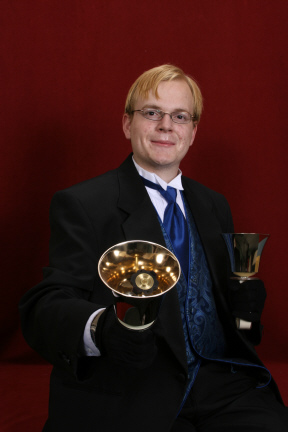
By the time I graduated in 2009, handbells were an important part of my identity. I even convinced Geoff Anderson to lend me a pair of handbells from the high school to pose with in my senior portraits. That summer, the Church released an episode of its Everything Creative podcast featuring members of the Bells on Temple Square. Listening to them explain their experiences—combined with my memories of performing with them and attending their November 2008 concert—planted a quiet desire: if the opportunity ever arose, I wanted to ring with them.
First, however, came college. Intending to study molecular biology with a focus on plants, I initially looked toward the University of Utah. Yet something felt off. When I attended an open house hosted by Utah State University, everything clicked. Just as when I had chosen choir over band six years earlier, I felt a familiar spiritual impression that USU was where I belonged.
Once again, the intuition proved right, for several reasons. One of those came during my first semester at USU, when a high school friend mentioned she had tracked down a local handbell ensemble: the Westminster Bell Choir at the Logan First Presbyterian Church. She invited me to join, and I jumped at the chance.
Simultaneously, I joined the American Festival Chorus under the direction of Craig Jessop, who had recently joined the USU faculty following his resignation from the Tabernacle Choir. The chorus mirrored the scale and style of the Tabernacle Choir, complete with a massive annual Christmas production. Dr. Jessop—who had fallen in love with handbells as a missionary in 1970 and had been the driving force behind founding the Bells at Temple Square—was determined to incorporate handbells into Logan’s concerts as well. He recruited the Westminster Bell Choir as an integral element of the show. As a member of both ensembles, I spent those concert nights dashing offstage to change positions, singing in one number and ringing in the next. It was exhausting and glorious.
A two-year church mission to Illinois, Missouri, and Iowa temporarily paused my studies, but music remained a constant companion. I accompanied meetings on piano and organ, sang, and composed original pieces. Handbells even made a brief, comical reappearance: while doing service at a public library in Story City, Iowa, I was handed a stack of sheet music to photocopy and immediately recognized the distinct markings of a handbell score. Thrilled, I approached the woman who brought it in and asked about joining. She seemed somewhat taken aback at the idea of a Mormon missionary wanting to join her ensemble (it was a bell ensemble hosted either by the Methodist or Lutheran church in town), but gave me the rehearsal time and said I could stand in for absent ringers. Regrettably, I forgot to write it down, showed up at the wrong hour to a locked building, and never saw her again. That particular handbell experience was not fated to happen, apparently.
Two days after returning home from my mission in December 2011, I was back in the audience for the Tabernacle Choir’s Christmas concert. I returned to USU, resuming my dual roles with the Westminster Bell Choir and the American Festival Chorus. Eventually, academic demands forced me to choose between the two; I chose the bells, where I felt my individual contribution made a greater impact. The closeness and camaraderie of the ensemble were additional benefits, especially once I dragged my closest childhood friend into the group.
Occasionally during these years, I heard the Bells at Temple Square perform, usually at their semiannual concerts or the annual Spring Ring—a gathering of bell ensembles in Utah in early March each year, where they performed an impressive solo showpiece each year. I was thrilled when my old high school choir teacher, Geoff Anderson, joined the Bells on Temple Square as Associate Conductor in 2017.
For most of the 2010s, however, my musical life centered on the Westminster Bell Choir. While not an elite ensemble by professional standards, it was well-organized, disciplined, and led by a stern yet deeply kind Presbyterian director who pushed us toward excellence. We played many times each year, including at monthly church services, semiannual concerts at the Logan Tabernacle, interfaith events in Ogden, and expeditions to senior centers in rural Cache Valley.
That experience reshaped my perspective. Serving in the music ministry of another faith broadened my respect for their tradition; I felt I was doing the Lord’s work even if my regular absence from my own ward prompted friends to joke that I had become a “part-time Presbyterian.” Playing in an understaffed bass section forced me to expand my technique, often covering parts meant for two or three ringers. The director also supported me in arranging and composing music for the ensemble, performing my arrangements of “Aberystwyth,” “Infant Holy, Infant Lowly,” and “There’s a Song in the Air” (which the director requested that I arrange). Furthermore, my director offered a grounded view of the handbell world, occasionally voicing frustration at how the dominant presence of the Bells at Temple Square unfairly overshadowed other talented groups in the state. Although I was living inside the 100-mile radius required to audition at Temple Square, I chose not to do so. The broader world of handbell music was richer than I had realized, and I loved where I was.
Eventually, fate intervened again. After completing my master’s degree, I took a temporary position at GE Healthcare, where I formulated media for research and development. While I stayed for two years, internal corporate politics stalled my transition to full-time status. Encouraged by a coworker, I looked toward a growing biotechnology company in Salt Lake City called Recursion. I applied, landed a position, and prepared to move south at the end of 2018, wrapping up my final season with the Westminster Handbell Choir.
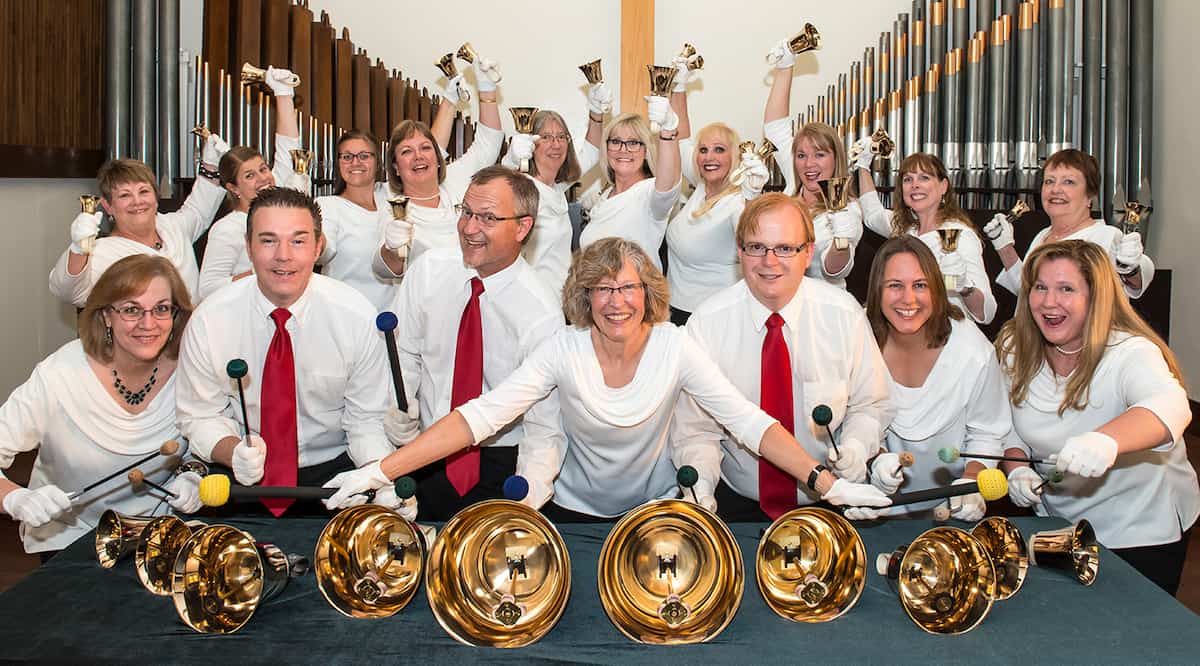
With the move closer to Salt Lake, the obvious next step presented itself. I submitted my application to the Bells at Temple Square and auditioned shortly after arriving. Years of rigorous ringing with Westminster had prepared me well for the complex repertoire. Ironically, while the leadership emphasized the ensemble’s demanding schedule, I found it surprisingly manageable compared to the relentless performance slate the ensemble in Logan kept. I was accepted into the ensemble in early 2019, beginning rehearsals that spring and performing in my first Music and the Spoken Word broadcast that August.
Ringing bronze handbells in an ensemble is a modest detail in the grand scope of the world, and I don’t think that the Bells at Temple Square need me as much as I need them. Yet looking back, it is striking to see how many subtle nudges stacked up to point me in this direction: an album included with a video game magazine, early piano lessons with a future charter member, a last-minute choice to take middle school choir, being involved in a handbell program under the direction of a future Conductor of the Bells at Temple Square during the only year when high school handbell musicians were invited to the Conference Center stage, and a college choice that dropped me right into a vibrant Presbyterian handbell program that played alongside a large chorus led by a former director of the Tabernacle Choir each December. It may very well be that these events were random chance at first and stacked up to create a high likelihood I would audition for and be accepted by the Bells at Temple Square. And each of these experiences had played an important role in my life in their own right, separate from my current calling. But while my personal theology of human agency means that I do not believe that God is always working behind the scenes as a puppet master, in this instance, I’m willing to believe that it was divine providence that prepared me for and led me to Temple Square.
Leave a Reply