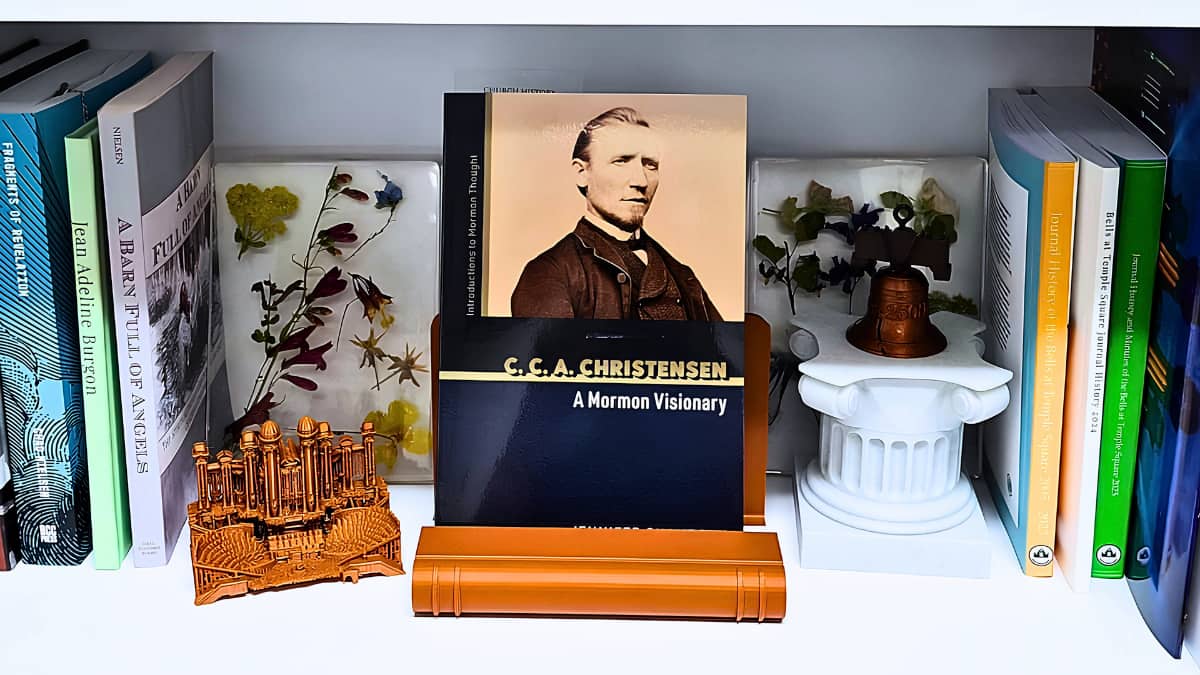
Jennifer Champoux. C. C. A. Christensen: A Mormon Visionary. Urbana: University of Illinois Press, 2026. 152 pp. Paperback: $17.95. ISBN: 978-0-252-08921-3.
Reviewed by Chad L. Nielsen
As a teenager growing up in the Latter-day Saint tradition, I developed an enduring passion for highlighting the cultural and artistic achievements of my heritage. In searching for a visual vocabulary that embodied the pioneer era, Carl Christian Anton (C. C. A.) Christensen (1831–1912) quickly became the defining artist of Church history in my imagination. His famous Mormon Panorama—a massive canvas scroll that he toured across Great Basin meetinghouses—stood out as a monumental preservation of pioneer memory. My fixation with his work carried into my college years, where I vividly recall attending a 2015 exhibition at the Brigham Young University Museum of Art celebrating his artwork. Yet, despite my long-standing fascination with Christensen, Jennifer Champoux’s brilliant new biography, C. C. A. Christensen: A Mormon Visionary, demonstrated just how much of his life and artistic output remained for me to discover.
Champoux, the director of the Book of Mormon Art Catalog and a premier scholar of Latter-day Saint visual culture, has produced a concise, beautifully contextualized (and beautifully illustrated) intellectual biography. She rescues Christensen from being treated merely as a folk-art curiosity or frontier novelty, elevating him to his proper place as one of the primary iconographers of nineteenth-century Mormonism who invented the visual language of the Restoration.
European Academic Training and the Danish Milieu
One of the volume’s most valuable contributions is Champoux’s careful grounding of Christensen’s work within nineteenth-century Danish and American art historical trends. Born in Copenhagen to an impoverished family, Christensen managed to gain admission to the Royal Danish Academy of Fine Arts during the vibrant “Danish Golden Age.” Champoux details how Christensen trained alongside artistic contemporaries such as Carl Bloch—whose later, classical portrayals of the life of Christ would heavily influence Latter-day Saint aesthetics throughout the twentieth century.
Placing Christensen alongside Bloch and within the academic traditions of Europe allows Champoux to demonstrate that his frontier paintings were not the crude products of an untrained amateur, but deliberate adaptations of European historical painting, theatrical storytelling, and the American moving panorama tradition. By framing Christensen within this broader artistic milieu, Champoux makes his work immediately relevant to scholars of nineteenth-century American art and transatlantic immigrant culture.
The Forest as Refuge and Lawlessness
Champoux’s thematic analysis of Christensen’s landscapes is particularly illuminating, nowhere more so than in her discussion of his recurring visual motif: the forest. Throughout his historical and scriptural paintings, dense woodlands appear repeatedly as central settings.
Champoux demonstrates that for Christensen and his nineteenth-century audience, the wilderness carried a complex, dual symbolism. On the one hand, the forest served as a sacred space of divine refuge and revelation—the quiet sanctuary where Joseph Smith knelt in the Sacred Grove, or where the Saints found temporary shelter from hostile mobs. On the other hand, the dark woods represented a site of lawlessness and vulnerability, where rogue militias and anti-Mormon vigilantes operated beyond the reach of civil authority. By decoding these environmental symbols, Champoux shows how Christensen’s landscapes communicated deep theological and historical anxieties to Great Basin audiences who had lived through those very wilderness exiles.
The Polymath: Poet, Historian, and Mission Hymnodist
To my delightful surprise, Champoux reveals that Christensen’s visionary output extended far beyond the paintbrush. He was a true Renaissance man: a poet, a historian, and a prolific writer who contributed regularly to Bikuben, a Utah-based Danish-language newspaper. Having previously engaged in research on historical mission hymnody, I was fascinated to learn about Christensen’s extensive literary contributions to the Scandinavian missions. His poetry and hymns provided a key component of the devotional songs used by Danish, Norwegian, and Swedish converts—a revelation that almost tempts me to begin planning a Danish Mission Hymnbook project as a sequel to my Mexican Mission Hymnbook Project!
Furthermore, Champoux traces how Christensen’s artistic focus shifted dynamically across his lifetime to match his evolving circumstances. As a young missionary in Scandinavia, a handcart pioneer, a husband in a plural marriage, and later an elderly man working to preserve the memory of his heritage in Utah, his visual repertoire adapted to institutional needs. Champoux highlights his 1890s Book of Mormon series—a major body of work depicting scriptural narratives—showing how Christensen actively sought to instruct the younger, Utah-born generation in the sacred history and communal identity of their faith.
Conclusion
C. C. A. Christensen: A Mormon Visionary is a masterclass in accessible, high-powered humanities scholarship. Jennifer Champoux has given us a brief, fluidly written, and deeply researched volume that enriches our understanding of Latter-day Saint art, memory, and identity. It is a book that refreshed and strengthened my own childhood appreciation for Christensen’s genius, proving that his giant moving canvases were not merely historical illustrations, but theological visions painted on cloth. For anyone interested in Mormon Studies, American art history, or the visual heritage of the Intermountain West, this book is essential reading.
For info on more books being published in 2026, see Mormon Studies Books in 2026.