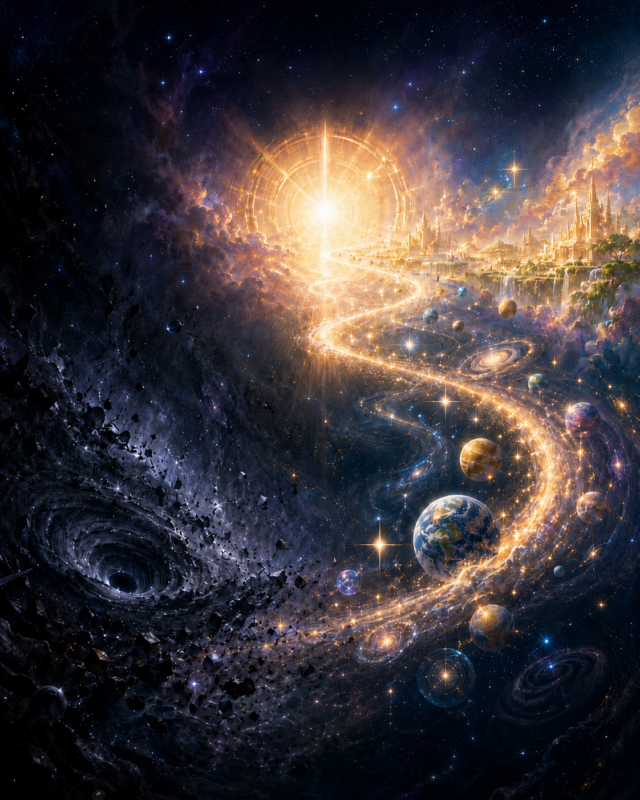
Latter-day Saint cosmology is radically unique in that its end-state is neither eternal stasis and rest in the presence of divinity, a cyclical series of rebirths, nor loss of individuality and absorption into the cosmic consciousness. Our individuality is preserved and we continue expanding. Our experiences in life are not an infinitesimally small flash that leads to an eternity of stasis, but neither does it repeat in a loop; rather the experiences expand spiral upward and outward ad infinitum “from eternity to eternity”
My favorite Latter-day Saint cosmology quote is from non-member (but Book of Mormon fan) Freeman Dyson:
No matter how far we go into the future, there will always be new things happening, new information coming in, new worlds to explore, a constantly expanding domain of life, consciousness, and memory.
This quote was a response to the spectre of heat death, the existential concrete wall at the end of the universe that Isaac Asimov was responding to in his classic science fiction short story “The Last Question,” (Asimov’s favorite story of his).
[Spoiler Alert]
A series of civilizations try to fight against the inevitable heat death of the universe prophesied by the second law of thermodynamics. They continually ask a supercomputer their civilization is built around whether entropy can be reversed, while the computer simply responds that it doesn’t have enough data. By the time the last person expires due to dissipated energy, the computer finally finishes its calculations and simply proclaims “let there be light,” beginning a new universe (and therefore reversing the heat death of the universe).
[Spoiler Alert End]
I’ve spoken more about the philosophical and existential implications of heat death here. Suffice it to say, the issue of why the universe started in such a low entropy state in the Big Bang, as implied in Asimov’s short story, is still an open question in physics.
My own take on this is that God’s ability to reverse entropy in the act of creation and through eternal increase is one of His defining characteristics. It’s His super power, if you will. Bringing order to the more natural chaos is the ur-miracle that all other miracles stem from. I suspect our ancestors intuited the existential importance this concept, which is why the theme of unorganized chaos being organized by the primordial Gods is nearly ubiquitous across the world. Whether it’s the biblical Leviathan and the Great Deep, the Egyptian Nun, the Norse Ginnungagap, or the Popol Vuh‘s creation myth, the creator Gods are almost always fighting (sometimes literally) against entropy.
To get more speculative, I would not be surprised, from my read of the Book of Abraham (with even more speculation here) if God creates continual universes through Big Bangs and the like, essentially doing what Asimov’s computer did. (I’d love to conjecture that Asimov’s ex-Mormon second wife had some influence here in regards to the idea of continual creation, but alas the story came out before they married). Even Christ’s resurrection was in a sense a reversal of entropy akin to the beginning of a new universe arising from a disorganized, high-entropy situation.
Finally, entropy and reverse heat death is another plausible interpretation of D&C 88, where it describes the Light of Christ as the power by which the celestial objects were made.
Which light proceedeth forth from the presence of God to fill the immensity of space—
The light which is in all things, which giveth life to all things, which is the law by which all things are governed, even the power of God who sitteth upon his throne, who is in the bosom of eternity, who is in the midst of all things.
Comments
5 responses to “The Gospel and Entropy”
It could be that the known universe is just a small division of the sacred cosmos–perhaps a sort of thin layer of fallen creation along the outer edge where the waters of chaos are constantly lapping upon its shore.
One thing I know is nothing really makes sense, whether it’s the scale of the universe or how my guts digest things, or how life is created. It’s all too bizarre to be either something someone created or something that just happens over time. Doesn’t make sense.
So faith is pretty much a conscious choice for me to choose one story that doesn’t make much sense instead of accepting a different story they also doesn’t really make much sense.
Finally, I think the story in the BoA of Adams without end and the roleplay (since disbanded and soon to be forgotten) of Adams and Eves in the temple is another pretty cool thing that doesn’t make much sense either.
What fascinating beings we are. A human concerned about the heat death of the universe today is like a stromatolite 4 billion years ago worrying that some day it will be dredged up to make way for a luxury beach resort.
We have a doctrine of eternal life. We readily have a solution for earthly mortality. I suppose the next concern is the heat death of the universe, uncountable eons in the future. Surely God has a solution for that, right?
I’m not trying to mock or criticize. I find this question fascinating as well. I just think it’s a little funny we spend any energy dwelling on these extraneous gospel topics. I guess we like it and that’s why we’re on this forum.
I was a physics major for most of my time as an undergrad, and I definitely came away with the sense that entropy/thermodynamics is the final boss of physics.
First, it’s so fundamental to reality as we know it. We can easily imagine a universe without gravity (it wouldn’t be very friendly to humans). We can imagine local violations of the 2nd law of thermodynamics (“Let there be light!”). But a universe that consistently ignored thermodynamics would be incredibly bizarre: “All the air molecules in your room decided to hang out in one corner today. Oh, you wanted to breathe that air? Sorry about that…”
Second, it really feels malign. It extracts an energy tax from everything we do. It’s the reason nothing is 100% efficient. It’s the reason we can’t have perpetual motion machines. More broadly, it’s the reason the whole universe seems to be running down. Never mind heat death, just think through all the energy sources you know and recognize they’re all going to run out eventually. Applying that to the whole universe is pretty abstract, but the fundamental sense that everything is gradually falling apart is part of our everyday experience.
So yes, the fact that God can overcome thermodynamics is huge, and glorious. And I love the idea that all the creation stories that involve overcoming primal chaos are echoes of that.
“So yes, the fact that God can overcome thermodynamics is huge, and glorious.” It’s not clear that God can overcome thermodynamics.