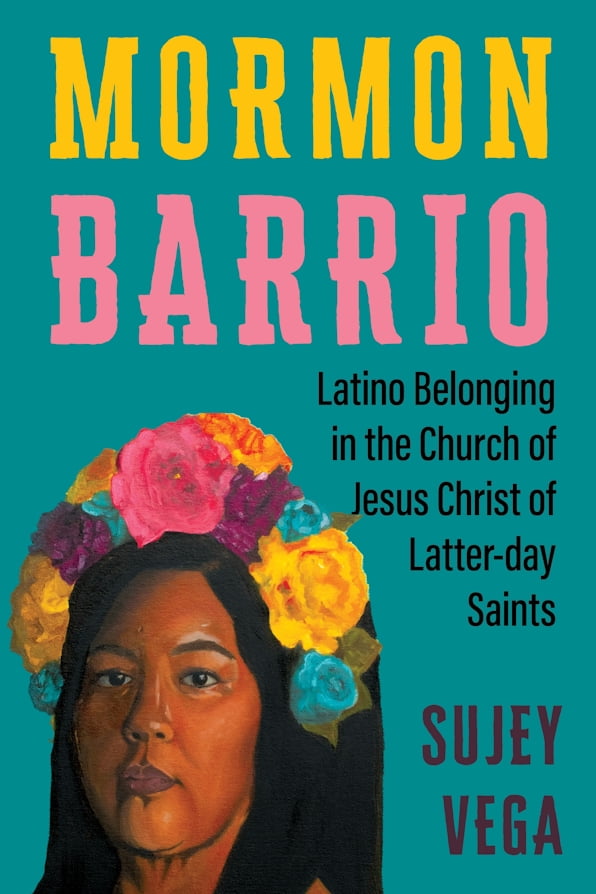
As the Church of Jesus Christ of Latter-day Saints continues its trajectory as a global faith, the specific experiences of its diverse subcultures become increasingly vital to our collective self-understanding. For decades, the history of Latino and Latina Saints in the United States has remained a relatively quiet corner of Mormon Studies, addressed in fragments by scholars like Jessie L. Embry (In His Own Language), the biographical work of Ignacio Garcia, and F. LaMond Tullis’s foundational histories of the Church in Mexico. In Mormon Barrio: Latino Belonging in the Church of Jesus Christ of Latter-day Saints (New York University Press, 2026), Sujey Vega provides a significant contribution to this field that goes a long way towards filling this lacuna. I don’t hesitate to say that Mormon Barrio is one of the most significant publications in Mormon Studies in 2026.
Mapping the Lacuna: History and Sociology
Vega, an Associate Professor at Arizona State University, performs a dual task that is as ambitious as it is necessary. She works first as a historian, reconstructing the specific legacy of the Latino ward in Mesa, Arizona—a community with a rich, complex heritage that serves as a microcosm for the broader Latino experience in the American Southwest. Secondly, she works as a sociologist, interviewing contemporary Latter-day Saints to understand the present-day nuances of “belonging” in a predominantly Anglo-centric institution.
This dual approach moves the conversation beyond the administrative “success stories” often found in institutional histories. By situating the Mesa experience alongside the work of predecessors like Embry and Garcia, Vega provides a much-needed scholarly bridge between the 20th-century missionary era and the 21st-century reality of a multi-ethnic Zion. Vega masterfully delivered on these goals, despite a scarcity of sources to document the history and experiences of Latino Latter-day Saints in Mesa during the first half of the twentieth century.
The Outsider’s Homework
One of the most refreshing aspects of Mormon Barrio is Vega’s transparency. She is not a Latter-day Saint, and she is careful to frame her observations as those of an empathetic but distinct outsider. It is clear, however, that Vega has done her homework. Her grasp of the theological and social scaffolding of the Restoration is impressive. And while there are occasional comments that feel slightly off-target to an insider’s ear, Vega’s central arguments regarding cultural identity and religious space are consistently on point. She understands that for Latina/o Latter-day Saints, the “Barrio” is not just a geographic location, but a spiritual and social ecology that must be navigated within the Church’s broader structure. I felt that she was also able to successfully illuminate the Church’s concept of Zion and demonstrate that ideal through her description of the best experiences of Latino wards and Relief Societies.
Navigating the Political Storm
Some Latter-day Saint readers may find the latter portions of the book challenging, as Vega does not shy away from the sociopolitical friction points currently facing the community. She addresses the anxieties Latina/o members feel regarding modern ultraconservative political movements (such as the MAGA influence) and is quite prescriptive regarding what she believes the Church’s stance on immigration and racial equity should be.
At times, her tone can feel “pushy,” moving from descriptive observation to a call for specific ecclesiastical changes. However, these insights are deeply rooted in the voices of the Latino Saints she interviewed. Further, even when her conclusions feel politically charged, they represent a vital perspective that American Saints of all backgrounds would do well to consider. If we are to truly be “no more strangers and foreigners,” we must be willing to listen to the concerns of Latina/o Latter-day Saints.
Conversion and Missionary Work
Vega’s research into conversion to the Church felt like it would be valuable for missionaries and policy makers in the Church to explore. Nathan Oman’s concluding challenge in Welding Another Link was for Latter-day Saint intellectuals to find new ways to celebrate and articulate the Restoration that will help missionary work move forward in the twenty-first century. Vega provides insight into the things that appealed to the population she studied, which offers data-driven insights into what we should focus on to help the mission of the Church move forward.
Conclusion
Mormon Barrio is an essential resource for future historians and sociologists. It provides a rich, data-driven foundation for a conversation that is only going to grow in importance as the Church’s demographics continue to shift. It is also a book that Latter-day Saints will find useful in understanding and reflecting on the practical dynamics of our religion. I highly recommend this book to anyone seeking a deeper understanding of the vibrant, complicated, and essential Latina/o experience in the modern Church.
For info on more books being published in 2026, see Mormon Studies Books in 2026.