Continuing a series on disciple scholars in different disciplines. I already did one on 20th-21st century physicists here. This entry focuses on pure mathematicians and logicians, so not including hybrid physicists/mathematicians like Newton. They will be addressed later. All italicized quotes are from Wikipedia unless otherwise stated.
Saul Kripke
One of the greatest logicians of the 20th century, although I don’t pretend to understand all his work. Glow-in-the-dark smart. Started teaching graduate-level courses at MIT as a Harvard sophomore. As far as I can tell he never got a PhD, he just entered (elite) academia right after his undergrad, and even then he saw his undergrad as a waste of time.
“Kripke was also partly responsible for the revival of metaphysics and essentialism after the decline of logical positivism.” (Note contrast with probably-most-accomplished-Latter-day Saint philosopher Mark Wrathall who edited a book called Religion after Metaphysics.)
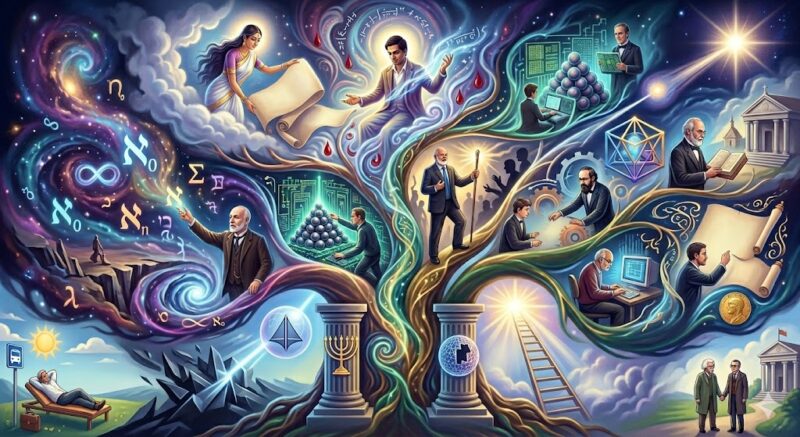
Kripke is Jewish, and he takes this seriously. He is not a nominal Jew and he is careful keeping the Sabbath, for instance he doesn’t use public transportation on Saturdays. He thinks religion can help him in philosophy:
“I don’t have the prejudices many have today, I don’t believe in a naturalist world view… and do not believe in materialism.”
Kurt Godel
His famous incompleteness theorem logically proved that any logical or mathematical system can’t prove its own truthfulness, shaking the foundations of math and logic and putting an axe to the long-running attempt to formalize mathematics into a series of rules. [Fun anecdote: he was a good friend of Albert Einstein’s, and before his oath of citizenship Godel thought he discovered a loophole in the constitution that would allow an authoritarian dictator to come to power. Worried that his quirky friend’s insistence on talking about the flaws in the constitution would ruin his citizenship application, Einstein accompanied him to his court date to make sure that he didn’t shoot himself in the foot, and the sympathetic judge had to cut Godel off as he started pointing out the error in the constitution].
Gödel believed that God was personal, and called his philosophy “rationalistic, idealistic, optimistic, and theological”. He formulated a draft of formal proof of God’s existence known as Gödel’s ontological proof.
Gödel believed in an afterlife, saying, “Of course this supposes that there are many relationships which today’s science and received wisdom haven’t any inkling of. But I am convinced of this [the afterlife], independently of any theology.” It is “possible today to perceive, by pure reasoning” that it “is entirely consistent with known facts.” “If the world is rationally constructed and has meaning, then there must be such a thing [as an afterlife].” He also read widely on other paranormal topics, including telepathy, reincarnation, and ghosts.
In an unmailed answer to a questionnaire, Gödel described his religion as “baptized Lutheran (but not member of any religious congregation). My belief is theistic, not pantheistic, following Leibniz rather than Spinoza.” Of religion(s) in general, he said: “Religions are for the most part bad, but not religion itself.” According to his wife, Adele, “Gödel, although he did not go to church, was religious and read the Bible in bed every Sunday morning”, while of Islam, he said, “I like Islam: it is a consistent [or consequential] idea of religion and open-minded.”
Georg Cantor
Discoverer of set theory and the mathematics of infinity. Attributed his discoveries to God, liked to discuss the theological implications of transfinite math, and named his discoveries after Hebrew letters instead of the traditional Greek ones (ergo “Aleph null” is the smallest level of infinity, and not delta naught or whatever). Eventually went crazy when he couldn’t prove what’s called the continuum hypothesis, and eventually just said that God revealed to him that it was true, so that was that.
Thomas Hales
Okay, I don’t know how churchy he is, but as the most accomplished Latter-day Saint mathematician he’s worth mentioning. Famous for proving the optimal way to stack cannonballs (Kepler’s Conjecture). Is somewhat controversial for pioneering the use of computers for mathematical proofs (basically, you can prove that there are only a certain number of possibilities, and then you use a computer to brute force show that none of those possibilities pan out).
John Lennox
Lennox earned a doctorate in mathematics from the University of Cambridge, followed by second and third doctorates from the University of Oxford and Cardiff University, respectively. As a professor, Lennox specialised in group theory. He is emeritus professor of Mathematics at the University of Oxford, where he is also Emeritus Fellow in Mathematics and Philosophy of Science at Green Templeton College, and has worked as adjunct lecturer at Wycliffe Hall and at the Oxford Centre for Christian Apologetics. He is also an Associate Fellow of the Saïd Business School and a Senior Fellow at the Trinity Forum.
He has written many books on religion, ethics, the relationship between science and God (such as Has Science Buried God and Can Science Explain Everything); he has also participated in public debates with atheists including Richard Dawkins and Christopher Hitchens.
Srinivasa Ramanujan
My vote for the smartest human being who has ever lived (neck and neck with Paul Erdos). Subject of the excellent film The Man Who Knew Infinity. Self-taught from a rural village in Commonwealth India who made novel, substantive mathematical discoveries on his own before he was discovered by Oxford mathematicians, who had to teach him the methods of proof because he kept just saying that God revealed the answers to him.
He credited his acumen to his family goddess, Namagiri Thayar (Goddess Mahalakshmi) of Namakkal. He looked to her for inspiration in his work and said he dreamed of blood drops that symbolised her consort, Narasimha. Later he had visions of scrolls of complex mathematical content unfolding before his eyes. He often said, “An equation for me has no meaning unless it expresses a thought of God.”
Augustin-Louis Cauchy
Pioneer of modern analysis and group theory. Very Catholic. May have helped convert Charles Hermite, another renowned mathematician.
Bernhard Riemann
His multidimensional geometry helped provide the mathematical groundwork for Einstein’s idea of curved spacetime. Also come up with the Riemann hypothesis for prime numbers and a billion other things, is considered one of the greatest mathematicians of all time.
Riemann was a dedicated Christian, the son of a Protestant minister, and saw his life as a mathematician as another way to serve God. During his life, he held closely to his Christian faith and considered it to be the most important aspect of his life. At the time of his death, he was reciting the Lord’s Prayer with his wife and died before they finished saying the prayer.
George Boole
Founder and developer of Boolean logic that laid the foundations of computers.
Though his biographer Des MacHale describes Boole as an “agnostic deist”, Boole read a wide variety of Christian theology. Combining his interests in mathematics and theology, he compared the Christian trinity of Father, Son, and Holy Ghost with the three dimensions of space, and was attracted to the Hebrew conception of God as an absolute unity. Boole considered converting to Judaism but in the end was said to have chosen Unitarianism. Boole came to speak against what he saw as “prideful” scepticism, and instead favoured the belief in a “Supreme Intelligent Cause”. He also declared “I firmly believe, for the accomplishment of a purpose of the Divine Mind.” In addition, he stated “To infer the existence of an intelligent cause from the teeming evidence of surrounding design, to rise to the conception of a moral Governor of the World, from the study of the constitution and the moral provisions of our own nature;–these, though but the feeble steps of an understanding limited in its faculties and its materials of knowledge, are of more avail than the ambitious attempt to arrive at a certainty unattainable on the ground of natural religion. And as these were the most ancient, so are they still the most solid foundations, Revelation being set apart, of the belief that the course of this world is not abandoned to chance and inexorable fate.”
Two influences on Boole were later claimed by his wife, Mary Everest Boole: a universal mysticism tempered by Jewish thought, and Indian logic. Mary Boole stated that an adolescent mystical experience provided for his life’s work:
My husband told me that when he was a lad of seventeen a thought struck him suddenly, which became the foundation of all his future discoveries. It was a flash of psychological insight into the conditions under which a mind most readily accumulates knowledge … For a few years he supposed himself to be convinced of the truth of “the Bible” as a whole, and even intended to take orders as a clergyman of the English Church. But by the help of a learned Jew in Lincoln he found out the true nature of the discovery which had dawned on him. This was that man’s mind works by means of some mechanism which “functions normally towards Monism.”
George Salmon
Was a distinguished and influential Irish mathematician and Anglican theologian. After working in algebraic geometry for two decades, Salmon devoted the last forty years of his life to theology. His entire career was spent at Trinity College Dublin, having served as the 32nd Provost of the university from 1888 to 1904.
Donald Knuth
One of the founding figures of computer algorithms. Less important but fun, also invented Knuth’s Up-Arrow Notation, which is a way to show really, really big numbers that are too big to show using standard decimal notation or “power towers” (2 to the power of 2 to the power of 2, etc.).
In addition to his writings on computer science, Knuth, a Lutheran, is also the author of 3:16 Bible Texts Illuminated,in which he examines the Bible by a process of systematic sampling, namely an analysis of chapter 3, verse 16 of each book. Each verse is accompanied by a rendering in calligraphic art, contributed by a group of calligraphers led by Hermann Zapf. Knuth was invited to give a set of lectures at MIT on the views on religion and computer science behind his 3:16 project, resulting in another book, Things a Computer Scientist Rarely Talks About, where he published the lectures God and Computer Science.
Laurent Lafforgue
A French mathematician who won the Fields Medal in 2002 for his monumental contributions to the Langlands program (connections between number theory and analysis). Outspoken, practicing Catholic who frequently writes and speaks about faith and his pursuit of truth.
Comments
One response to “19th-21st Century Mathematician and Logician Disciple Scholars”
I’m late to the party, but Thank you, Stephen! This was a delightful diversion into nerd-dom.