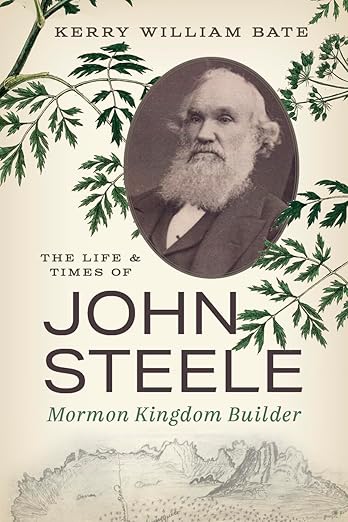
For many modern Latter-day Saints, the term “pioneer” evokes a fairly standardized image: a sturdy, stoic trekker motivated by a simple, quiet faith. While that image certainly captures part of the truth, it can often obscure the more vibrant—and sometimes perplexing—complexities of those who actually built the early Mormon kingdom. In The Life and Times of John Steele: Mormon Kingdom Builder (University of Utah Press, 2026), Kerry William Bate offers a masterful deep dive into the life of a man who defies easy categorization. John Steele was an Irish immigrant, a stonecutter, a city founder, a militia major, and a practicing mystic.
From Scarcity to the Kingdom
Bate, who previously published about Steele in his 1994 Utah Historical Quarterly article, has expanded his decades of research into a comprehensive biography. Steele’s story begins in the scarcity of 19th-century Ireland, but its heart lies in his radical conversion to Mormonism. For Steele, the Restoration was not merely a set of new doctrines; it was a blueprint for a utopian, egalitarian society—a “Kingdom of Christ” that he sought to realize in the desert soil of the American West.
Steele’s resume reads like a map of early Latter-day Saint expansion. He was among the first into the Salt Lake Valley, a founder of Parowan, and a pioneer in the Las Vegas Mission. He explored the vistas of what would become Zion National Park and the Grand Canyon. Yet, Bate is careful not to let these institutional milestones overshadow the man’s interior life.
The Mormon Mystic
The most arresting aspect of Bate’s biography is Steele’s “Mormon mysticism.” To the modern eye, Steele’s multifaceted roles as a high-ranking militia major and a justice of the peace seem at odds with his practice as a self-taught doctor using folk medicine, astrology, and occult charms. However, Bate brilliantly contextualizes these practices within the broader cultural milieu of early Mormonism. Steele represents a generation that saw no conflict between the keys of the Priesthood and the ancient traditions of folk magic—a worldview that has largely been smoothed over in contemporary correlation.
Steele’s diaries reveal a man who felt the presence of the supernatural in the everyday, using “charms” to heal and astrology to govern his movements. Bate’s meticulous research into these personal papers provides a rare, unvarnished look at how one “kingdom builder” integrated his radical faith with a deeply ingrained supernatural heritage.
Confronting the Difficult Past
A significant value of this volume lies in its refusal to shy away from the darker corners of our history. Steele was a major in the Nauvoo Legion in Parowan during the time of the Mountain Meadows Massacre. Bate provides new insights into Steele’s role and his subsequent reflections on that tragedy, drawing from primary sources to navigate the complex loyalties and communal pressures of 1857 Southern Utah.
Steele’s role in the tragic massacre was complex. Steele was present during at least one of the council meetings in Parowan when the Cedar City leaders came to consult their ecclesiastical and military superiors. The historical record indicates that Steele was opposed to doing further harm to the Baker–Fancher wagon train and was among the voices who led the council to decide to have a company of men call off the Native Americans, end the siege, and help the emigrants on their way. The Parowan militia was not called out as reinforcements as a result, though after the subsequent private “tan bark” council, William Dane caved to Isaac Haight and authorized the massacre.
While Steele was a voice for reason in the moment, his actions four years previous had helped to make sure that there weren’t enough voices for reason present in Cedar City to prevent the massacre from happening in the first place. During the “Wakara War,” Brigham Young and George A. Smith ordered outlying settlements to send cattle to Salt Lake City for safekeeping. Cedar City residents had little else to their name and balked at the orders. Their resistance (which Bate referred to as the “great cattle rebellion” of 1853) meant that Church leaders had to make multiple attempts at enforcing the order, with the Parowan branch of the Nauvoo Legion providing the reinforcements needed to pry the cattle away from their rightful owners. As a result, most of the people with the guts to stand up to their leaders left Cedar City and moved to California. Had they still been around in 1857, Bates suggests that Haight and John D. Lee would likely not have been able to orchestrate the massacre.
The book also offers a grounded analysis of the United Order and communal economics. Steele’s commitment to an egalitarian kingdom often clashed with the harsh realities of frontier survival, conflicts with the United States, and ecclesiastical politics. Bate treats these frictions not as “problems” to be solved, but as essential components of the pioneer experience.
Conclusion
The Life and Times of John Steele is a “micro-history” at its finest. By training his lens on a single, colorful individual, Kerry William Bate helps us better understand the institutional whole. Steele was a man of his time—fiercely loyal, occasionally strange, and untiring in his effort to carve Zion out of the wilderness.
For the Latter-day Saint reader, this biography is a fascinating reminder that the “pioneers” were a diverse and often radical lot. Steele’s life reminds us that the “Kingdom of God” was built by people who brought with them all the baggage, brilliance, and eccentricities of their previous lives. For anyone looking to complicate and enrich their understanding of the nineteenth-century Saints, this biography is an excellent addition to the shelf.
For info on more books being published in 2026, see Mormon Studies Books in 2026.