Two things need to be noted first of all: One, I don’t think scriptures should be read as an Ikea manual—do things exactly this way or else you’ll ruin it. They are meant to be read as wisdom literature. Their purpose is to throw us off our stride by subverting our expectations; they make us slow down a little. And that approach is critical to my reading of the Abraham, Sarah, and Hagar story.
Secondly, to understand where I’m coming from it is necessary to take it seriously when our Heavenly Parents and Savior say that they choose the weak. We quote this but I don’t think we really believe it. I’ve heard it said so many times, especially when it comes to the ancient Israelites or individual prophets, that these people are the best that God has to work with. But God never says that. (Let’s be honest, Joseph Smith was not even the best God had to work with in the Smith family.) The Chosen are not picked from among the people we are supposed to emulate—they are people we are supposed to learn from. They are the weak ones of the earth who try and fail and try over and over and over again so that millions, or even billions, of people can have the benefit of sitting in the privacy of our living rooms and the safety of our churches, where we can discuss them and judge them and see what we can glean from their stories. In the scriptural model, being a chosen one is not something any sane person would aspire to, and this certainly seems to be the case for Abraham.
In the Genesis narrative God gives the covenant to Abraham multiple times. Most scholars think this is because the author is stitching together different traditions, but I noticed something reading it this time that felt very pertinent to our current moment regarding what our responsibilities are toward The Other, and how pertinent that question is to our own inheritance of the Abrahamic covenant.
The experience of the people of Abraham among the nations is integral to the Israelite identity and to the covenant they all make with God, to the point that the covenant of Abraham cannot be understood without it. Central to their entire identity as God’s chosen people is having experienced failure, disenfranchisement, homelessness, marginalization, and oppression. This shared history is used by God as a template to explain the responsibilities that God’s people are expected to abide by in how they live in the world God has created, particularly regarding those who are strangers (or just strange) to them. It is also reflected in the series of covenant interactions between God and Abraham, as narrated in Genesis 12–22.
In each iteration of the covenant with Abraham there are shared themes (such as Abraham and Sarah having eternal descendants and a home) and there are important differences. Significantly, these pronouncements of the covenant are often immediately followed by a story of Abraham falling short of those very blessings. For example, in Genesis 12: 1-3 we first have God promising Abraham that through him all the nations of the earth will be blessed. But soon afterwards, Abraham immigrates to Egypt to escape famine and lives there as an “alien”. While there he not only lies to protect himself from the Egyptians whom he thinks will kill him to take Sarah, but does so by putting his wife in that very situation himself, exposing her to whatever the Pharaoh, captivated by her beauty, might choose to do to her. As a direct consequence of this decision, Abraham grows rich while his wife lives in danger and the people of Egypt are afflicted. Not only are the nations of the earth not blessed by Abraham (as they were supposed to be), he is actually enriched through harming them (Genesis 12: 10-20).
Later God reiterates the covenant (Genesis 15: 1-16), and I can’t help but wonder if it’s because Abraham had failed so spectacularly in Egypt. This time Abraham is told that in the future, his and Sarah’s descendants will be strangers in a strange land (harkening to Abraham and Sarah’s own experience in Egypt?), and in that state of need and vulnerability they will be enslaved and oppressed. Just as in the first giving of the covenant, I don’t think the next story is coincidental: Abraham and Sarah take a woman, Hagar (whose name literally means “immigrant”), and enslave and oppress her—the very tragedy God had warned Abraham would happen to his own long-hoped for family. And not only do they immediately turn around and do this to the stranger among them, but they even do it as attempt to force God’s covenant to come true. (In despair Hagar attempts to escape, but is met by an angel in the wilderness where she is given her own promise that she will be the mother of a great nation. Ironically, it will be the descendants of Hagar, not the chosen branch, who will preserve the covenant and lead the Israelites back to it after they fall away (Genesis 16; D&C 84). Again we have a scenario of Abraham failing in his part of the covenant, trying to find a fulfillment of God’s promise of a peaceful place to live and a posterity through trickery, coercion, and oppression.
Then the covenant is given yet again, with circumcision being its sign (Genesis 17), and afterwards Abraham is again confronted with The Other and he finally seems to get it. This time when he sees three strangers wandering in the desert he brings them in and cares for them. It is only then that Abraham and Sarah are finally able to conceive (Genesis 18: 1-14).
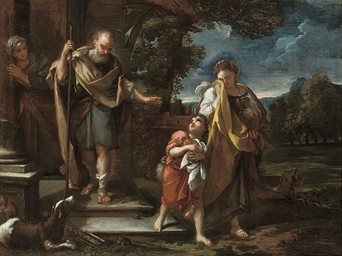
However, we have three more important stories about Abraham and his imperfect—or even failed—efforts to reflect the covenant. One is when he, once again, throws Sarah and the people of Abimelech under the proverbial bus in order to protect himself, at the cost of her safety and the welfare of the people of Abimelech who take him in, and who are only protected through God’s intervention (Genesis 20). Another is the exile and near death of Hagar and Ishmael, when once again Hagar is protected by God, and her own promises are renewed (Genesis 12: 8-20).
The final interaction in scripture between God and Abraham is when Abraham is commanded to sacrifice Isaac. I admit that I’ve always struggled with this story. Read in isolation, it gets told as a straightforward narrative of a righteous man having his faith tested yet further to make sure it is sufficient enough for God’s exacting standards, and gets used as an archetype for a similarly soul-wrenching test God will put all of us through. But, read in context with the other stories of Abraham’s interactions with God, I have come to find another meaning in it. Over and over again Abraham fails in his responsibilities to God and others. He fails in regards to the nations who have taken him in; he fails in regards to the people of Sodom and Gomorrah whom he was willing to argue with God to save, but then returns to his home rather than warning them (Genesis 18: 16-33); he fails his wife; he fails Hagar; he fails his first-born son, helping to create a cycle of distrust and violence that would last for generations. Finally, God creates a scenario in which Abraham is set to lose everything he had worked so hard for and for which he justified so many of his failures: his promised legacy. And now he must make a decision: does he trust God or not?
It wasn’t many years ago when I would not have been able to tolerate this kind of reading of Abraham. And I would have thought it was my faith that made me defend him and the other person’s lack of faith that made them tear him down (which is what I would have interpreted this post as doing). But in all actuality my need for nearly perfect prophets was as much a result of fear as faith–fear of failure, fear of going astray, fear of not being right and being known to be right. But over the years I have finally learned the value of real, loving care. And that kind of care, that kind of love, cannot live in fear, including, perhaps especially, fear of human failure. This does not mean justification of failure, or passing over those most hurt in favor of the growth of the person considered to be at the “center” of the story–rather it means caring for all the people effected, hurt, and traumatized by it. (I once heard sin defined as a failure to care, and I find that to be a helpful guide).
I know that this is not a reading for everyone, nor is my intention to say that this is the “correct” reading; again, it is approaching scripture as wisdom literature, not an Ikea manual. The latter approach eases us into quick and cheap judgments of who is “good” and who is “bad”, making us enamored with our perfect heroes who never let us down and who always inspire. These stories and heroes are so easy for us to digest. They’re also, however, a bit artificial; missing something important that we encounter in actual, everyday life. In reading scripture as wisdom literature, though, I have come to wrestle with and care about the deeply flawed people in their stories. I am grateful that ancient Israelites didn’t pass down Abraham’s story as a series of magnificent triumphs, but as a reflection of someone who was deeply, profoundly human. These traditions don’t leave Abraham’s legacy as a man who proved himself to God and came out on the deserving end, but as a human who desperately needed mercy. One who needed God like he needed air. He feels so real to me. My heart breaks for all the people involved in this story—particularly Hagar, Ishmael, and Sarah, as well as Abraham. These people are real. They are God’s weak ones; the vulnerable and hurt ones; and they point the way to Christ by showing us how badly we all need him. That none of us are exempt, and that God is clearly not looking for perfection. And they also illustrate a little better perhaps why, when the disciples asked Christ how they could be ready for him, he said it would be in their relationships with those who are strange to them: the hungry, the orphaned, the immigrant, the homeless, the imprisoned (Matthew 24). There is a special place in God’s heart for the ones who are neglected and forgotten and don’t fit and are seen as a threat; and it is that Godly heart that is woven into the covenant itself. And now in our lives, in all the little moments that make up our own covenant, we get to learn to weave in our own heart with God’s.
Comments
6 responses to “Abraham: A Study in Humanity”
Great article. Much better to accept leaders in their weaknesses than to jump through convoluted hoops to say wrong behaviors were right. Thanks for sharing!
You write, “My heart breaks for all the people involved in this story—particularly Hagar, Ishmael, and Sarah, as well as Abraham.” We add might, Isaac, whose father was willing to offer him as a sacrifice to God. That story used to inspire me–until it didn’t.
How many faith traditions have used that Abrahma’s story to justify homicide, genocide, and war? How many religious zealots have used his example to justify slavery, homophobia, and sexism? How many do today?
John-I agree, it is a wonderful moment when you realize faith no longer requires constant mental gymnastics and suppression of your conscious.
Rose-excellent point! I totally should have included Isaac. I can’t imagine what that must have been like for him. It’s interesting that afterwards Abraham dos not go back to Sarah’s camp, and there is no record of them interacting again. I hope Isaac went back to Sarah.
Also, it is astounding how often Abraham is used as justification for doing something…troubling. Another example that comes to mind is “lying for the Lord” :/
Great piece! I ironically have had the inverse trajectory as you: all throughout my youth and mission and YSA and most uncritically believing years, I was still always low-key uncomfortable with the disturbing elements of the Old Testament, especially the story of Abraham. It’s only as I’ve gotten older that I’ve come to better appreciate and admire the OT, precisely in the ways you’ve outlined here, as an extended record of the *failures* of faithful men, of how none of us are truly righteous and all are without exception in dire need of repentance, as a massive compendium of what NOT to do.
This is one of my favorite T&S posts ever. You actually make me want to go back and read the stories again. Thank you!
Sitting in Gospel Doctrine, I was dismayed by the exclusive language the instructor was using in teaching about the Abrahamic Covenant. Your post was the balm I needed. Thank you.