“Maybe I need to believe my dad was a genius because I don’t want his life to be worthless. And … if he isn’t a great artist, that means he was just a prick.”
Adam Sandler character in The Meyerowitz Stories
Lay not up for yourselves treasures upon earth, where moth and rust doth corrupt, and where thieves break through and steal [and where AI scoops thee]: But lay up for yourselves treasures in heaven, where neither moth nor rust doth corrupt, and where thieves do not break through nor steal, [and where AI does not scoop thee]: For where your treasure is, there will your heart be also.
Last Friday was the greatest day in mathematics in a century–probably more. The Riemann Hypothesis was (almost certainly) solved by a mathematician working with AI.
This was the Holy Grail of modern mathematics. Some of the greatest minds our species has ever produced spent lifetimes picking away at it. The great mathematician David Hilbert quipped “If I were to awaken after having slept for a thousand years, my first question would be: Has the Riemann Hypothesis been proven?”
Last Friday we got our answer.
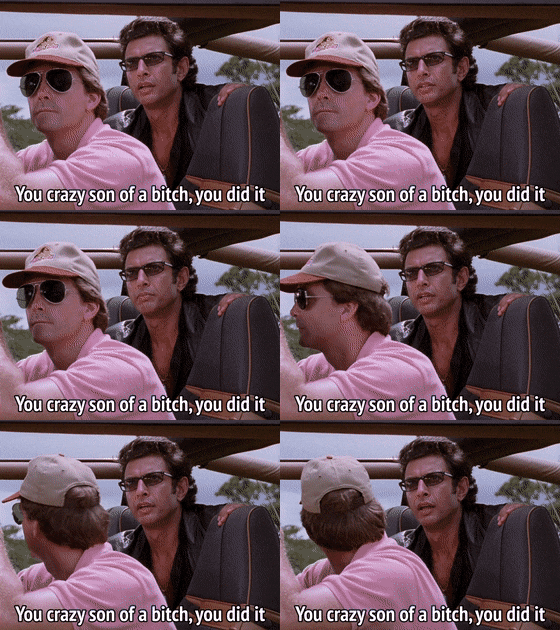
(TS is usually G-rated but this scene from Jurassic Park best captures what just happened.)
I ran across a moving piece on the pathos around this event by Eric Hoel here titled “On the day the Riemann hypothesis fell to AI, I took my son for a walk.”
I’m not going to go into the specifics (it has to do with the distribution of prime numbers), but for me the more interesting ramification is the fact that AI indisputably has superhuman creative intelligence. Proving a theorem is as creative an endeavor as writing a novel, so now humanity is facing the spectre haunting our place in the universe when what many saw as our defining characteristic, our intelligence, is vastly superseded by the machines, and not just in a soul-less, adding big numbers kind of way.
I don’t want to turn this into the standard debate about “AI simply can’t go to X! only humans can do that” because at this point that just feels like psychological cope, that boundary keeps shrinking into a sort of AI pessimism of the gaps position, and I don’t want to get sidetracked into that argument (FWIW, I believe that AI fundamentally can’t experience internal sense experience, what philosophers call qualia, everything else is on the table in terms of what it can do).
Instead, let’s assume for the sake of argument that it can do all of the intellectual things. It can create better art, make better music, write better novels (literary award winners have already been caught using AI, just because undergraduates with free models can’t get past the slop stage doesn’t mean it isn’t capable), create better movies, and make better arguments than humans to a superhuman degree.
I suspect much of the existential freakout over AI is coming from those sectors of society that grounded their purpose in being renowned at something intellectually or artistically.* Mathematics is certainly going through a malaise right now, and AI progress is “jagged” (it still can’t do my dishes), but for many other fields it’s probably just a matter of time.
So what then? We tend to give lip service to the idea that our value is not pegged to our intelligence, but we are being given a rude awakening to how much our society has been driven by the cult of intelligence and accomplishment now that my four-year old has an army of IQ 150 researchers/writers/and game designers at his fingertips. In all, I think this is healthy. God wants us to ground our value in being His children, and not to our skills or portfolio,** and the religious-to-your-bones people are about to have quite the “I told you so” moment over the secularists who found their God in the accolades of mortals.
For generations aspects of our popular culture encouraged people to delay or forego family, skip religion, and not spend time with friends so that we could put in our 10,000 hours and become Zora Neal Hourston or Beethoven and get their personal immortality and exaltation through the arm of flesh of intellectual, or popular fame or renown, but this particular cult is getting a very rude awakening no less existentially shaking than those doomsday cults that come out of their bunker the next morning after the world has not ended.
*There is also the separate unemployment issue. That is completely valid concern and I strongly affirm those anxieties. I get it, and if we solve the robotics issue and human labor literally has no value add we’ll have to figure out some kind of UBI, but this post is not about that. Also, the AI leaders are being complete weirdos here, I have no idea who is in charge of PR over there: “what we’re building might kill us all, but it will certainly take all of your jobs….wait, why are you voting against data centers?”
**I mentioned this to a colleague and he pointed out that he saw the same thing with GLP-1s. Now that we have a tight-tummy-in-a-pill, and will probably have safe “steroids” (myostatin inhibitors) and generic GLP-1s in the next couple of decades, people whose sense of being special was being taut and sexy-looking pilates instructors/bodybuilders are going to have find something else, since we’ll all be taut fitness models.
Leave a Reply