
Last year brought Joshua M. Sears’s A Modern Guide to an Old Testament in connection with the Church’s Come, Follow Me curriculum. This year, Deseret Book has followed up with a sequel in the form of Luke Drake’s A Modern Guide to the New Testament. Much like its predecessor, Drake’s book bridges academic biblical scholarship and a lay Latter-day Saint readership to enrich scripture study in 2027 and beyond.
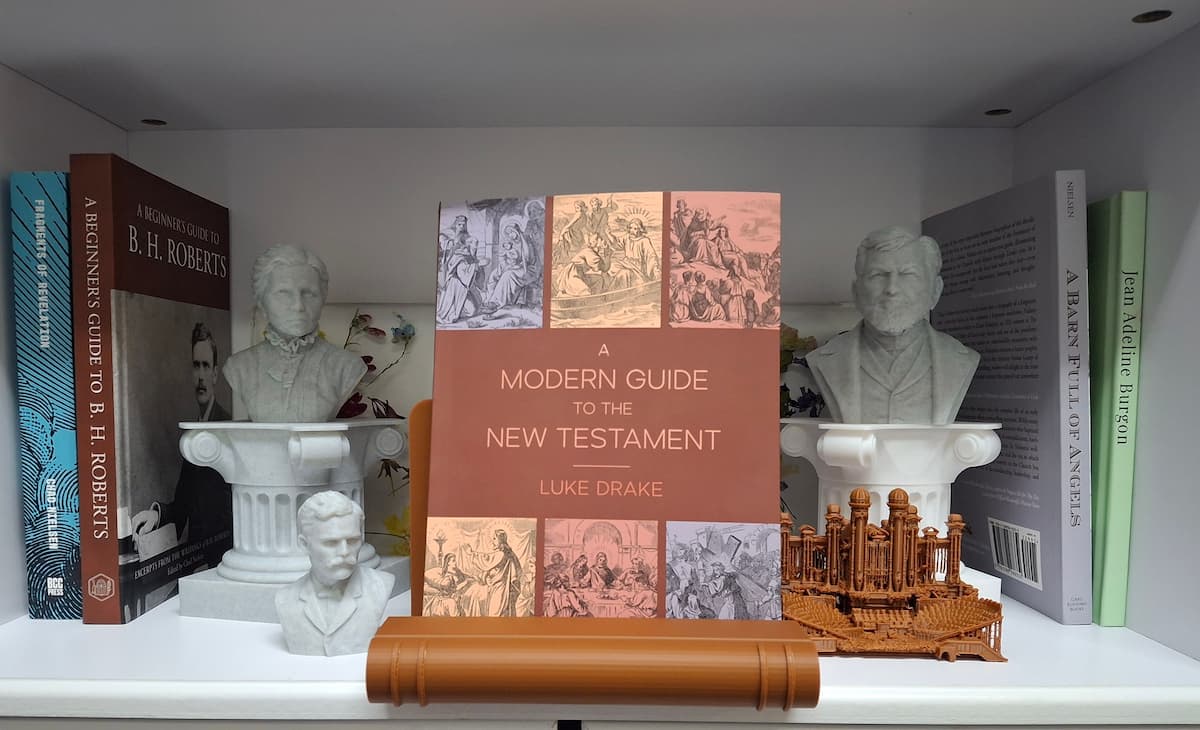
Drawing on his experience teaching young Latter-day Saints at BYU, Drake tailors the volume to address the specific questions and concerns students often bring to the New Testament. At the heart of his approach is the idea that Latter-day Saints typically read scripture through two lenses: personal application and Restoration doctrine. Drake argues that adding a third—an exegetical reading that seeks to understand an ancient author’s original context and intent—deepens rather than diminishes insights people can gain from scripture study. As he states in the introduction, “the exegetical lens does not need to constrain the way we read scripture—it should expand it. It should not leave you with less, but with more.”
The book is organized into three parts: Gospels, Letters, and Apocalypse. Each section opens with a broad overview of its literary genre before zooming in on smaller groupings of books to examine their historical context, authorship, and major themes. At the close of each discussion, Drake includes reflection questions—a built-in “homework” feature that invites readers to ponder how these historical insights apply to their own scripture study.
Drake handles scholarly consensus with a remarkably deft touch, particularly on topics that might unsettle traditional assumptions. For instance, he is transparent about scholarly debates surrounding the authorship of letters attributed to Paul, Peter, etc., noting plainly that Hebrews was almost certainly not written by Paul, and he leaves room for differing voices within the New Testament itself. Yet throughout the book, he works carefully to defuse potential anxiety, explaining how texts can remain inspired scripture even when written pseudonymously—and reminding readers that many biblical books are anonymous to begin with.
This pastoral sensitivity gives Drake’s volume an edge over Alex Douglas’s The New Testament for Latter-day Saints (alongside the practical advantage of Drake’s ongoing affiliation with the Church). While both books do similar work, and while I like both books, Douglas offers a more thoroughgoing survey of the scholarship while taking a much blunter approach to tensions within early Christianity and between New Testament texts and modern Church teaching and practice. Consequently, for Latter-day Saints seeking an accessible, faith-affirming introduction to New Testament scholarship—especially those encountering these ideas for the first time—Drake’s book is an ideal starting point, and its study questions will dovetail seamlessly with Come, Follow Me. Readers who finish Drake’s guide and want to dig deeper into the academic literature will find Douglas’s volume a natural next step.
Deseret Book has a winning formula with this series, and I highly recommend picking up a copy of Luke Drake’s A Modern Guide to the New Testament as we turn our attention to the New Testament in the coming year.
Leave a Reply