We are all rebels in some way or another, just like we are all sinners. Any sin is a kind of rebellion. As a result, we do things that are against the counsels of the Lord willingly and intentionally, often justifying it through the scriptures. And too often we dismiss statements like “Rebel Not Ye against the Lord” as counsel meant for those others who are sinning. So then what does it mean to rebel against the Lord?
I suspect this idea of rebellion is often tied up with human development, and the natural course of relationships. As we develop as people, we naturally want to differentiate ourselves from our parents and care givers, and this development often appears as rebellion. Likewise, in relationships, we often at first try to assimilate, to be appealing to others, and as that relationship develops and we become more secure, we try to differentiate from others, asserting our independence. This differentiation doesn’t have to be rebellion, and it certainly doesn’t have to include sinning or offending the other — but we don’t always distinguish between differentiation and rebellion.
Is this also true with our spiritual development? I’m not sure. While I’m sure that we do not need to rebel against our Heavenly Parents, I am attracted to the idea that we do need to differentiate to some degree. Perhaps that is what mortal life is for — a place for us to safely learn how to differentiate without rebelling, or maybe a place where the effects of rebelling can be safely contained?
Regardless of this speculation, we should recognize our need to differentiate from others, and work on how to do that without rebelling against the Lord.
Revelation is available to everyone, but God guides His Church through His prophet.
Our teachings about revelation actually encourage differentiation from others in our community. We teach that the prophet receives revelation for the whole Church. And we also teach that each member can receive revelation for themselves. So while we follow the prophet, we also do what the Lord tells us to do ourselves. We resolve conflicts between these two by recognizing that the revelation comes from the same source — and that individuals may have exceptions to general rules. What isn’t acceptable is anyone besides the prophet receiving revelation for the whole church.
Our poetry has emphasized the idea that we, as individuals, can receive revelation for ourselves. In this example, Mirla Thayne prays for revelation today — and while her poem-prayer is now nearly 70 years old, it seems very relevant to life today. While it is not revelation through the prophet to the whole church, it seems to me to be something many of us will agree with.
Prayer for Today
by Mirla Greenwood Thayne
- Great God of Truth, deliver us from this:
- The cowardice that shrinks from truth that’s new,
- The laziness that knows the doubtful bliss
- And dross content that half-truth tends to brew.
- Spare us the arrogance that thinks it knows
- All truth—to spurn the need of any more.
- Unseal our minds and lead our vagrant feet
- In open fields, new vistas to explore.
1958
“Moses was very meek.”
The idea of meekness seems contrary to any kind of rebellion, and perhaps even against differentiation. Can we be meek, submissive and lowly of heart and still differentiate from others? How exactly do we resolve the paradox of being meek but also being forthright in the gospel? Perhaps the answer to this paradox will help us figure out how to differentiate without being rebellious.
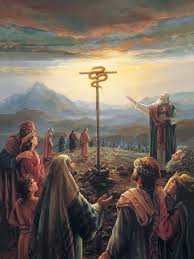
The scriptures we are reading now focus on Moses and his difficulty speaking in public. Was this meekness? Does a prophet need to be meek in his own feelings to communicate the word of the Lord instead? The following poem is one of a few that discuss Moses’ life, part of a genre of poetry that re-tells scripture stories. Hannah Tapfield King, an English convert who became prominent in 19th century Utah, was also the author of the first complete epic poem about the LDS Church.
Aaron’s Rod
by Hannah Tapfield King
- Hist! Jehovah speaks! Moses, his servant,
- With his brother Aaron bend to listen
- To that voice from which love had cast out fear;
- They waiting to receive and then obey
- The mighty mandates from the voice of God:
- “Lo! a miracle will Pharaoh ask of thee—
- Then say to Aaron, take thy rod and cast
- It down before King Pharaoh’s feet, and lo!
- It shall become a serpent ‘nenth his gazing eye.”
- Enthroned sits Pharaoh, servants waiting round,
- When lo! the servants of a higher King,
- A greater Potentate–but drop at once
- All vain comparison, where none can be—
- The servants of the God of earth and heaven.
- The King of kings and Lord of lords, present
- Themselves before proud Egypt’s king,
- Bearing an edict from that God he braved.
- But which he cannot with impunity resist.
- No pompous forms, or courtly etiquette
- Precede these men of God! but prompt to do,
- Surely and simply the bidding of their king.
- With brow serene, and calm majestic mien
- The brother of Moses, Aaron, lifts his arm,
- Nerved with the spirit of the living God,
- And hurls his rod before King Pharaoh’s eyes:
- E’en that prond, stubborn spirit quails before
- The mighty reptile springing into life
- From ont the mystic rod that left his hand.
- To spring to life, alone, its mission seemed;
- And there it lay before King Pharaoh’s eye,
- And the eyes of pharoh’s servants, alive—
- A living, panting, breathing, monster thing,
- Waiting the mission it was sent to fill.
- Then rose the passionate, wicked, daring king,
- And called bis sorcerers and his wisest men,
- Magicians of proud Egypt’s magic realm,
- And bade them use their cabalistic charms:
- In like manner, they, with their euchantments,
- Cast down, every wan, to earth, his rod,
- When lo! they sprang to life, and serpents they became!
- Marvelous power of infernal art!
- The mind can scarcely grasp the horror
- Such a scene could throw round, and cause
- The stoutest heart and eye to shake and quail.
- Pharaoh exults and feels his art excels
- The God of Moses and of Aaron too.
- Wait! not long has he for exultation,
- Before that serpent God has sent, by Him
- Chosen, ordained, and fitted by Himself,
- To show His wonders to the world of men,
- The mighty reptile opened wide his jaws
- And swallows up the puny worms around!
- That God still lives! His servants live to serve
- His bidding, and to work His will; and He
- Again has spoken in these latter times,
- And in another dispensntion. Yes,
- Pharaohs on the earth still live; Moses and
- His brother Aaron also have their types
- Upon this earth of God. Yes, blessed truth!
- Holy writ abounds in types and parables—
- And in my simple mind a thought springs up,
- Which takes a form embodied, palpable—
- I see with Daniel’a eye—or rather,
- Reading him, I drink into his spirit,
- And clearly see that in the latter days
- A kingdom shall arise and stund forever!
- And that it shall consume and break in pieces
- All other kingdoms, as the rod of Aaron.
- Which became a living thing that swallowed up
- The counterparts and connterfeits of Satan.
- So shall the last day’s work gather up
- All things in One, and that One shall be eternal.
1879
With faith in the Lord, I can have hope for the future.
Resolving the conflict over rebellion and differentiation may simply require faith in the Lord. Often the idea that we must be meek, and follow what the Lord teaches comes down to revelation and having faith that doing so will work out for the best. We might well say that faith leads to hope for the future, in this sense.
The following poem is part of the genre of New Year’s poems, which has a long and frequent presence in our culture. These poems usually feature both a reaction to the previous year and a prayer for the year to come — and in this case, Annie Malin suggests that faith—“trusting in His guidance“—gives hope for the new year.
The Glad New Year
by Annie Malin
- The New Year comes, we’ll gladly say good-bye,
- To all the Old Year’s grief, to all its pain.
- The past is gone nor can it be recalled
- To grieve o’er its mistakes is all in vain,–
- So say good-bye to every doubt and fear
- And looking forward greet the Glad New Year.
- The New Year comes, to all it whispers hope,
- Look up with eyes of Faith and falter not.
- The future lies before us fair and bright
- ‘Tis ours – let not God’s mercies be forgot.
- Give praise to Him and cast aside all fear –
- Then looking forward, greet the Glad New Year.
- And when the New Year wanes, if we can say,
- That we have truly tried to do His will –
- With Faith unfaltering our trials have borne
- And trusting in His guidance serve Him still –
- Then we may surely cast aside all fear,
- And looking forward greet the Glad New Year.
1924
If I look to Jesus Christ in faith, He can heal me spiritually.
Rebellion can, of course, cause spiritual harm. I think other things, such as the actions of others who we admire or follow, might also cause spiritual harm. And often this harm takes time and effort to heal.
In the following poem, Maria Berry, echoes the hymn “When upon life’s billows” and suggests that having faith in Christ is how we can be healed and led to the promised land.
Seek Ye The Lord
By Maria Berry
- When upon life’s heaving billows
- You are tossed from side to side,
- Broken-hearted and forsaken
- You are drifting with the tide;
- Hope no longer is your anchor,
- You’ve forgotten how to pray,
- You have lost your hold on Jesus,
- And, without Him, missed your way.
- Raise your voice once more to Heaven,
- Ask the Lord to be your guide;
- You will find the safest harbor
- By His kind and loving side;
- He will heal your broken spirit,
- Fit you for the storms of life;
- Resting all your cares on Jesus
- You will never fear the strife.
- We could never fight life’s battles,
- If we did not seek His aid;
- He will bear the weary burdens
- That have heavy on us laid;
- He will guide our faltering footsteps,
- Walking with us hand in hand;
- Cheering, helping, He will lead us
- Safe into the promised land.
1913
I can follow God’s will, even if others try to persuade me not to.
Rebellion also doesn’t happen in a vacuum. Sometimes we are persuaded to act against others. Other times we are trying to get closer to friends and that attempt pushes us against our parents, other friends, culture and authority. This push and pull between different relationships can also be true for whole groups of people, whose attempts to become closer to one group lead them to distance themselves from another. The history of the LDS Church has been read as in tension between differentiating from U.S. culture and assimilating to that culture. And I suppose that to the degree these changes are making us closer to God, its all the better.
Here, poet Henry W. Naisbitt sings the glories of Zion, focusing on its relationships with those around it — their persecution and persuasion that tries to move Zion away from (or perhaps towards) God in some way.
The Zion of God
by Henry W. Naisbitt
- Though dark clouds may gather around thee,
- Oh Zion, thou Zion of God;
- Though nations unite to confound thee,
- And make persecution their rod;
- Yet thy light shall no more be suspended,
- Thy name from the earth be erased,
- Till the reign of oppression is ended,
- Thy foes are for ever disgraced!
- Oh Zion shall triumph, and shine as the sun,
- As the Prophet said, long, long ago;
- For the will of her God on the earth shall
- In that kingdom no might can o’erthrow.
- Thine enemies now may upbraid thee,
- Oh Zion, thou Zion of God;
- By dungeon and fine may persuade thee,
- And threaten thy sons with the rod;—
- Thou can’st point to the martyrs of ages,
- To Prophets, Apostles of old;
- Or tell the wild world of the sages,
- Of Jesus “the Lamb” of the fold!
-
-
- Chorus-Oh Zion, etc.
-
-
- Of Jesus “the Lamb” of the fold!
- The battle-cry need not alarm thee,
- Oh Zion, thou Zion of God;
- No weapon yet fashioned shall harm thee,
- Or cast thy head down to the sod;
- Should the smoke of the fray in its blackness,
- Outrival what Egypt once knew,
- In the infinite arm is no slackness,
- Beyond the dense cloud is the blue.
-
-
- Chorus-Oh Zion, etc.
-
-
- Beyond the dense cloud is the blue.
- For thee, there is more than oppose thee,
- Oh Zion, thou Zion of God;
- Then do not in sadness suppose thee,
- Thy pathway of thorn is untrod!
- For the angels before thee shall hover,
- Thy rearward by day and by night,
- And the hand of the Father shall cover,
- To keep in the highway of right. be done,
-
-
- Chorus-Oh Zion, etc.
-
-
- To keep in the highway of right. be done,
- As gold in the furnace he tried thee,
- Oh Zion, thou Zion of God;
- His great heart, His love will not chide thee,
- For feeling, then kissing the rod!
- Thou shalt sing with the hosts from all nations,
- The songs of the Zion divine,
- ‘Mid the Temples, with his generations,
- From worlds which in glory shall shine!
- All Zion shall triumph and shine as the sun,
- As decreed in the long, long ago;
- One will in the universe, then shall be done
- What a kingdom beyond overthrow!
1886