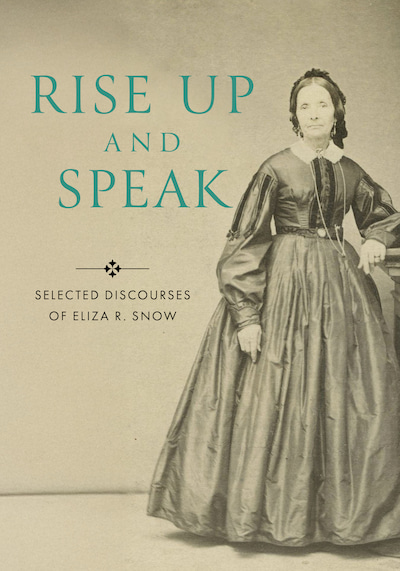
The publication of Rise Up and Speak: Selected Discourses of Eliza R. Snow represents a landmark achievement in the ongoing effort by the Church Historian’s Press to document the foundational voices of the Restoration. Edited by Jennifer Reeder, Sharalyn D. Howcroft, Elizabeth A. Kuehn, and Jessica M. Nelson, this volume serves as a powerful corrective to the popular, albeit limited, image of Eliza R. Snow as primarily a poet and hymn writer. Here, we encounter Snow as she was known to her contemporaries: a formidable orator, a theologian, and a tireless administrator who shaped the lived religion of nineteenth-century Latter-day Saint women.
Archival Depth and Theological Precision
The scale of the research project distilled into these fifty-two representative addresses is daunting. The editors processed nearly 1,300 discourses discovered across 1,600 minute books—a daunting archival task. The editors have curated a selection that prioritizes Snow’s doctrinal contributions. What emerges is a Christ-centered theology that is both practical and aspirational. Snow frequently reminds her sisters of their covenant identity, stating, “We are sisters, doubly sisters. We are sisters by being the daughters of God … and sisters by receiving the everlasting gospel in its fulness” (p. 96).
Snow’s understanding of the Relief Society was inherently tied to the priesthood. She was blunt in her assessment that “many of the sisters do not realize that the Female Relief Societies are an organization of the priesthood, but treat the matter as of little consequence. They must learn better … Their calling is a high, holy, and honorable one” (p. 84). For Snow, this calling encompassed both temporal and spiritual spheres: to “relieve the poor,” and “to look after the morals and virtue of the society,” and “also to save souls” (p. 175).
A Manual for Modern Discipleship
For the contemporary church member, Rise Up and Speak is more than an academic resource; it is an invaluable toolkit for personal study and lesson preparation. Those preparing sacrament meeting talks or Sunday School lessons will find an abundance of clear and evocative teaching.
If one is seeking to teach on the nature of grace and judgment, for example, Snow offers the comforting assurance that “God will judge the motive of the heart … God will accept the will for the deed” (p. 45). On the topic of enduring trials as soul-building experiences: “If we want to be superfine flour, we must stand still and let the mill roll on; He can overrule all things for our good” (p. 51). She understood that “it is necessary for us to taste affliction that we may learn to appreciate the blessings of God” (p. 51).
Lessons on character and self-worth would be greatly enriched by Snow’s thoughts on “dignity of character,” which she argued should be cultivated because, “with dignity of character, if I have not a farthing in my pocket, I am still Father’s daughter and a sister of Jesus Christ’s” (p. 99). Likewise, her instructions to the youth in the Nauvoo Common School remain startlingly relevant: “The boys and girls of the present are an index to the society of the future” (p. 81). She warned against wasting time, noting that how we “improve the present period will have a bearing upon your conditions and characters hereafter” (p. 9).
Navigating History and Patriotism
One of the greatest strengths of this volume is the editors’ commitment to intellectual honesty. They do not attempt to sanitize Snow’s voice to fit modern sensibilities. The introductions and notes candidly address her defense of plural marriage, her exercise of charismatic spiritual gifts (such as healing by the laying on of hands and speaking in tongues), her perspective on the Fall and Eve, and the cultural biases typical of Americans in her era.
For instance, the inclusion of her discourses regarding Indigenous peoples reflects the complex, often contradictory Latter-day Saint settler view of the time: seeing them as part of the House of Israel while simultaneously employing the “civilizing” and assimilationist rhetoric common to the nineteenth-century frontier.
We also see her fierce, yet nuanced, patriotism. Even after the Saints were driven from the United States, she exhorted them to “struggle to preserve the sacred Constitution of our country, one of the blessings of the Almighty” (p. 73). She distinguished between “pure principles” and a “degenerate administration,” insisting that the Constitution remain “sacred” and be “borne off triumphantly” (p. 18, 73).
By providing this context, the editors allow Snow to remain a “woman for her time” while still highlighting the enduring value of her core testimony as a woman for all times.
Conclusion
Rise Up and Speak is an essential resource for both the general membership of The Church of Jesus Christ of Latter-day Saints and for any serious student of Latter-day Saint history or theology. It demands that we take Eliza R. Snow seriously as a religious thinker. Reading these discourses rewards the reader with a deeper understanding of the spiritual power that fueled the pioneer era and continues to offer guidance for our own. Whether used for a Sunday lesson, for personal reflection on the “sweeping consolation” of the Spirit, or in historical and theological research, this book is a wonderful addition to the Latter-day Saint library.
For info on more books being published in 2026, see Mormon Studies Books in 2026.
Comments
4 responses to “A Review: Rise Up and Speak: Selected Discourses of Eliza R. Snow”
They do not attempt to sanitize Snow’s voice to fit modern sensibilities. The introductions and notes candidly address her defense of plural marriage, her exercise of charismatic spiritual gifts (such as healing by the laying on of hands and speaking in tongues), her perspective on the Fall and Eve, and the cultural biases typical of Americans in her era.
Absolutely, some of the best church scholarship along side the JSP.
Thanks for the review, will pick up when I visit Utah next.
@rl, as an aside, it appears this is avail on amazon as well as deseret book web site itself. no need to travel or wait!!!!
The idea that Joseph Smith was some fast talking charlatan who was able to con some backwoods yokels, so he could sleep with a few other women, really ignores the reality that Joseph Smith was surrounded by very smart and assertive people, like Eliza R Snow, who would have called him out on his shenanigans in a second.