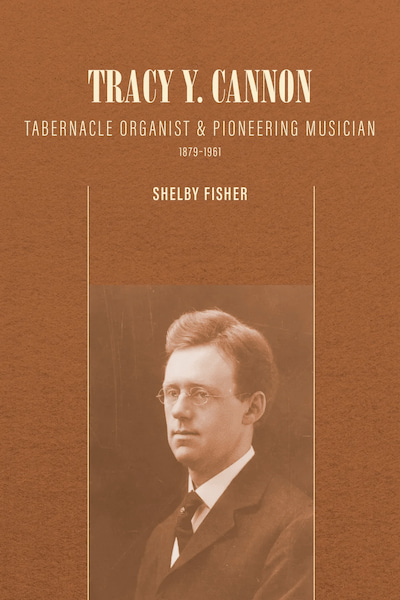
Signature Books has found a successful niche with its series of brief biographies, providing concise yet substantive introductions to key figures in Latter-day Saint history. The latest entry, Tracy Y. Cannon: Tabernacle Organist and Pioneering Musician, 1879–1961, by Shelby Fisher, is another fantastic addition. Clocking in at approximately 100 pages, it is a fast and accessible read that nevertheless manages to pack a significant punch in the information it delivers.
A Multifaceted Musical Legacy
Fisher’s biography uses Cannon’s multifaceted career as a lens through which to explore the broader evolution of Latter-day Saint hymnody, “art music,” and cultural tastes during the first half of the twentieth century. Cannon was a man of many hats—a Tabernacle organist, a composer, a director of the McCune School of Music and Art, and a key figure in the Church Music Committee.
For the contemporary reader, Cannon’s work on Latter-day Saint hymnody is particularly relevant. As the Church currently undergoes the process of creating a new unified hymnbook, understanding the past choices and the “evolution of taste” that Cannon participated in—especially his work on the 1948 and 1950 editions—is essential. Fisher illustrates how Cannon helped steer the Church away from the “sentimentalism” of earlier eras toward a more standardized, professional musical identity that has served as a good foundation in an increasingly globalized institution.
Situating History in the Human Element
Readers familiar with Michael Hicks’s important book, Mormonism and Music: A History, will find some significant thematic overlap here. However, where Hicks provides a sweeping institutional history, Fisher adds a vital human element. By situating these musical shifts within Cannon’s lived experience—from his rigorous training in Europe to his administrative struggles—Fisher makes the “history of music” feel deeply personal.
The book also shines in its discussion of music education. Cannon’s role in the McCune School of Music and Art demonstrates a broader commitment to artistic excellence that transcended denominational boundaries. This context is important for understanding how Salt Lake City developed as a cultural center in the early 1900s, showing that Cannon’s pioneering work was as much about elevating the community’s artistic standards as it was about ecclesiastical service.
Conclusion
The brief format of this biography is one of its greatest strengths. It serves as an easily accessible introduction to a pivotal era in Church history without becoming bogged down in minutiae. Shelby Fisher has provided a clear-eyed and appreciative look at a man who, perhaps more than anyone else of his generation, shaped the “sound” of the Restoration. For anyone interested in the intersection of faith, education, and the arts, this biography of Tracy Y. Cannon is highly recommended.
For info on more books being published in 2026, see Mormon Studies Books in 2026.