Years before we moved into my high school ward the bishop there–the classic 1990s Utah conservative curmudgeon type–announced from the stand (I imagine as parents were quickly trying to shield their children’s ears) that Santa Claus was not real and that parents should not lie to their kids. The man has since passed away, but he is an absolute legend to this day.
While I find acting as some kind of mythbuster holiday edition without parental permission problematic, we do not in fact do Santa Claus in our house. This is in no way to cast judgment on those who do do Santa Claus, just one perspective.
Before my parents told me the truth, I often wondered how the Santa Claus world interfaced with the religious one. Did God give Santa his powers? There was clearly some connection since it was on Christ’s birthday. When my parents told me the truth, I remember openly wondering what other supernatural things they were telling me that would later turn out to be well-curated myths designed to keep us well-behaved. My wife, having not been raised with Santa, didn’t have that experience (evidently her sister first heard of the man in a red suit who came down chimneys at her elementary school and told everybody that was the stupidest thing she ever heard), but she knows other people besides me who had the prepubescent Santa Claus-induced religious crisis.
And then when I hit high school/college the New Atheists were in vogue, and the “Jesus is Santa Claus for adults” one liner became a favorite among the secular Bro types. So the Santa Claus/religion interrelation became complex enough that we thought it was simpler to simply have a rule of never intentionally telling our kids an untruth.
So far it’s worked out for us. Maybe our kids have had less magic in their lives, I don’t know (as a fun aside, in a moment of four-year old rebellion, years ago my son defiantly told us that he didn’t believe in God but he did believe in the Santa we told him didn’t exist.), but the “Jesus is Santa Claus for grownups” is simple and superficially appealing enough that it just seems like a more even keel to always keep a fairly significant distance between the two.
Comments
19 responses to “Bah Humbug: Why We Don’t Do Santa”
Being active in online homeschool groups for years, I’ve participated in or observed what feels like about a million Santa vs. not-Santa debates. None of them have changed my mind. I grew up with Santa, never felt lied to, we’ve done Santa with our kids, and I feel like we struck a good balance and handled the transition from believing to knowing the whole story successfully. I’ve never felt like Santa overshadowed having a Christ-centered holiday. My favorite tradition is the lighting of Advent candles each Sunday for four weeks before Christmas, so I made that a big deal in our home.
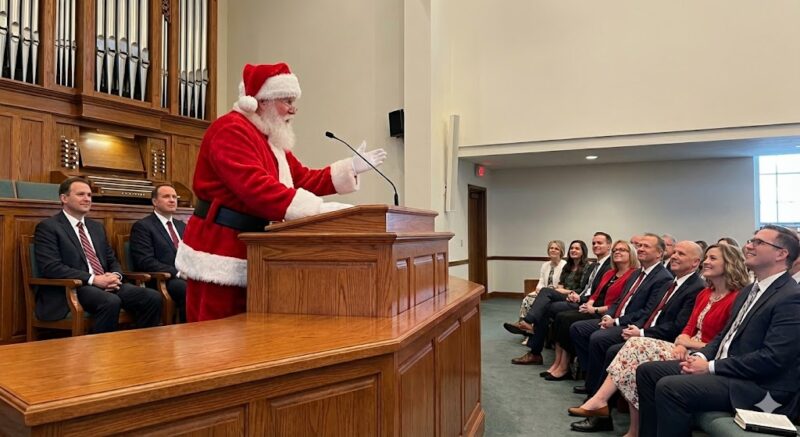
But mainly I’m curious about the photo you used… is that a real LDS chapel (I’m thinking not)? Because I *want* that organ in my ward!
Although Santa has 5 fingers, you can tell it’s AI because people are sitting on the front row of the chapel.
Lol. Yes, it is indeed AI; the people in the front row are just a little too excited to be at church.
We did Santa and I told the kids it was something fun to do in commemoration of Saint Nicholas, a godly man who lived long ago and gave children gifts. The story didn’t always stick. Even though i told them this every year, i would still occasionally get the question “is Santa Clause real” I would answer “yes, but he’s dead.”
We didn’t do Santa either. At the time my rationale was similar to Stephen C’s, but in retrospect I just squirm any time I have to say anything untrue, no matter the reason. It takes a deliberate effort to put my brain in a mode that will let me play a game like Werewolf, and sustaining that for months wasn’t going to happen. This is not me bragging: Jesus was a pragmatist who didn’t get hung up on principles when they got in the way of helping people and I want to be more like that.
As for that picture, I’d be pretty excited if Santa came to speak! But it would be an interesting room: either the organ is off to the left of the chapel or the pulpit is off to the right. (Also, the organ console needs either a mirror or a monitor, given its placement, or the organist can’t see the conductor.)
Side note from the orthographic police: it’s Santa Claus, with no e at the end.
I think Santa is a great myth—not because it’s false, but because it’s formative. It gives young children a world charged with wonder, generosity, and surprise. For a short, age-appropriate season, they live inside a story where gifts are freely given, goodness is rewarded, and joy comes from something outside themselves. That kind of enchantment matters. It trains the heart before it trains the mind.
What’s especially meaningful is that belief in Santa isn’t meant to last forever. It has a built-in transition. At some point, kids don’t really “lose” Santa so much as they inherit him. They cross a threshold from receiving the magic to creating it—quietly and anonymously—for the sake of someone else’s delight. They become Santa themselves.
That cycle—first believing, then embodying—is doing real moral and even religious work. Early faith is mostly received as gift, story, and trust. Later, faith matures into responsibility, practice, and love enacted for others. The point was never to cling forever to the literal form, but to be shaped by it and then live it out.
There’s also something deeply religious about the hiddenness of Santa. The goodness is real, the gifts are real, but the giver stays unseen. What matters isn’t recognition but generosity; not proof but trust; not control but love. In that sense, the myth quietly tutors us in how divine grace often works—indirectly, and through ordinary people who choose to give.
So Santa isn’t really a deception kids eventually outgrow; it’s more like a ritual of formation. It teaches that goodness precedes us, that joy can be gratuitous, and that maturity means taking responsibility for the very grace we once received. That feels like a deeply religious pattern to me: being given life as a gift, and then learning how to give it away.
@ Mark Ashurst-McGee: I like that way of threading the needle. It also reminds me of one of the funniest Christmas memes I saw where a child is sitting on Santa’s lap who asks him “Homoousios or homoiousios?” Santa reacts with a befuddled “what?” and the kid responds “you’re not the real St. Nicholas.”
@RLD: Ditto, I have the same hangup; not to subtly disparage anybody who doesn’t have it, but I do.
@ David Robbins: Oh dear, this is embarrassing. At least I was consistently misspelling it throughout. I went ahead and corrected it.
@Carey F: That’s another profound way to see it.
Just be careful.
My parents didn’t “do” Santa, so I (of course) told all the kids at school their presents weren’t from Santa, because he’s not real.
I was not well-liked after that.
My parents “did” Santa. I remember them driving us away from my grandparents’ Christmas party in Logan. I saw the red navigation light on a cell tower somewhere in the Wellesvilles and thought it was Rudolph. I’ve never forgotten that sense of wonder and always cherished the yearly rituals of leaving milk and cookies out and cleaning up the empty plate the next morning. We made sure to include some carrots for the reindeer.
Mom and Dad never told me they were eating the cookies and arranging the presents. It just sort of dawned on me that the other kids probably had a point. But the Christmas season has always struck me as the richer for it. It’s the one time of year where we are encouraged not to be cynical, where we are encouraged to believe, where the best in mankind can yet be expected and people aren’t suckers for letting it out. It would not surprise me if God had angels sent abroad to foster that sentiment. What else would we call them, servants of He who loves little children?
I suppose this is my way of saying that, after all these years, I still believe.
When my kids asked if santa was real, I told them santa wasn’t a name but a job title. Whoever is santa gives the gifts. Everyone can be santa.
We couldn’t decide, and so the indecision forced our decision. We didn’t do gifts “from Santa,” but once our oldest was of sufficient age, we just went straight for “he embodies the spirit of giving in this special season” kind of thing. And that was good for him, as it turns out he is incredibly literal and we would have likely had a trust issue with him.
Where it didn’t work was with our second, a girl, who WANTED to believe in Santa. So it became her saying she believed in Santa, and he would go out of his way to correct her on that, and she’d argue back that she just wanted to believe.
All that said, it is still fun for me to just entertain the idea of that spirit of giving and joy.
I think what your former Bishop did was admirable. There are plenty of justifications for perpetuating the Santa myth (most fall short). But Church, and Church leaders, should be a place for truth. You can’t teach children the remarkable story of Christ (which can be hard to believe) and also the remarkable story of Santa (pretty hard to believe), expecting them to believe both but knowing one is a lie. Parents shouldn’t do it, either, of course. But if you’re a Church leader and want to be known for telling the truth, this is how you do it.
I expect vitriol and rationalizing in the comments. So be it.
The phrases “Santa Claus is real” and “Santa Claus is a real person who lives at the North Pole and flies around the world in a sleigh pulled by reindeer and comes down your chimney with presents” are not making the same claim.
‘Santa’ always filled a stocking at our house but there was never an illusion of Santa being anyone other than the parents for much the same reasons as the OP. We did ‘Santa crawls’ – like a pub crawl but getting to as many department store Santas as possible in one day – and so onto make sure it was clear. But there’s a downside – if no one ever believes there’s no obvious cut off and so we’re still doing stockings for anyone at our house on Christmas Eve ?
I think the picture is AI because although Santa has all five fingers, there is something wrong with the fingers on that guy sitting on the stand. They are interlaced, but he has two fingers where one should be. Zoom in and you can see it. As for all the other AI proof, well, it could be a fireside for stake presidents and their wives, which would explain the enthusiasm of sitting on the first row. But it for SURE isn’t Sacrament meeting because it is all adults of about bishopric and stake presidency age. And there are a few very old buildings that do have pipe organs, my husband knows of one in Austria if it still exists.
We did Santa with the explanation that, yes, it is pretend and pretend can be fun, so don’t ruin it for others. But thinking back, my parents did the same, only my autism spectrum brother didn’t understand “pretend” and was disillusioned at 12. And I suppose that my children were the same with their children, but one granddaughter was disillusioned at 11 when her parents had to sit her down and explain, but I swear that kid is also on the autism spectrum. It runs in my family, and even if her parents refuse to get her tested, I have a degree in psychology and she has the symptoms. So, even being clear that it is a game can still leave children who have learning/social disabilities confused. But stating angrily that the pretend is a “lie” is also morally reprehensible because it isn’t a “lie” unless it is presented as truth, and most parents give hints that it is a game, and the pretend nature of the whole thing is pretty obvious after you live a normal life, unless the person has a problem picking up social clues, like autistic kids do. I mean, you see it in movies and there is a Santa in every store who is obviously a guy in costume, so unless the kids are clueless most kids catch on. My autistic daughter was not slow realizing that Santa in no more real than the Grinch. Well, at my house he was always more real than Santa, cause we didn’t say Grinch was pretend.
Perhaps this does a good job of “threading the needle”—or perhaps not. That’s for each individual [parent] to decide. I’ll hasten to add that I’m not a parent [and likely never will be in this life], so it’s not a dilemma I’ll ever have to confront. Whatever your view, for your reading pleasure, I give you …
https://www.nydailynews.com/2025/12/24/yes-virginia-there-is-a-santa-claus-11/
Merry Christmas, everyone.
Oh, so I suppose it was my parents who punched Arius during the Council of Nicaea, huh?
I have a son on the autism spectrum and Santa was never an issue for him. But while we enjoyed the myth, we didn’t go overboard. We didn’t take the kids to sit on Santa’s lap (unless we happened to be at a party where that was occurring), we didn’t tell the kids that they had to be good or Santa wouldn’t bring them presents, we didn’t leave out milk and cookies, etc. At the point when each child started naturally questioning, we didn’t prolong things or try particularly hard to keep them believing. I usually put it back to them: “What do you think?” At point when I could tell my daughter knew he wasn’t real but desperately wanted to keep believing, I told her, “If you really want to know the whole real story, I will tell you. But you have to be sure you want to know.” She replied that she didn’t think she was ready. We had this conversation several times over a year’s time and finally she said yes, she really wanted to know the whole truth, and I told her.
My view of this is very similar to what Carey F. shared. I also think that believing in mythical creatures is a very normal developmental thing for children, particularly young ones, and I’d even go as far as to say it’s a *good* thing. I also think it’s important for children to hear fairy tales and other such stories, which are actually deep stories that speak to them and teach truths on an inner level. I think they outgrow these stories when they are ready. I personally think that to deprive children of these rich and imaginative experiences is to their detriment. (I’m not saying that Santa in particular has to be specifically part of those experiences…)
As far as organs, there are a number of LDS chapels that have pipe organs and even some that look somewhat like the one in the picture. What gives away the fakeness of the one pictured is that it has three keyboards.