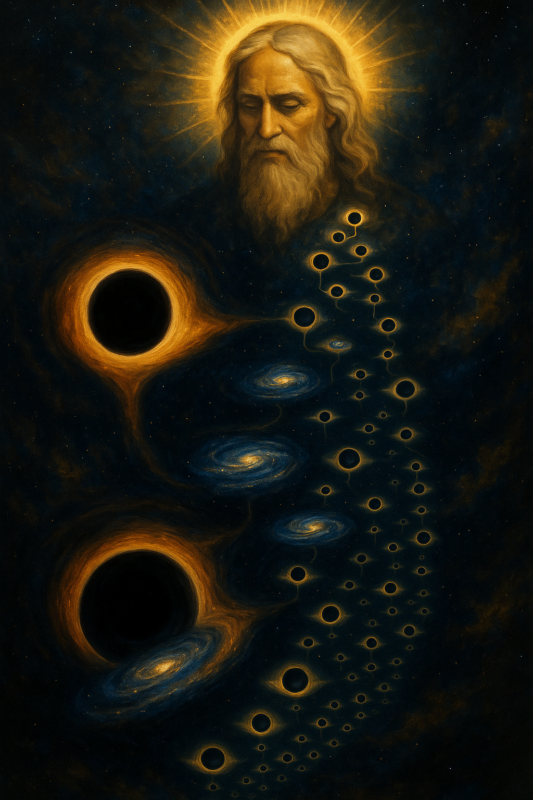
[Note: I know that in my last post I noted that, pursuant to Elder Gong’s counsel on this, I wouldn’t be posting any more AI depictions of deity, but this post was in the queue before I was aware of the Gong talk, so this will be my last AI depiction of deity.]
One of the most exciting and intriguing big-picture theories in physics is the idea that our universe is the inside of a black hole in another parent universe. Unlike many other creative big theories in physics that started almost as kind of a fun lark or an act of desperation, this one is gradually accumulating (admittedly somewhat circumstantial) evidence in its favor.
For example, and most relevant to our discussion, we have no reason to think that galaxy rotation should be anything other than random, so it should be about half clockwise and half counter-clockwise. However, a census of the earliest galaxies from the James Webb telescope suggests that about two-thirds of such galaxies are spinning clockwise, suggesting that the universe itself has a preferred “spin,” which fits with the idea that we’re inside a rotating black hole.*
To shift gears for a second (I promise it all comes together): one plausible, straightforward reading of Book of Abraham 3 suggests that there are a nested series of astronomical objects that reckon their time (possibly rotate around?) each other. To a certain level modern-day astronomy has supported this particular interpretation. Our earth rotates around the sun, which rotates around the center of the galaxy.**
This is one reason why some have speculated that Kolob is Sagittarius A, the black hole in the middle of our galaxy. We might snicker at any speculation that gets too specific on this point, but my main hesitancy with this idea is that it essentially makes God the God of the Milky Way, which seems a bit small to me, especially given the scale implied in the Book of Moses (“And were it possible that man could number the particles of the earth, yea, millions of earths like this, it would not be a beginning to the number of thy creations; and thy curtains are stretched out still…”) in the same way that the Book of Mormon musical line that we “get our own planet” is eccentrically grand yet comically small at the same time.
To continue upwards, our galaxy in turn rotates around the gravitational center of a galactic cluster. So far so good. However, as far as we can tell this is about where it stops. At its largest scales the distribution of galactic superclusters is random: there is no “center” of the observable universe.
However, Black Hole Cosmology raises another possibility: the “times” of our universe are in a sense governed by its parent black hole that sprung out of another universe. And by extension, presumably every black hole in our universe is a Big Bang in other universe. Universes creating universes creating universes. A whole universe, not just a galactic cluster or solar system, has its own parent universe that to some extent determines its “times” and rotation. This cosmology elegantly fits with the “Chain of Being” theology as discussed by Samuel Brown or the “Infinite Regress” model supported by a variety of 19th- and early 20th-century Church leaders. Sort of a turtles all the way down with universes nested within universes and Gods giving rise to Gods.
__________________________________________________________
*Other coincidences include the fact that the radius of the observable universe is approximately equal to the radius of the event horizon of a black hole with the same total mass-energy as the observable universe. From what I read it’s not fine-tuning level fluke, but still an interesting coincidence that is one more point in favor of the Black Hole Cosmology theory. Finally, there’s some evidence in favor of Black Hole Cosmology dealing with the Cosmic Microwave Background radiation that I don’t pretend to understand.
** To get the throat clearing out of the way. Yes, this is all speculative, it doesn’t have anything to do with our salvation, we have no current revelation on the topic, etc. However, not everything God values has to do directly with our salvation in some kind of patently direct or technical way (“it is beautiful and glorious,” “God shall give unto you knowledge by his Holy Spirit, yea, by the unspeakable gift of the Holy Ghost, that has not been revealed since the world was until now…if there be bounds set to the heavens or to the seas, or to the dry land, or to the sun, moon, or stars.”) There’s a temptation to simply wave our hand at the weirder aspects of our canonized scripture, but if Joseph Smith was inspired to write it down I assume it’s appropriate for at least some discussion or even fun speculation in a TS post even if it wouldn’t be for a sacrament meeting talk or EQ lesson.
Comments
11 responses to “Black Hole Cosmology and the Book of Abraham”
Speculative fun. Thanks!
There’s a lot of stuff out there. I’m wondering where it all comes from when the black hole creates a “big bang.”
Still, it’s fun to think about. The idea of universes “begetting” universes matches up nicely with the idea of families begetting families.
Re: Abraham’s astronomy: there are the varied reckonings of time (and perhaps space) to consider. They seem to line up with varying degrees of glory, including perhaps the many degrees that may be found between individual stars–analogically speaking.
And with that in mind it’s interesting to consider how black holes might be portals to realms of greater or lesser reckonings/glories–in which case some of those realms might be incomprehensible to our mortal minds.
Whenever somebody asks me if I hope to get my own planet in the next life (OK, that’s never actually happened), I tell them that I am holding out for a universe.
Last Lemming,
Actually I think there’s some truth in what you say–that is, in the sense that we’ll have the opportunity to help expand the Father’s creations–his cosmos.
Yeah–the idea of getting our own planet is almost 150-200 years old. It took the saints three months to travel from the Mississippi River to the Salt Lake Valley–a trip that we make today in three hours on a Boeing 777. And so the “planet” was much larger to them than it is to us moderns. Large enough I dare say that it may have represented (in their minds) a division of the sacred cosmos. And so when they talked about inheriting a planet it was a slick way of saying a large chunk of the universe–not some little globe you could spin on your finger like a basketball.
Thanks for the fun post.
If I’m not mistaken, the star at the center of the Milky Way is named “Sagittarius A*”
“my main hesitancy with this idea is that it essentially makes God the God of the Milky Way, which seems a bit small to me . . . .”
Perhaps you are underestimating the magnitude of the galaxy. It’s plenty big. I mean, it is incomprehensibly enormous. It is gloriously massive beyond belief. Any such God of the Milky Way Galaxy is easily worship worthy.
“And so when they talked about inheriting a planet…”
I wonder if we as a people even pay attention to the temple or if they get distracted by how much is going on.
Adam helped create the earth as an apprentice to God and then came down and populated it.
Pearl of Great Price, translated or inspired by Joseph, however you want to look at it, talks about many planets and many Adams.
Joseph explained all this to Brigham and said put the ceremony in order. Brigham said he only taught what he received from Joseph.
Now, he’s not here to quiz about all the intricacies of some of his controversial statements and I understand why many want to distance themselves from them.
But I find it preposterous that anyone would be upset at that idea that Adam could be exalted but totally ok with the idea that we will be exalted. It’s odd that we seem to put binders on and act like no one in past creations was exalted. And we run in fear at thinking it robbery to be equal with God. Stephen drives the religious mobs into a murderous frenzy by daring to see that Jesus was on the right hand of God and we tip toe around the implications of that when it relates to all of God’s children and the greater purpose of the atonement.
I’m not claiming to have everything worked out or exactly how it is going to be. But clearly our theology is predicated on things people want to distance themselves from because they cringe at the criticism. As if all of it isn’t completely looney, and the preposterous scale and construct of the universe itself is even more absurd. And this black hole idea, which I was also drawn to as well when I first heard it, is equally looney (and astounding).
I really don’t know why it’s totally ok to accept that many premortal Adams (and Eves) without number went to planets to populate them, but it’s a bridge too far to imagine that glimpse into the past is also a possible glimpse into the future.
It’s at least far more compelling weaving of our theology and doctrine into a coherent tapestry than the ethereal whispy angelic happy blissful heaven people seem to posit that practically aligns with most evangelicals thoughts but without much purpose.
We know what God’s purpose and glory is. Why would we assume it begins and ends with us? That it will keep going, and we will take to the mantle seems to answer a lot of questions that abound about the purpose of life, marriage, family, gender, etc
Sute,
Just to be clear–what I’m saying is: what was a “planet” to the early saints is a “big bang” to us modern saints. To them a planet was really, really big. And I think, in spite of the fact that they had a rudimentary understanding of Copernicus’ model, their view still carried a few vestiges of the ancient idea that the earth represented a division of the sacred cosmos–it was that big to them.
And so however true it may be that exalted beings inherit worlds — and do we know for a fact that all worlds are whirling orbs? What are worlds like in higher realms of glory? — what we can say with certainty is that we will participate in the Father’s creative enterprise–and that means we will inherit some portion of the cosmos. Whether that means something that looks like the universe we’re familiar with or something beyond our comprehension or both remains to be seen–well, by me, at any rate.
Mark Ashurst-McGee is right that the Milky Way is plenty big enough (hundreds of billions of stars!) to contain “worlds without number” if you make optimistic but defensible assumptions about the frequency of habitable worlds and the evolution of intelligent life. Personally, I lean towards more pessimistic assumptions that would make Earth unique in the universe, but not because I have any special insight into the probabilities involved.
It seems to me that the entire universe, or rather physics itself, is fallen and mortal. Everywhere we look–even billions of light years away–everything is running down. Usable energy is dissipating; entropy is increasing; heat death grows inexorably closer. Perhaps celestial worlds are (undetectable, or at least undetected) bubbles where physics has different laws. Or maybe they’re taken somewhere else entirely. But I suspect that when this Earth’s mortal phase comes to an end, not just it but the entire universe will be renewed and made into a place fit for immortal beings to dwell. That suggests that when God wants to create a world where his current generation of children can experience mortality, he creates a new universe and waits patiently (probably with occasional nudges) until it obediently produces a planet where life has emerged and then evolved into fit tabernacles for his spirit children.
I’m not sure if atheists or mainstream Christian theologians would be more appalled that I can look at countless galaxies and think “Yep, this is all for humanity” but there we are. :)
“Whether that means something that looks like the universe we’re familiar with or something beyond our comprehension or both remains to be seen”
I’m sure it’s a mixture of both depending on how creative we want to get with our language but as we believe in the important of the physicality of this life as it relates to the eternities, I tend to push back against creeping l, almost nicene like beliefs of drastically different vague nothingness and everythingness notions of eternity.
God has a body. We have a similar one. He experienced mortality. So do we. So did eons of others in the last, and presumably in presents elsewhere. That suggests that suddenly we aren’t the end of ACT I and then we’ll move on to becoming wormhole travelling cat-octopusses or something. Not saying anyone is arguing this, but I don’t see any reason given what we know about the past that the future will suddenly be different in substance.
So ya, maybe there’s multiple universes or portions of this universe, and miracles of worm hole travel, a single creation for each black hole in the universe etc.
But we are experiencing life with a body in this frame of reference for a reason. Not suggesting you, but when others create possibilities of eternity outside that standard it undermines our resemblance and relevance to divinity.
Sute,
I agree. And just so you know–I’m a great fan of your comments.
I believe there is a strict continuity sorts. We’ll experience the same sociality there as we do here–and that’s comforting to know.
That said, I think we both agree with Paul’s statement:
Eye hath not seen, nor ear heard, neither have entered into the heart of man, the things which God hath prepared for them that love him.
I think of President Nelson’s likening us to an acorn that barely sprouts in this life–but is destined to grow into a mighty oak. Though the difference between what we are now and what we might become is vast beyond comprehension there is still a continuity of genus and identity.